In 2023, most companies were still arguing over chatbot scripts. By 2026, Gartner expects 40% of enterprise applications to carry task-specific agents that plan, act, and course-correct on their own, up from under 5% a year earlier.
That jump did not happen because software got prettier. It happened because large language models learned to call tools, hold context across multiple steps, and fix their own mistakes mid-task. The result is what the industry now calls AI agents: software built to finish work, not just answer questions about it.
Anthropic, OpenAI, Google and a wave of Indian startups have all pushed money and engineering hours into this shift through 2025 and 2026. Salesforce’s Agentforce alone helped push customer-service agent adoption from 39% to 66% in a single year, according to Salesforce’s own 2026 data.
This guide breaks down what AI agents actually are, how they work under the hood, where they part ways with a chatbot, which companies are already running them, and what a founder or CXO should watch before signing a contract.
Quick Glance
| What It Is | Software that plans, decides, and executes multi-step tasks with limited human input |
| Core Technology | Large language models combined with tool-calling, memory, and orchestration layers |
| Global Spend (2026) | Agentic AI-embedded enterprise software spend projected at $201.9 billion (Gartner, 2026) |
| Standalone Market Size | Roughly $7.8 billion in 2025, heading toward $52.62 billion by 2030 (MarketsandMarkets, 2025) |
| Enterprise Adoption | 23% of organisations scaling agents in at least one function; 88% use AI in some form (McKinsey, November 2025) |
| Projected Integration | 40% of enterprise applications will embed task-specific agents by the end of 2026 (Gartner, 2025) |
| Known Examples | Salesforce Agentforce, Microsoft Copilot Agents, Cognition’s Devin, Haptik |
| Key Differentiator | Executes multi-step work autonomously instead of answering one question at a time |
| Biggest Risk | Weak governance only about a third of organisations report mature agent controls (McKinsey, 2026) |
What Are AI Agents
An AI agent is a program handed a goal, not a script. Give it an objective clear a refund queue, or find three vendors under budget and it decides which steps to take, in what order, using which tools.
That is the line separating agentic AI from the generative AI most people used through 2023 and 2024. A generative model answers a prompt. An agent pursues an outcome, checks its own progress, and adjusts when the first attempt does not work.
An AI agent is judged by what it finishes, not by how well it talks. That single sentence explains most of the shift in enterprise software over the past two years.
The concept itself is not new; researchers described agent architectures back in the 1990s. What changed between 2023 and 2026 is that models finally got enough working memory, tool access, and reasoning ability to make the idea commercially useful.
How AI Agents Work
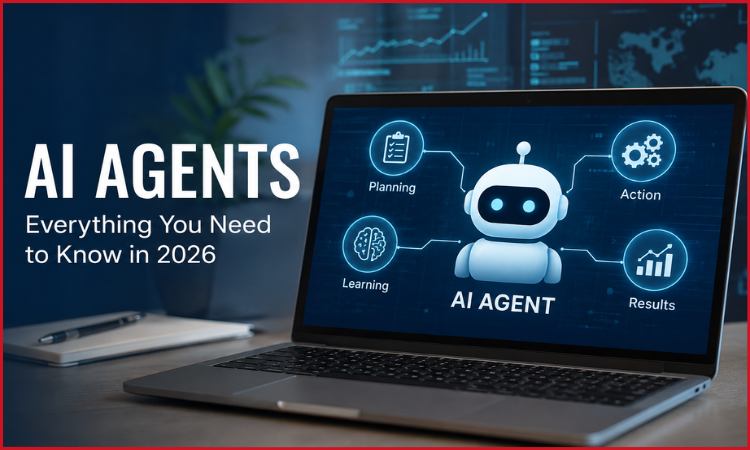
Most production AI agents run on a repeating loop rather than a single pass through a model:
● Perceive: pulls in the task, relevant data, and current state, such as a support ticket, a calendar, a spreadsheet.
● Plan: breaks the goal into an ordered set of steps.
● Act: calls tools, an API, a database, a browser, sometimes another agent to execute each step.
● Observe: checks whether the action actually worked.
● Revise: adjusts the plan if a step failed, then continues or escalates to a human.
That loop repeats until the goal is met, or the agent decides it needs a person. Most serious deployments in 2026 still keep a human checkpoint on anything touching money, legal exposure, or a live customer, and the companies getting real results built that checkpoint in on purpose, not as an afterthought.
Types Of AI Agents
| Type Of Agent | What It Does | Where It Is Used |
| Task Agents | Handle one narrow, repeatable job such as scheduling or data entry | Back-office operations |
| Autonomous AI Agents | Run a full workflow with little to no human checkpoints | Research, procurement, monitoring |
| Multi-Agent Systems | Several specialised agents coordinate toward one larger goal | Supply chain, complex operations |
| Customer-Facing Agents | Handle support, sales or onboarding conversations end-to-end | Customer service, e-commerce |
| Coding Agents | Write, test, and ship code changes with limited supervision | Software engineering teams |
Multi-agent systems are the fastest-growing slice of the category. MarketsandMarkets tracks the underlying agentic AI market growing at a 46.3% CAGR through 2030, with multi-agent architectures gaining ground on single-agent deployments as coordination tools mature.
AI Agents Vs Chatbots
| Aspect | Chatbots | AI Agents |
| Interaction Style | Answer one message at a time | Plan and execute multi-step tasks |
| Memory | Limited to the current session, in most cases | Holds context across sessions and tools |
| Tool Use | Little to none | Calls APIs, databases, and other software directly |
| Decision-Making | Follows a script or a single model reply | Plans, acts, checks results, and adjusts |
| Best Fit | FAQs, basic support, lead capture | Onboarding, procurement, code review, claims processing |
The distinction matters commercially, not just technically. A chatbot lowers the cost of a conversation. An AI agent lowers the cost of a process, and that shows up as a bigger line item on a P&L statement.
Real-World AI Agent Examples
Examples now sit inside real revenue lines, not just demo videos.
● Salesforce Agentforce: pushed customer-service agent adoption from 39% to 66% of Salesforce’s customer base in one year, per the company’s 2026 figures, handling support and sales conversations end-to-end.
● Cognition’s Devin: a coding agent that writes, tests, and debugs software with limited human supervision, positioned as a teammate rather than an autocomplete tool.
● Microsoft Copilot Agents: embedded inside Dynamics 365 and Microsoft 365 to handle sales follow-ups, supplier communication and routine approvals.
● Haptik: bought by Reliance Jio, now runs WhatsApp, web and app-based sales and support automatically for brands including Paytm, Whirlpool and P&G.
India’s own agent ecosystem is building fast around this shift. Business Outreach has tracked how generative AI startups in India are layering agent capability onto conversational AI, and how the country’s broader top AI companies in India list is increasingly dominated by agent-first products rather than plain chatbots.
Foundation-model players such as Sarvam AI are building the India-first models that many of these agents run on, while infrastructure companies like Scale AI supply the data-labelling backbone that makes agent training possible at scale.
Why AI Agents Matter For Business
The money backs up the shift. Gartner puts 2026 spending on agentic AI capability across enterprise software at $201.9 billion, while the standalone AI agents market tools sold specifically as agents sit closer to $7.8 billion in 2025 and is projected to reach roughly $52.62 billion by 2030, according to MarketsandMarkets.
Pricing is changing alongside the technology. Vendors are moving away from flat, seat-based SaaS licences toward usage-based and outcome-based pricing, because a company buying an agent wants to pay for tasks finished, not seats issued. Salesforce, Microsoft and a wave of vertical AI startups have all tested consumption-based pricing for agent products through 2025 and 2026.
That pricing shift is also why AI agents show up in most fresh AI-powered business ideas lists this year, and why more companies are treating an agent rollout as a strategy decision covered in guides on why every business needs an AI strategy rather than a tooling purchase handled by IT alone.
Conclusion
AI agents are turning into default business infrastructure rather than a bolt-on feature, and the gap between pilot and production is now a management problem more than a technology one.
Businesses that treat agentic AI as a procurement decision with governance, a redesigned workflow, and a named owner are the ones most likely to convert Gartner’s 40% integration forecast into actual margin, instead of another stalled pilot.
Frequently Asked Questions
1. What is the difference between AI agents and AI chatbots?
A chatbot answers one message at a time and mostly follows a script. An AI agent plans a multi-step task, calls tools such as APIs or databases, and adjusts its approach until the task is actually finished.
2. How do AI agents work step by step?
They run a loop of perceiving the task and data, planning the steps, acting through connected tools, observing the result, and revising the plan when something fails, repeating until the goal is met or a human is needed.
3. What are some real examples of AI agents in business?
Salesforce’s Agentforce handles customer-service conversations end-to-end, Cognition’s Devin writes and debugs code, Microsoft Copilot Agents run inside Dynamics 365, and India’s Haptik automates sales and support for brands like Paytm and Whirlpool.
4. Are AI agents safe for enterprise use?
They can be, with the right controls. Gartner and McKinsey both flag governance and oversight, not the underlying model, as the main risk, so companies that keep a human checkpoint on money, legal, and customer-facing decisions see fewer failures.
5. How big is the AI agents market in 2026?
Estimates vary by definition. The standalone AI agents market sits near $7.8 billion in 2025, heading toward roughly $52.62 billion by 2030, while Gartner’s broader measure of agentic AI capability spend across enterprise software reaches $201.9 billion in 2026 alone.
Read also: Top AI Companies In India 2026: Business Outreach Report