Harsimarbir Singh had already failed at four startups before he tried a fifth. That track record does not usually get a founder a term sheet from Sequoia Capital. It got him one anyway, because the problem he picked next was bigger than his past misses.
In August 2018, Singh teamed up with Dr. Vaibhav Kapoor and Dr. Garima Sawhney to fix something almost every Indian family has struggled with: a routine surgery that turns into a maze of unclear pricing, unverified doctors and confusing hospital paperwork. That idea became Pristyn Care, now one of India’s better-known healthtech unicorns.
This profile covers the founder’s background, the current CEO, revenue and valuation numbers, the funding history behind its growth, and the IPO roadmap as the company eyes a public listing. Expect real figures, not just a brand story, because the surgery-booking business is a lot harder to run profitably than it looks from the outside.
The pitch is simple: standard pricing, USFDA-approved equipment, and a dedicated coordinator for every patient. That pitch has scaled into a network spanning dozens of Indian cities, surviving layoffs, a culture controversy, and one of the toughest funding winters Indian startups have seen along the way. Anyone researching this company for investment, career, or reporting purposes will find the founder story, the revenue trend, and the valuation trajectory are all closely linked.
Quick Glance: Pristyn Care
| Company Name | Pristyn Care (legal entity: GHV Advanced Care Private Limited) |
| Founded | August 2018 |
| Founder(s) | Harsimarbir Singh, Dr. Vaibhav Kapoor, Dr. Garima Sawhney |
| CEO | Harsimarbir Singh (Co-founder and CEO) |
| Headquarters | Gurugram, Haryana, India |
| Sector | Healthtech, secondary-care surgeries |
| Valuation | Approximately $1.17 billion, roughly Rs 10,300 crore (Tracxn, November 2025) |
| Peak Valuation | $1.2-1.4 billion, hit during the December 2021 Series E round |
| Total Funding Raised | Over $180 million across seven rounds (CB Insights, Tracxn) |
| Revenue (FY24) | Rs 632 crore, up 28 percent year-on-year |
| FY24 Net Loss | Approximately Rs 381 crore |
| Key Investors | Peak XV Partners, Tiger Global Management, Hummingbird Ventures, Epiq Capital, Trifecta Capital |
| Founders’ Combined Net Worth | Approximately Rs 4,970 crore in Pristyn shareholding (Tracxn, November 2025) |
| Known For | Network of 800-plus partner surgical centres, 400-plus in-house surgeons |
| IPO Target | FY28, by the company’s own guidance |
Who Is Harsimarbir Singh? The Founder Behind Pristyn Care
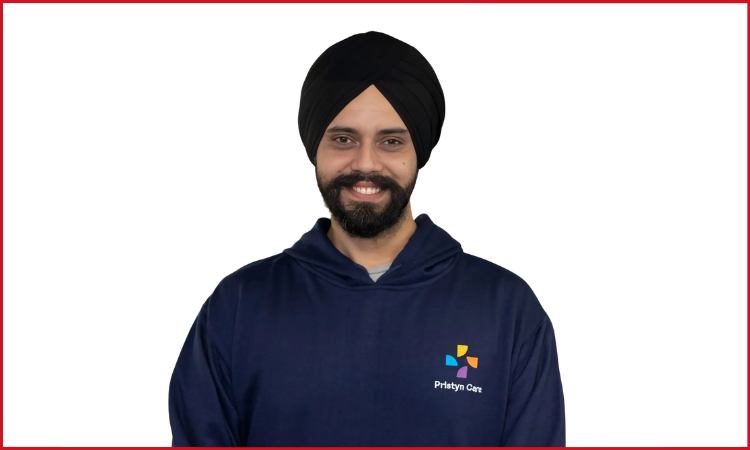
Harsimarbir Singh, the company founder and current CEO, is not the polished, first-time-founder type that gets profiled for “overnight success.” Before Pristyn, he worked in operator roles at MobiKwik and Urban Company, and he had already run through four failed ventures. That is the part most success-story pieces skip. It matters here because it explains why Pristyn was built the way it was: lean, metrics-obsessed, and allergic to burning cash on categories that don’t convert.
Dr. Vaibhav Kapoor and Dr. Garima Sawhney, the two co-founders alongside him, brought the clinical side. Between the three of them, the founding team mapped roughly 20 friction points in a typical patient’s surgical journey — from finding a trustworthy surgeon to getting insurance cleared to arranging a hospital bed. The plan was to remove each one, not by owning hospitals at first, but by plugging its own surgeons, technology and patient-support staff into hospitals that already had operating theatres.
That asset-light model is the real starting point of this story, because it explains both the early growth and the strategic pivot happening now.
CEO And Leadership Structure
Harsimarbir Singh, the company founder, continues to serve as co-founder and CEO, a role he has held since the company’s launch. He has been the public face of the company through its unicorn milestone in December 2020, a difficult restructuring phase in 2022 and 2023, and the current push toward direct hospital ownership that is central to the growth plan.
Leadership at Pristyn has had to manage more than growth targets. In 2022, Singh faced public criticism after reports surfaced about extreme work-hour expectations inside the company, a reminder that scaling a healthcare startup on thin margins can spill into how a workforce is treated. The company’s response involved restructuring internal management layers and a more deliberate approach to hiring, which the company has pointed to since as evidence of a course correction.
Pristyn Care Growth Strategy: From Asset-Light To Owned Hospitals
For its first several years, the company profile watchers knew it mainly as a network operator. It supplied roughly 80,000 to 90,000 surgeries a year using its own doctors and equipment, while partner hospitals supplied the operating theatres and beds. This kept capital requirements low and fuelled the company’s growth into 30-plus cities quickly.
That is changing. The next stage involves buying and running its own hospitals, starting with a facility in South Delhi that reportedly hit double-digit margins within weeks of opening and still operates with spare capacity. This is a vertical-integration bet: own the infrastructure, control the patient experience end to end, and stop splitting margins with partner hospitals on every procedure.
| Model | Details |
| Asset-Light Partnership (2018-2023) | Surgeons and tech supplied by Pristyn, operating theatres rented from partner hospitals, low capital intensity |
| Hospital Ownership (2024 onward) | Pristyn owns and operates hospitals directly, higher upfront capital, better long-term margins |
| Category Focus | Exited dental, dermatology and physiotherapy in 2023 to concentrate on higher-margin surgical specialities |
| Acquisitions | Bought health-tech platform Lybrate in 2022 and Laparo Obeso Centre in September 2025 to add specialists and categories |
The trade-off is obvious: owning hospitals means Pristyn now carries real estate, equipment and staffing costs it never had to worry about before. If the South Delhi hospital’s margins don’t repeat elsewhere, this pivot could pressure the balance sheet exactly when the company is trying to reach profitability and exactly when the growth story needs to convince pre-IPO investors.
Revenue And Financial Performance
Revenue has grown consistently, even as losses have stayed stubborn. Consolidated revenue climbed from around Rs 494 crore to Rs 632 crore in FY24, a 28 percent jump, according to reporting cited by IPO Central and TaxTMI. The core surgery business cut its EBITDA burn by 42 percent in the same year and was targeting a further 60 percent reduction going into FY25.
The number that keeps analysts cautious is the net loss, which stayed close to Rs 381 crore in FY24, almost unchanged from FY23. Management has said profitability is the goal for FY26, a target that has been pushed back before. In 2024, guidance pointed toward profitability by FY25; the latest public guidance shifts that milestone to FY26, tying revenue growth directly to the IPO timeline.
One number worth watching closely: customer acquisition cost. According to a 2026 investor analysis, roughly Rs 1.69 was spent to earn every Rs 1 in FY24 — a ratio that shows how expensive it still is to bring a new surgical patient through digital channels. Reduced ad spend and more organic traffic through the Lybrate acquisition are the levers management is pulling to improve revenue quality, not just the top line.
Valuation And Funding History
Unicorn status in December 2020 at a valuation of roughly $1.2 billion. A year later, its Series E round pushed the figure as high as $1.4 billion, backed by Sequoia Capital (now Peak XV Partners), Tiger Global, Epiq Capital, Hummingbird Ventures and Trifecta Capital.
Since then, the valuation has cooled. As of November 2025, Tracxn puts it at approximately $1.17 billion, translating to roughly Rs 10,300 crore, a decline from its 2021 peak, in line with the broader repricing of Indian consumer-tech unicorns since 2022.
| Metric | Detail |
| Total Raised | Over $180 million across seven rounds |
| Series D (Apr 2021) | Raised $53 million, valuation crossed $550 million |
| Series E (Dec 2021) | Raised close to $96-100 million, valuation reached $1.2-1.4 billion |
| Series E-II (Jul 2025) | A smaller top-up round of around $4 million |
| Lead Investors | Peak XV Partners, Tiger Global Management, Hummingbird Ventures |
| Founders’ Stake | 48.08 percent of the company as of November 2025 (Tracxn) |
The founders’ collective stake was worth close to Rs 4,970 crore as of late 2025, a figure that matters for anyone tracking founder net worth, since the business itself is privately held and none of the founders have individually disclosed personal net worth. This valuation trend is one of the clearest signals of how investors are pricing the path toward an eventual public listing.
Pristyn Care IPO: Roadmap To A Public Listing
The IPO has been on the table since 2024. However, the timeline keeps moving from an original FY27 listing tied to FY25 profitability, to a revised FY28 target tied to FY26 profitability. It will likely hinge on shrinking the roughly Rs 381 crore net loss, proving the owned-hospital model repeats its South Delhi margins elsewhere, and bringing acquisition costs down enough that revenue growth looks efficient rather than expensive. Until then, the timeline is a target, not a certainty.
| Milestone | Timeline |
| Earlier IPO Guidance | FY27 target, announced in March 2024 alongside a profitability-by-FY25 goal |
| Revised IPO Guidance | FY28 target, announced in 2025 alongside a profitability-by-FY26 goal |
| Pre-IPO Priority | Cut net loss, prove the hospital-ownership model, and hold customer acquisition cost down |
| Listing Venue | Domestic bourses (a Dalal Street listing), per management’s public statements |
Growth: Scale, Reach And Competitive Position
Operations span roughly 30 to 40 Indian cities, working with 800-plus surgical centres and a roster of more than 400 in-house surgeons performing procedures across more than 50 conditions using laser, laparoscopy and Lasik technology. Employee headcount has grown alongside the expansion curve, standing at around 1,300 as of August 2025 — a 39 percent year-on-year increase, with more recent estimates putting the number above 1,600.
The closest domestic rival is Glamyo Health, a smaller, venture-backed surgical network chasing the same asset-light playbook. Indirect competition also comes from large hospital chains such as Max Healthcare and Manipal, though the pitch to patients here is standardisation and price transparency rather than scale of infrastructure. For a wider view of how India’s healthtech sector stacks up, see this list of top healthtech startups in India.
Challenges And Risks To Growth
- High Customer Acquisition Cost
Pristyn spent roughly Rs 1.69 to earn every Rs 1 in FY24. That is not a sustainable ratio long-term, and fixing it is central to revenue quality going forward. - Repeated IPO Delays
The listing target has already moved once from FY25 profitability and a 2027 listing to an FY26 profitability goal and an FY28 listing. - Culture And Workforce Scrutiny
The 2022 backlash over work-hour expectations and the 2023 layoffs of roughly 120 employees remain reputational overhangs the company hasn’t fully shaken off. - Category Discipline
Exiting dental, dermatology and physiotherapy shows Pristyn is willing to cut underperforming lines. It also narrows the company’s total addressable market in the process. - Capital Intensity Of Hospital Ownership
Moving from an asset-light model to owning hospitals raises the stakes. If new facilities don’t replicate the South Delhi hospital’s early margins, the balance sheet absorbs the difference.
Conclusion
Every Pristyn company profile eventually comes down to one tension: strong revenue growth against a net loss that refuses to shrink at the same pace. The company has proven it can scale a surgical network across dozens of cities and win backing from investors like Peak XV Partners and Tiger Global Management. What it hasn’t proven yet is that the newer, capital-heavier hospital-ownership model will close the profitability gap in time for the planned IPO. For founders and operators tracking the Indian healthtech unicorn story, the company’s growth is a useful case study in how far an asset-light model can carry a business and how much harder the next phase gets once real estate ownership and a fixed IPO timeline enter the picture.
Frequently Asked Questions
1. Who is the Pristyn Care founder?
The Pristyn Care founder is Harsimarbir Singh, who started the company in August 2018 with Dr. Vaibhav Kapoor and Dr. Garima Sawhney in Gurugram.
2. What is the Pristyn Care valuation right now?
As of November 2025, the company valuation is approximately $1.17 billion, or roughly Rs 10,300 crore, according to Tracxn.
3. What is Pristyn Care’s revenue?
Its revenue reached Rs 632 crore in FY24, a 28 percent increase over the previous year, while its net loss stayed close to Rs 381 crore.
4. When is the Pristyn Care IPO expected?
The company’s IPO is currently targeted for FY28, alongside the company’s shift from an asset-light partner-hospital model to owning and operating its own hospitals.
Read also: Top Healthtech Startups In India’s Growing Digital Health Sector