Enterprise Adoption Is Soaring, But Value Realization Requires Strategy
Enterprise organizations have never been more bullish on artificial intelligence. According to recent industry research, nearly 88% of companies now deploy some form of AI, from generative AI assistants to autonomous agents reshaping workflows. Investment is robust. Deployment is accelerating. Yet something critical is missing: a clear path from implementation to measurable business impact. The paradox facing enterprises in 2026 is not whether to invest in AI products, but how to orchestrate them into a coherent strategy that drives genuine competitive advantage. This is where the gap emerges and why AI strategy consulting has become as essential as the AI products themselves.
The Adoption-Value Gap
The numbers tell a curious story. Enterprise adoption of AI has reached an inflection point; worker access to AI grew by 50% in 2025, and organizations expect the number of companies with 40% or more AI projects in production to double in the coming months.
Telecommunications, retail, and consumer packaged goods sectors are leading the charge, with deployment rates exceeding 45%. Yet beneath these metrics lies an uncomfortable truth: most organizations are not realizing proportional business value.
According to enterprise leadership surveys in 2026, 79% of organizations report challenges in translating AI adoption into organizational outcomes. While 66% of companies report productivity gains from their AI initiatives, only 20% have achieved revenue growth so far, despite 74% hoping to reach it. The discrepancy points to a fundamental issue: enterprises are acquiring and deploying individual AI products without a unifying strategy to connect them into enterprise-wide value.
The ‘Buy Over Build’ Shift and Its Hidden Challenge
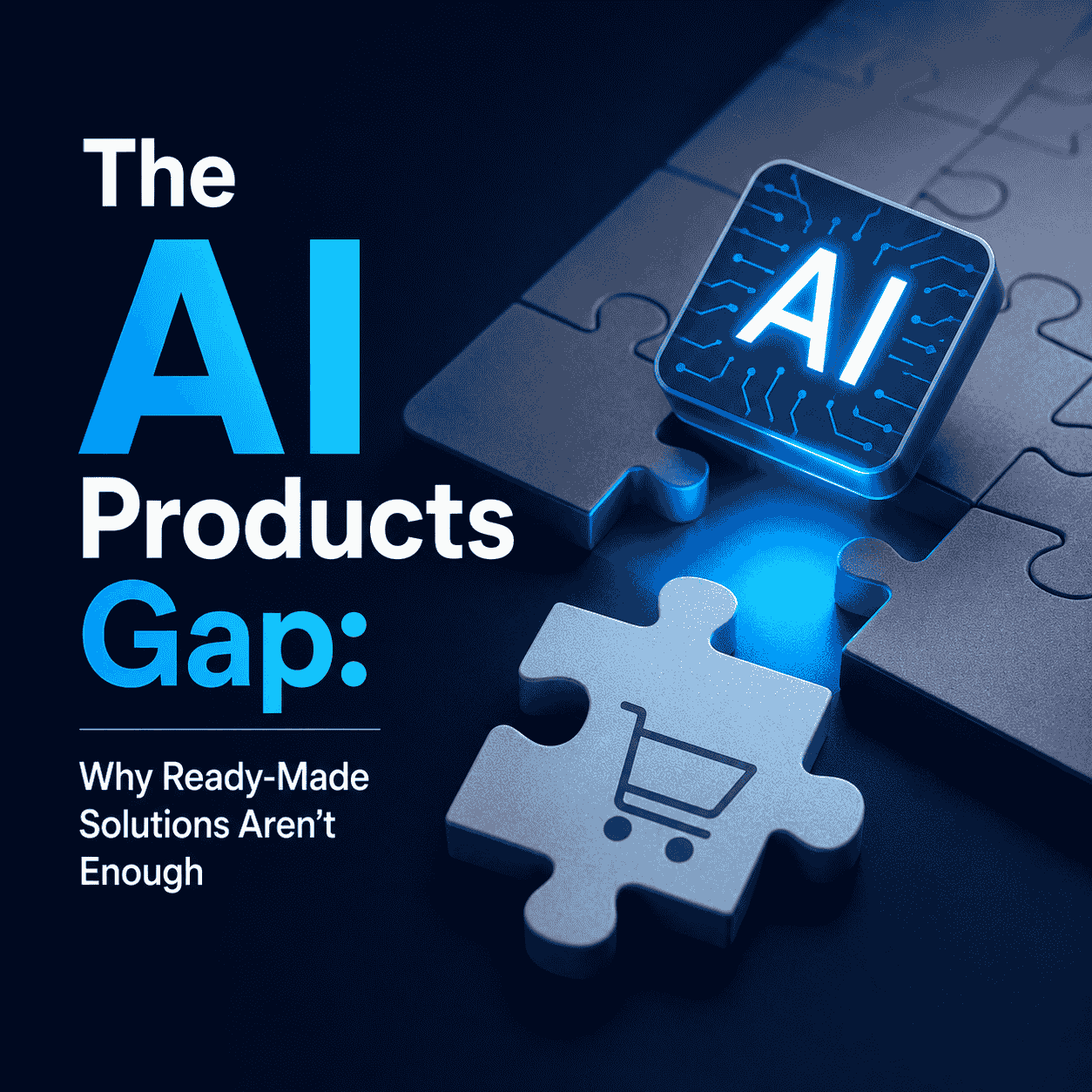
A critical shift is underway across enterprises. Chief information officers are increasingly favoring ready-made AI products, specialized platforms, SaaS solutions, and industry-specific models over building proprietary systems internally. This trend makes operational sense. The AI landscape evolves rapidly, model architectures change quarterly, and few internal teams can match the optimization, scalability, and security baked into vendor solutions. By purchasing proven AI products and platforms, enterprises can implement capabilities faster and with lower technical risk.
But velocity of acquisition does not equal velocity of value. The problem emerges when enterprises deploy multiple AI products across different business units: a generative AI platform for customer service, an agentic AI solution for supply chain optimization, specialized models for analytics, and autonomous workflows for finance. Each solves a specific problem. Few connect to a broader strategic vision. Without orchestration, governance, and deliberate integration, these AI products become siloed tools rather than components of a unified capability.
What’s Trending in Enterprise AI Products for 2026
Agentic AI Goes Mainstream. In 2025, 44% of companies were assessing or deploying agentic AI systems. In 2026, that exploration has become deployment at scale. Agentic AI products- systems capable of autonomous reasoning, planning, and execution are now touching customer support, finance operations, R&D, and supply chain workflows across industries. Telecommunications adoption leads at 48%, with retail and CPG close behind at 47%. The appeal is clear: agentic AI products reduce manual workflow steps, execute complex tasks with minimal human intervention, and adapt to changing conditions in real time.
Integration Becomes the Bottleneck. As enterprises accumulate AI products, integration challenges surface immediately. Nearly 60% of AI leaders cite legacy system integration as a primary obstacle to adoption. Modern AI products need to plug seamlessly into existing enterprise resource planning systems, customer relationship management platforms, and data warehouses. The companies succeeding in 2026 are those investing heavily in middleware, APIs, and integration architectures, treating orchestration as a first-class design concern rather than an afterthought.
Governance Moves from Peripheral to Core. As AI products handle more autonomous decisions, governance maturity has become a competitive differentiator. Only one in five companies has mature governance models for autonomous agents. The leaders in enterprises achieving transformative impact with AI embed governance into the product selection and integration process itself, not as a parallel initiative. This shifts the conversation: choosing which AI products to acquire is now inseparable from how they will be governed, audited, and integrated.
Data Infrastructure Modernization. Modern AI products require real-time, high-quality data. Organizations are prioritizing data lake consolidation, cleaning pipelines, and real-time availability. This is less about individual AI products and more about building the foundation, the orchestration layer, upon which multiple AI products can operate reliably.
The AI Strategy Consulting Imperative
The insight emerging from 2026 enterprise leaders is clear: AI product selection and procurement must be driven by strategy, not the reverse. Organizations that treat AI product acquisition as a tactical shopping exercise, “let’s buy this generative AI platform and this agent solution,” end up with disconnected capabilities and fragmented value. Those that succeed anchor their AI product portfolio in a deliberate AI strategy consulting engagement that clarifies three critical questions:
- What are the highest-value business workflows that AI can transform, not just optimize? This requires industry expertise, competitive analysis, and strategic foresight, not just technology evaluation.
- How should selected AI products integrate, share data, and coordinate decisions? This is an orchestration question, and it shapes the technical architecture, governance model, and operating model.
- What governance, skill, and cultural changes are required to sustain AI product value at scale? Many implementations fail not because the products are weak, but because organizations lack the maturity to operate them effectively.
Why AI Products Need AI Strategy Consulting
The market is flooded with AI products. Dozens of agentic AI platforms compete for market share. Generative AI tools multiply monthly. Specialized models for specific industries proliferate. Yet enterprises do not need more tools; they need orchestration. This is where AI strategy consulting diverges from vendor evaluation. AI strategy consulting asks:
Which AI products align with our strategic priorities? Not all AI products are equally valuable to all organizations. A financial services firm’s need for AI-powered compliance differs from a retail business’s need for real-time personalization. Strategic consulting prioritizes high-impact use cases first, then aligns product selection to those priorities.
How do these products work together? This is the orchestration challenge. When a customer service AI product feeds into supply chain optimization agents, which feed into financial forecasting models, the coordination becomes complex. Strategy consulting designs the integration architecture, data flows, and governance guardrails.
How do we measure and sustain value? Organizations often define success narrowly: “Did the chatbot reduce support tickets?” True value comes from enterprise-wide impact: “Did AI reduce cost-to-serve while improving customer satisfaction and freeing teams to focus on higher-value work?” AI strategy consulting establishes metrics and feedback loops that align product performance with business outcomes.
The Path Forward: AI Strategy Consulting + AI Products
Enterprise organizations in 2026 are recognizing a hard truth: buying the right AI products is necessary but not sufficient. The real competitive advantage lies in orchestrating those products into a coherent, governed, value-generating system. This is where the convergence of AI strategy consulting and AI products creates leverage.
Forward-thinking enterprises are structuring their AI initiatives in two interlocking workstreams. The first focuses on strategy and architecture: clarifying high-impact use cases, designing integration frameworks, and establishing governance. The second focuses on execution: selecting the right AI products, integrating them, and operationalizing them at scale. Both are essential. Strategy without products is academic. Products without strategy are waste.
Organizations that close the adoption-value gap in 2026 will be those that treat AI product procurement as the expression of a deliberate strategy, not as an independent tactical decision. This requires a partnership among business leadership, technology teams, and external expertise, grounded in both the realities of AI product capabilities and the strategic requirements of enterprise transformation.