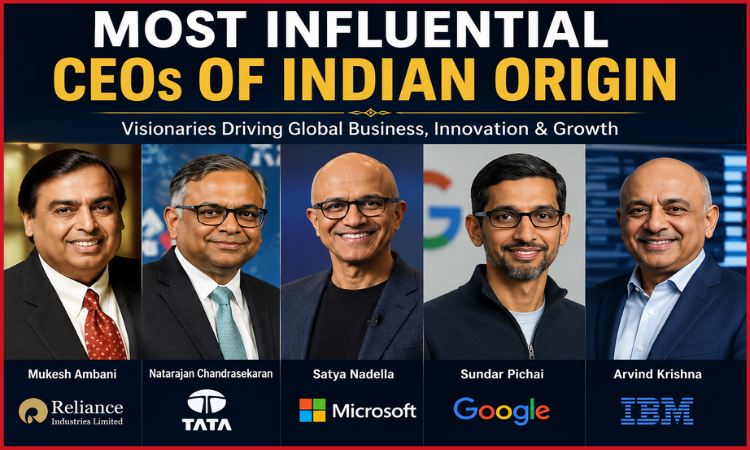
The Indian business scene is undergoing an unprecedented pace of change. Artificial intelligence, Information infrastructure, manufacturing boom, financial innovation, and sustainability are transforming business sectors from north to south. CEOs are the key drivers of this transformation, and their choices are impacting markets, investors, consumers, and economic activity.
India is now one of the most attractive investment destinations on the global map. However, business heads are increasingly and rapidly coming under heavy risks due to AI disruption, cybersecurity risks, and dynamic market environments. New surveys have revealed that the Indian CEOs are now concentrating more on investing in AI-related technologies than many of the top business leaders around the world.
This list recognizes executives who have driven growth, innovation, and transformation in technology, manufacturing, infrastructure, financial services, consumer, and digital services industries across the globe
How We Selected These CEOs
This ranking considers:
• Industry influence
• Economic impact
• Innovation leadership
• AI and digital transformation initiatives
• Strategic vision and market expansion
• Global recognition
• Contribution to India’s growth story
• Ability to influence the development of their fields
Quick Glance
| CEO | Company | Industry | Primary Influence Area |
| Mukesh Ambani | Reliance Industries | Conglomerate | Telecom, Retail, AI, Energy |
| Natarajan Chandrasekaran | Tata Sons | Conglomerate | Technology, Manufacturing |
| Anish Shah | Mahindra Group | Manufacturing | EVs, Mobility |
| S N Subrahmanyan | Larsen & Toubro | Infrastructure | Construction, Engineering |
| Sanjiv Puri | ITC | FMCG | Consumer Business |
| Salil Parekh | Infosys | IT Services | AI, Cloud |
| C Vijayakumar | HCLTech | IT Services | Digital Transformation |
| Amitabh Chaudhry | Axis Bank | Banking | Digital Banking |
| Sundararaman Ramamurthy | BSE | Capital Markets | Financial Markets |
| Lalit Keshre | Groww | Fintech | Retail Investing |
| Rajiv Bajaj | Bajaj Auto | Automotive | Manufacturing, EVs |
| Satya Nadella | Microsoft | Technology | AI, Cloud |
| Sundar Pichai | Alphabet | Technology | Search, AI |
| Shantanu Narayen | Adobe | Software | Creative Technology |
| Arvind Krishna | IBM | Enterprise Technology | AI, Hybrid Cloud |
1. Mukesh Ambani
Chairman and Managing Director, Reliance Industries
Among India’s most influential business leaders, Mukesh Ambani stands out. He has been at the forefront of a major transformation in Indian business under Reliance Industries.
Reliance, once famous for the energy and petrochemicals sectors, has entered into telecom, retail, media, digital, and more future-oriented technologies under Ambani’s leadership. The launch of Jio transformed internet access in India by bringing millions of people into the digital ecosystem.
Today, Reliance is heavily investing in AI platforms, digital ecosystems, renewable energy, and other next-generation infrastructure. This will anchor Reliance in many sectors that will fuel India’s future economy.
2. Natarajan Chandrasekaran
Chairman, Tata Sons
Natarajan Chandrasekaran serves as Chairman of the Tata Group, one of India’s most respected and diversified conglomerates. Under his leadership, Tata Sons has worked to streamline operations, enhance governance, increase profitability, and accelerate digital transformation.
The Tata Group operates across technology, steel, automotive, aviation, consumer products, hospitality, and financial services, requiring strong strategic discipline and long-term vision.
Chandrasekaran has directed Tata companies to accelerate investments in digital technologies, artificial intelligence, electric mobility, and advanced manufacturing and sustainability projects. Tata’s multinational presence allows Chandrasekaran to shape the industrial and technological trajectory of India.
3. Anish Shah
Group CEO and Managing Director, Mahindra Group
Anish Shah has led the Mahindra Group towards a transformation of profitability, technology, and future-ready industries. Since taking on the roles of Group CEO and Managing Director, he has focused on a strategy of disciplined capital allocation, efficiency in operations, and long-term value creation.
Mahindra Group consists of multiple industry sectors, including automobile, farm equipment, financial services, technology, logistics, hospitality, and renewable energy. Led by Shah, the company has sharpened its focus on electric vehicle (EV) strategy, while consolidating its stronghold in conventional manufacturing segments.
A key aspect of Shah’s leadership approach is balancing innovation with financial discipline. Alongside investments in new technology and cleaner mobility, maintaining profitability has remained a key priority.
4. S N Subrahmanyan
Chairman and Managing Director, Larsen & Toubro
S N Subrahmanyan is one of the most influential leaders shaping India’s infrastructure landscape. As the leader of Larsen & Toubro (L&T), he oversees one of India’s premier engineering, construction, and infrastructure companies.
L&T is one of the most prominent players involved in the building of roads, metros, airports, power projects, defense establishments, factories, and infrastructure projects in the digital space. With Subrahmanyan at the helm, the organization has further extended its global reach and has left an indelible mark on almost all of India’s landmark infrastructure projects.
Apart from construction, L&T has shifted its emphasis more to technology-based engineering, renewable energy operations, digitization, and enhanced manufacturing processes. The company continues to play a critical role in the industrial and infrastructure development of India.
5. Sanjiv Puri
Chairman and Managing Director, ITC Limited
Sanjiv Puri has been responsible for driving the considerable transformation of ITC from being a tobacco-focused corporation to one of India’s largest diversified consumer companies. He has led the expansion of the company into numerous sectors, including FMCG, agriculture, hospitality, and paperboards, while also focusing on sustainability initiatives.
One of Puri’s most successful initiatives has been to supplement the growth of the consumer brands portfolio of ITC. Various products from packaged foods and personal care, along with education and household categories, have contributed significantly to business growth.
Apart from business success, Puri is known in the international business community for promoting sustainability and responsible business management. ITC’s commitment to environmental issues, renewable energy initiatives, and sustainable value chains has made ITC a symbol of corporate sustainability.
6. Salil Parekh
Chief Executive Officer and Managing Director, Infosys
Salil Parekh’s leadership has strengthened Infosys’ position as one of the leading technology services companies in the world. In the era of accelerating digital transformation, the company has been pioneering digital and emerging technologies, including cloud computing, artificial intelligence, automation, cybersecurity, and next-generation digital services.
Infosys caters to clients in banking, health care, retail, manufacturing, and telecom. As organizations increase their IT spending, Parekh has positioned the company to keep pace with the growing demand for digital transformation.
Infosys is continuously investing in AI, data analytics, and cloud computing services that enable enterprises to modernize processes and stay competitive.
7. C Vijayakumar
Chief Executive Officer and Managing Director, HCLTech
C Vijayakumar has been instrumental in propelling HCLTech into the league of top Indian technology services firms. The company has grown under his direction through cloud, AI, engineering services, cybersecurity, and digital transformation.
One hallmark of Vijayakumar’s approach is not just innovation but implementation as well. HCLTech concentrates on offering pragmatic solutions that enable enterprises to upgrade their processes, become more agile, and speed up digitalization.
The company has also grown its emphasis on artificial intelligence-enabled services, automation, data analytics, and enterprise modernization, providing services across all industries.
8. Amitabh Chaudhry
Managing Director and CEO, Axis Bank
Amitabh Chaudhry has been at the helm of significant transformation in the private banking space in India. Since his appointment in 2019, he has leveraged the bank’s existing position to focus more on retail banking, enhance its digital capabilities, and broaden its market reach.
During his leadership, Axis Bank has focused extensively on digital banking, customer service, risk management, and technology-enabled financial services. These efforts have enabled the bank to stay competitive in a very dynamic financial services environment.
Banks continue to adapt to changes in fintech innovation, digital payments, and AI-based customer engagement. Through its continued leadership in these areas, Chaudhry has helped position Axis Bank for long-term growth.
9. Sundararaman Ramamurthy
Managing Director and CEO, BSE
Sundararaman Ramamurthy serves as the Managing Director and CEO of one of India’s leading stock exchanges. In his role at the Bombay Stock Exchange (BSE), he is responsible for a platform that facilitates both access to capital for enterprises and investor participation.
He assumed leadership when India’s capital markets were witnessing record retail participation, increasing technology adoption, and growing global interest. Under his leadership, BSE has taken focused initiatives to improve market modernization, transparency, investor confidence, and technology.
The further growth of digital investing throughout the country will also require Ramamurthy to emphasize the importance of trust, cybersecurity awareness, and financial literacy.
10. Lalit Keshre
Co-Founder and Chief Executive Officer, Groww
Lalit Keshre represents a new generation of entrepreneurs emerging from India’s startup boom. Under Keshre’s leadership as CEO, the investment platform Groww has helped make investing more accessible for Indians.
Established in Bengaluru in 2016, Groww transformed from a mutual fund platform into one of India’s prominent investment ecosystems with stocks, mutual funds, ETFs, and other financial offerings.
Groww has helped catalyze India’s retail investing culture. By streamlining financial services and lowering entry barriers, Groww has attracted millions of first-time investors.
11. Rajiv Bajaj
Managing Director and CEO, Bajaj Auto
Rajiv Bajaj is often regarded as one of India’s most respected business leaders. Bajaj Auto has been able to retain a competitive edge in both Indian and international markets despite changes in consumer preferences and technological advancements.
His strategy is generally organized around a clear vision and product differentiation, which has helped Bajaj grow in overseas markets without compromising its dominant share in India’s fiercely competitive two-wheeler industry.
Bajaj Auto has increasingly focused on electric mobility in recent years. The company has been moving toward cleaner transportation through investments in electric vehicles and electric drive technologies. It continues to remain at the forefront of the Indian automotive industry.
12. Satya Nadella
Chairman and Chief Executive Officer, Microsoft
Satya Nadella is one of the most influential business leaders today. Since becoming CEO of Microsoft in 2014, Nadella has led the company to become one of the world’s most valuable technology businesses through investments in cloud computing, AI, enterprise software, and productivity products.
Thanks to Nadella, Microsoft made a big push into its Cloud business with Azure and emerged as one of the main players during the AI revolution. Microsoft’s investments in AI technologies put Nadella’s company at the forefront of one of the biggest technological shocks experienced in decades. Nadella has been outspoken about the responsible development of AI while urging organizations to embrace AI-powered solutions.
Beyond Microsoft, Nadella remains an influential voice on these topics. His expertise in cloud, AI, digital transformation, and the future of work remains relevant outside Microsoft.
13. Sundar Pichai
Chief Executive Officer, Alphabet and Google
Sundar Pichai is one of the most powerful and influential technology executives in the world. Pichai serves as CEO of Google as well as its parent company, Alphabet.
Pichai has led the company through fundamental changes in search, cloud computing, mobile, AI, and advertising. AI has become one of Alphabet’s most important business priorities, supported by continuous investments in generative AI, AI infrastructure, and other advanced computing technologies.
Given Google’s sweeping influence on the availability of information, digital commerce, and innovation, Pichai has the power to disrupt an array of industries, including education, health care, finance, and entertainment, among others.
14. Shantanu Narayen
Chairman and Chief Executive Officer, Adobe
With extensive senior management experience, Shantanu Narayen transformed Adobe from a software company primarily focused on creative tools into a global enterprise offering digital platforms, content creation solutions, and enterprise software.
His most remarkable success was the conversion of Adobe from a traditional licensing-based software vendor to a cloud-based subscription company.
Currently, Adobe’s tools and services are immensely popular among designers, marketers, content creators, and businesses worldwide. In addition, the company has embraced AI-enabled innovation across its products and services.
15. Arvind Krishna
Chairman and Chief Executive Officer, IBM
In the company’s most significant era of technological disruption, Arvind Krishna heads IBM. Since taking over as CEO, he has worked to bolster the company’s dominance in areas like hybrid cloud computing, artificial intelligence, enterprise technology, and consulting.
Krishna has focused on enabling organizations to leapfrog their modernization of technology infrastructure with AI technologies in the right way. Currently, IBM’s quantum computing, blockchain advancements, and AI offer great potential to enable innovation and efficiency in the future, under his leadership.
His leadership approach focuses on practical business outcomes, helping organizations adopt emerging technologies while generating tangible returns from their digital transformation initiatives.
Leadership Trends Defining 2026
Artificial Intelligence as a Core Business Priority
AI has progressed from being a subject of experimentation to emerging as a business imperative. Organizations are using AI to improve productivity, automate operations, enhance customer experiences, and unlock new avenues of growth. Indian CEOs are placing significant emphasis on AI adoption, and it is expected to remain one of the defining business trends of 2026.
Digital Transformation Continues to Accelerate
Companies are pressing ahead with investments in cloud computing, cybersecurity, analytics, and digital infrastructure; those that achieve seamless adoption are seeing tangible results through improved competitiveness.
Sustainability and Long-Term Value Creation
Businesses have increasingly had to balance profitability with environmental responsibility and community impact. Several business leaders are working towards sustainability in addition to growth and development plans.
India’s Rising Global Influence
India is becoming increasingly prominent in technology, manufacturing, financial services, and all areas of innovation, offering exciting opportunities for companies and investors. As Indian companies venture worldwide, Indian CEOs are gaining prominence.
Conclusion
The most powerful CEOs of India are senior executives leading some of the country’s most influential companies across technology, manufacturing, infrastructure, finance, consumer goods, and digital services.
These companies are making the market adopt AI, enhancing its digital infrastructure, pushing toward sustainability, generating jobs, and catalyzing growth. Traditional business groups, global technology giants, and high-growth fintech companies, all led by these executives, are shaping the future of the Indian industry.
Meanwhile, as AI, sustainability, and digital innovation rapidly impact business, the choices made by these executives will be continually scrutinized by investors, businesses, and policymakers.
FAQs
Who is the most powerful CEO in India in 2026?
There is no single answer. Leaders such as Mukesh Ambani, Natarajan Chandrasekaran, Satya Nadella, and Sundar Pichai are widely regarded as highly influential due to their contributions to technology, infrastructure, investment, and broader economic growth.
What was the criterion for their selection?
The selection considered factors such as industry leadership, economic impact, innovation, AI adoption, strategic vision, market influence, and contribution to long-term business growth.
How is AI relevant to CEO power in the modern era?
AI is revolutionizing how business is conducted, engaging customers, enhancing employee productivity, and guiding decision-making. Those achieving the successful implementation of AI will tend to influence the whole industry.
Are there any specific industries with the most powerful CEOs in India?
Industries such as manufacturing, technology, consumer goods, telecom, financial services, and infrastructure contribute a significant share of India’s most influential business leaders.
What are the reasons Indian CEOs are becoming renowned worldwide?
India’s growing market, thriving technology ecosystem, expanding manufacturing base, and increasing global influence are giving Indian business leaders greater visibility and recognition worldwide.