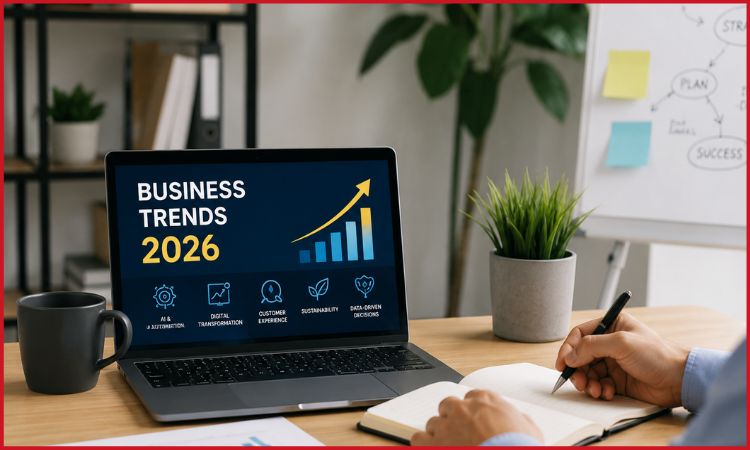
It is 2026, and the business world is evolving faster than many organisations can keep up. AI is becoming a core part of business operations, customer expectations are changing rapidly, and organisations are under pressure to grow faster, adapt faster, and stay resilient in unstable markets.
Meanwhile, entrepreneurship itself is evolving. It’s not only products and pricing anymore, but execution speed, digital reach, agility and positioning for the long term.
In this post, we’ll investigate the biggest business trends that will shape entrepreneurship in 2026 and how they’re changing growth, customer experience, hiring and operations.
1. AI is becoming a core business infrastructure
AI is no longer an experiment for giant corporations, and in 2026 it’s taking off for little businesses: Startups, e-commerce brands, SaaS Apps, Logistics and Service Companies.
Entrepreneurs are using AI for customer service, content development, forecasting, workflow planning, lead validation, and running operations.
The discussion has shifted from whether organisations should adopt AI to how fast they can integrate it into their operations.
Companies that do not include AI in their operating models risk slower execution, higher operating expenses, and being overtaken by faster-moving AI-enabled firms.
But the largest value is not the tools, but the ability to include AI in corporate processes to improve efficiency, decision-making, and customer experience.
2. AI Agents Are Revolutionising Business Operations
One important paradigm shift we expect to see in 2026 is a usable type of AI agent that can handle multi-step tasks with very little human intervention. They won’t just complete jobs like most automation platforms; they will also analyse data and make decisions on different operating cycles.
Customer assistance, cybersecurity, financial services, e-commerce, and organisational back-office operations are beginning to feel the impact.
Entrepreneurs can now adopt automation at a level that matches their capabilities, while companies are evolving into decentralised structures.
The major gains in operating efficiency will be achieved by those organisations that learn the art of balancing human oversight and AI-driven execution.
3. Hyper-personalisation is becoming the norm
Companies need to see their customers as individuals, and customers want to be seen that way. “Mass marketing doesn’t work anymore, and customer experience strategy is moving towards customised service.
AI is being used by businesses in recommendation engines, behavioural targeting, predictive analytics and automatic content personalisation to boost consumer engagement and retention.
This is especially true for e-commerce, streaming websites, banking apps, e-learning, and other digital services where consumer demands are continuously changing.
Brands that focus on personalised experiences can improve customer retention and establish loyalty by focusing on data-based customer experiences in their marketing and communication. Entrepreneurs who do so will outperform the competition.
4. Digital transformation is accelerated by MSMEs
Small businesses are accelerating digital transformation in 2026. Competition, access to ecosystems, altering consumer attitudes, and affordable technology for Micro, Small, and Medium Enterprises are driving cashless systems, automation, e-commerce, and AI adoption.
Many organisations that used to rely on traditional methods are now moving to cloud platforms, CRM systems, AI tools, and online markets to remain competitive.
Entrepreneurs who understand the consequences of digitising MSMEs may find tremendous growth prospects throughout emerging economies.
5. Growth Is Coming From Tier 2 & 3 Markets
Now, Tier 2 and Tier 3 cities are becoming business growth engines. The increased adoption of the internet, digital payments, e-commerce, and low-cost cellphones has begun to create a new set of consumer markets in and around large metros.
Many firms are building their products, logistical networks, and marketing around these areas.
This trend is especially visible in countries like India, where increased digital penetration is unleashing enormous, underserved markets with rising disposable income.
By personalising the product, price, customer experience, and logistics, corporations can enter expanding regional markets and create a durable competitive edge.
6. Sustainability is becoming a business must
Sustainability is not just about worldwide business branding strategies. By 2026, there will be a higher degree of regulation for companies and investors, and supply chain standards, and customers will be increasingly concerned about the environmental effects.
The manufacturing, fashion, logistics, energy, and FMCG businesses are facing increasingly demanding investor and customer expectations.
Inclusion of sustainability in the first phase of business activities might have a good effect on brand trust, as firms might be in a better position to cope with future legislation and market challenges.
7. The Creator Economy Is Becoming An Infrastructure Of Business
The creator economy is becoming more structured and commercially driven. Creators are evolving beyond traditional influencer roles.
They create media brands, digital enterprises, subscription communities, e-commerce businesses, and educational items.
More and more, organisations are coming to see the importance of collaborating with creators beyond traditional marketing tactics. Other benefits include a stronger customer position and involvement in speciality communities.
It’s transforming the way firms advertise, tell stories, and establish communities.
Brand ecosystems of brands with creator partnerships and community-driven business models may be stronger than those that use traditional marketing.
8. Skill-Based Hiring Is Replacing Traditional Workforce Models
The workforce is already changing due to automation and AI. Jobs are disappearing, evolving, and being newly created, while a new type of employer is emerging, with digitally enabled, flexible workforces and constantly evolving skill sets.
Entrepreneurs are facing new challenges and opportunities in recruitment, team organisation, training, and long-term workforce planning.
Those firms that create flexible team management methods that can keep up with changing technology are more likely to succeed in the long run in a world that is constantly evolving.
9. Data-Driven Decision-Making Is Growing Ever More Critical
Entrepreneurship is becoming data-driven in 2026. Firms have access to large volumes of customer, operational, and market data.
The real value lies in using that data effectively to make decisions that improve execution.
Businesses can track consumer behaviour and use analytics to improve pricing strategy, client retention management, demand forecasting, inventory management, advertising performance, and business intelligence.
For example, founders who trust their gut instinct rather than measurable data may find themselves outpaced by competitors who can pivot faster using real-time analysis.
10. Business resilience is becoming a major competitive advantage
There are numerous drivers for companies to experiment with new ways of working: economic uncertainties, geopolitical difficulties, regulatory changes, and rapid technological disruption.
Entrepreneurs are equally worried about their resiliency, numerous streams of income, constant cash flow, and sustainability.
Businesses are becoming more and more concerned with too much concentration in one place. Whether it’s one platform, one market, a few suppliers, or one way of acquisition.
Value is moving away from scaling fast without operational stability. Companies founded by founders who build flexible and resilient organisations are more likely to endure future challenges and continue growing.
Abstract
What will shape the business climate of 2026? Digital transformation driven by AI, changing customer expectations, expanded digital channels, and rising corporate complexity.
Now, entrepreneurs need to understand that the game of competition is not simply about selling a good product or a smart idea. It’s also about knowing what it takes to be flexible and implement, knowing what to innovate and how to leverage technology to adapt rapidly.
The entrepreneurs who will probably win out in the next years will be those who spot changes early, establish dependable systems, and adapt gracefully to changing market patterns.
FAQ
What business trends should you know in 2026?
Here are some of the top business themes to look for in 2026: AI adoption, AI agents, hyperpersonalization, sustainability, the emerging creative economy, digital transformation, and data-driven decision-making.
How will AI affect entrepreneurs differently by 2026?
AI enables entrepreneurs to work smarter, automate processes, optimise costs and deliver better experiences for customers at scale with smaller teams.
What influence does the growth of Tier 2 and Tier 3 markets have on business?
The surge of digital usage, growth of e-commerce, and expansion of consumers in the Tier 2 and Tier 3 cities are opening up enormous new business prospects.
Why is business resilience more interesting to people?
We are living in a time of economic upheaval, technological disruption, and rapid evolution in global marketplaces. This shift has pushed companies toward operational stability, diversified income streams, and long-term sustainability.
How do entrepreneurs prepare for the future of business?
To prepare, entrepreneurs can use technology, create data-driven plans, develop flexible workforce capabilities, offer customised services, and build scalable operational processes.