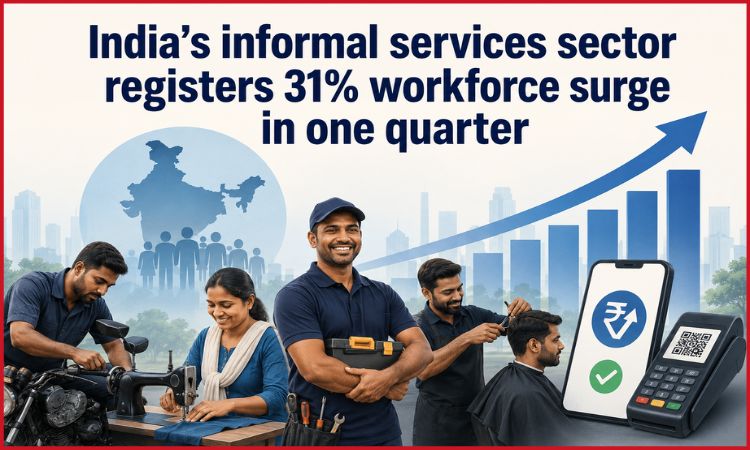
India’s unincorporated services sector, spanning everything from local repair shops to neighbourhood service providers, expanded its workforce by 31.13% year-on-year in the January to March 2026 quarter, the sharpest employment growth of any segment in the informal economy, according to quarterly data released by the National Statistics Office (NSO) this week.
15+ crore workers employed
The services surge drove the broader sector’s employment past the 15-crore mark for the first time, with total unincorporated non-agricultural employment reaching 15.17 crore, a 15.51% year-on-year increase. Within that, the unincorporated services segment also expanded its establishment count by 24.82% over the same period — the highest among manufacturing, trade, and services. The overall unincorporated sector now counts 9.16 crore establishments, up 16.69% from 7.85 crore in the corresponding quarter of the previous year.
A caveat embedded in the data
Point to be noted here is that ASUSE 2026 adopted a new industrial classification — NIC 2025 — replacing NIC 2008 used in earlier rounds. Under the revised framework, motor vehicle and motorcycle repair establishments, previously counted under ‘trade’, are now classified under ‘services’.
The NSO itself cautions that users should interpret quarterly movements carefully, given potential sampling variability and changes in classification. How much of the 31% employment jump reflects genuine services expansion versus reclassification is a question the bulletin does not separately quantify.
Digital without the paperwork
Alongside the services data, the NSO release says 81% of unincorporated establishments report using the internet for business purposes, and an equal share have adopted cashless transaction modes, including UPI, online banking, and POS devices. Yet only 41.37% of establishments report any form of business registration. The informal economy has digitised at a pace that formal compliance has not matched — these enterprises are transacting on traceable digital rails while remaining largely outside the GST net and formal credit system.