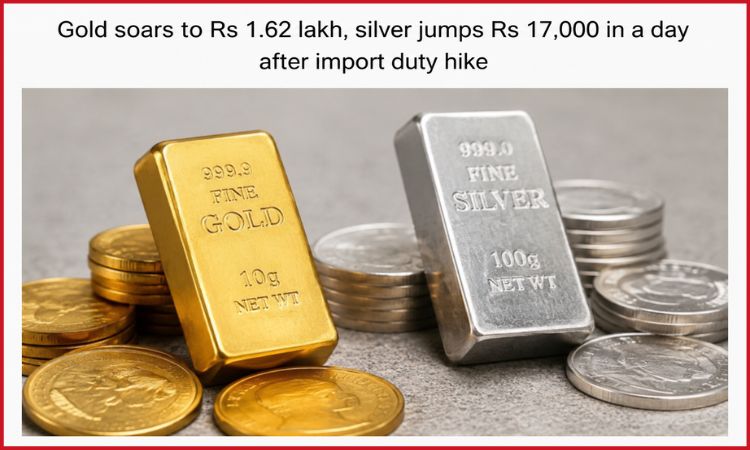
“Almost every Indian household will indirectly feel the impact of this in some way,” says Anant Sekhsaria, a CA and finance and marketing professional, reacting to the government’s decision to raise import duty on gold and silver from 6% to 15% — a move that sent bullion prices surging within hours of the announcement.
Gold and silver prices in India rose sharply on Wednesday, May 13, after the Centre announced the 15% import duty hike. Gold climbed to Rs 1.62 lakh per 10 grams while silver leapt nearly Rs 17,000 in a single session, with silver prices hovering close to Rs 2,90,100 per kilogram in the domestic bullion market.
The duty structure has been overhauled significantly. Basic customs duty has been raised from 5% to 10%, while the Agriculture Infrastructure Development Cess has been hiked from 1% to 5%, taking the combined effective rate to 15%. The revision is not limited to raw gold and silver — duties on jewellery-making components (findings) and platinum have also been revised, meaning the overall production cost for the jewellery industry will rise.
The move comes days after Prime Minister Narendra Modi made an unusual public appeal urging Indians to avoid buying gold for a year, flagging pressure on the country’s forex reserves and the rupee. The Indian rupee hit a record low of 95.63 against the US dollar on Tuesday.
India’s gold imports had already surged more than 24% to an all-time high of $71.98 billion in 2025-26, driven largely by higher international prices even as volumes dipped 4.76% to 721.03 tonnes.
Industry reacts
Those in the finance sector reacted saying the policy whiplash had been building for a while. Kirttan Shah, founder of Truvanta Wealth, noted that policymaking around gold has been erratic: “In 2024, duty was decreased from 15% to 6% because of SGB redemptions.
In 2025, LTCG was introduced on SGB redemptions retrospectively. In 2026, duty increased again.” Shah also pointed to a structural problem. “Import is a problem for India from a currency standpoint. The more we import, the more the rupee depreciates. We can’t do anything about crude import, and hence gold imports are always on the firing line. Won’t be surprised if petrol and diesel prices are next,” he said.
For investors, the duty hike creates a complicated calculus. Domestic gold prices could rise further even if international bullion prices remain stable, and higher domestic premiums mean gold in India may trade at a bigger markup compared to international prices. Inflows into India’s gold ETFs had already jumped 186% year-on-year in the March quarter to a record 20 metric tons, according to the World Gold Council — a trend likely to accelerate as physical gold becomes costlier.
Surendra Mehta, national secretary at the India Bullion and Jewellers Association, acknowledged the government’s intent while flagging consequences. “This could affect demand, as gold and silver prices were already elevated,” he said.
Illegal gold, silver imports to rise?
The more pointed worry is the return of smuggling or illegal imports.
A Mumbai-based bullion dealer warned that grey markets are likely to become active again. “At current price levels, smugglers could make significant profits,” he said. Smuggling had eased after the 2024 duty cut — Wednesday’s sharp reversal risks unwinding that progress.
For now, the message to investors seems clear: gold ETFs over physical metal, patience over panic buying, and a close watch on how long this policy holds.