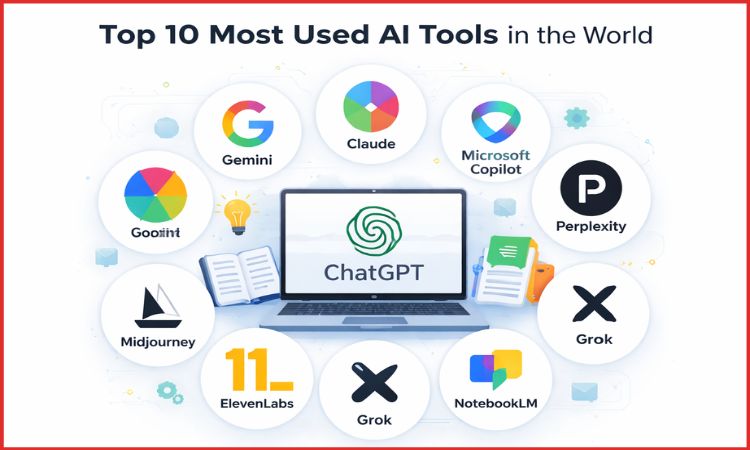
Over one billion people now use AI tools every month. DataReportal confirmed this in their Digital 2026 Global Overview Report — a milestone the internet itself took more than a decade to reach. AI got there in under three years.
Nobody uses just one tool anymore. A March 2026 survey of 900+ software engineers by The Pragmatic Engineer found that 70 percent use two to four AI tools simultaneously. The market has stopped being a single winner story. It is a stack now — and businesses that have not figured out their stack are already behind.
Below are the ten most used AI tools in the world as of April 2026. Each entry covers the company, the CEO, current valuations, real user numbers, recent ad campaigns, and what the tool actually does well. No fluff.
#1 ChatGPT — OpenAI
CEO: Sam Altman
Valuation: $852 billion — March 2026 (OpenAI / AIBusiness)
Revenue: $2.6 billion per month; $31B+ annualised (OpenAI, March 2026)
Users: 900 million weekly active; 50 million paid subscribers
Pricing: Free; Plus $20/month; Pro $200/month
ChatGPT reached 100 million users faster than any consumer product in history. Today it sits at 900 million weekly actives — more than 10 percent of the entire global population. That is not a chatbot. That is infrastructure.
OpenAI closed a $122 billion funding round in March 2026 at an $852 billion valuation. Amazon put in $50 billion. Nvidia and SoftBank each added $30 billion. CEO Sam Altman, who owns zero equity in the company he runs, told the BG2 podcast the company is generating ‘well more’ than $13 billion annually — then suggested $100 billion by 2027 is an internal target, not a press release (TechCrunch, November 2025). Monthly revenue is confirmed at $2.6 billion.
| “The obvious tactical thing is just get really good at using AI tools. When I was graduating from high school, the obvious thing was get really good at coding. This is the new version of that.”— Sam Altman, CEO of OpenAI | Stratechery Podcast |
One advertising move worth noting: OpenAI introduced ads into ChatGPT’s free tier in early 2026. That single decision triggered one of the most entertaining corporate feuds in recent AI history — Anthropic spent Super Bowl money mocking it. More on that below.
Upcoming: The company acquired OpenClaw in February 2026 — an open-source AI agent that became GitHub’s most-starred repository, beating both React and Linux. Agentic AI is clearly OpenAI’s next frontier. An IPO targeting $1 trillion in valuation is expected in Q4 2026.
#2 Google Gemini — Google DeepMind / Alphabet
CEO: Sundar Pichai (Alphabet)
Valuation: ~$4 trillion market cap — Alphabet hit this milestone in January 2026 (Fast Company)
Revenue: $1.2B from Gemini subscriptions in 2025; Alphabet crossed $400B total annual revenue
Users: 750 million monthly active (Sundar Pichai, Q4 2025 earnings call)
Pricing: Free; Gemini Advanced at $19.99/month
When Google and Apple announced in January 2026 that future Siri versions would run on Gemini, Alphabet’s market cap crossed $4 trillion for the first time. That one deal probably says more about Gemini’s position than any benchmark score.
Gemini has 750 million monthly active users and is embedded into 1.5 billion monthly Google Search interactions through AI Overviews. Google lowered Gemini’s serving cost by 78 percent in 2025 through model optimisations — so the unit economics are improving even as the user base grows (Sundar Pichai, Q4 2025 earnings call). The company plans to spend $175 to $185 billion on capital expenditure in 2026, mostly on AI infrastructure.
| “Our Gemini App now has over 750 million monthly active users. We are also seeing significantly higher engagement per user, especially since the launch of Gemini 3 in December.”— Sundar Pichai, CEO of Alphabet | Q4 2025 Earnings Call |
IPL 2026 advertising move: Google signed a three-year sponsorship deal with BCCI worth Rs 270 crore, making Gemini an official AI partner of the Indian Premier League. Google then secured the co-presenting sponsor slot across JioStar broadcasts — a category-exclusive deal that locked rival AI brands, including OpenAI, out of the tournament entirely (Storyboard18, March 2026). ChatGPT had signed a smaller deal with the Women’s Premier League earlier. Cricket is now the main advertising battleground for AI brands in India.
Upcoming: Gemini 3.1 Pro launched February 2026 and scored 77.1 percent on the ARC-AGI-2 reasoning benchmark — more than double its predecessor. Project Genie (real-time interactive world generation) and expanded Gemini App Actions across all Android devices are expected before year-end.
#3 Claude — Anthropic
CEO: Dario Amodei — net worth ~$7 billion as of February 2026 (Forbes)
Valuation: $380 billion — February 2026 Series G (Fortune / Anthropic)
Revenue: $19 billion annualised run rate — March 2026 (Sacra); Claude Code: $2.5B+ ARR
Users: 300,000+ business customers; 8 of Fortune 10 are Claude customers
Pricing: Free; Pro $20/month; Team and API plans available
Anthropic’s revenue grew 1,167 percent year-on-year to reach $19 billion in annualised revenue by March 2026. That number is not a typo. Eight of the ten largest US companies are now Claude customers. More than 500 clients spend over $1 million annually on the platform (Sacra, March 2026). Claude Code — the terminal coding agent launched in May 2025 — crossed $2.5 billion in annualised revenue on its own.
| “We are working with pharma companies to use Claude to write clinical studies, and they have reduced the time from 12 weeks to three days.”— Dario Amodei, CEO of Anthropic | TechCrunch, Paris AI Action Summit, February 2025 |
Super Bowl 2026 was Anthropic’s debut on advertising’s biggest stage. The campaign, titled ‘A Time and a Place,’ featured four darkly funny ads — set to Dr Dre’s ‘What’s the Difference’ — showing people asking AI for health and relationship advice, only to receive sponsored promotions for fictitious products. The tagline: ‘Ads are coming to AI. But not to Claude.’ Sam Altman called the ads ‘deceptive’ on X. Claude’s app jumped from rank 41 to rank 7 on the US App Store within days. Daily active users rose 11 percent that week (CNBC / BNP Paribas, February 2026).
Claude’s strongest user segment is software engineers and enterprise knowledge workers. Claude Opus 4.6 supports a 1 million token context window — large enough to process an entire codebase in a single pass. An IPO targeting $400 to $500 billion is reportedly in active preparation for October 2026.
#4 Microsoft Copilot — Microsoft
CEO: Satya Nadella — Microsoft market cap ~$2.78 trillion (April 2026)
Revenue: AI annual revenue run rate ~$26 billion; Q2 FY2026 total: $81.3 billion (CNBC, January 2026)
Users: 15 million paid M365 Copilot seats; 150 million monthly active AI feature users|
Pricing: Free with Windows; M365 Copilot at $30/user/month
Microsoft invested $13 billion in OpenAI between 2019 and 2023. At OpenAI’s current valuation, that stake is worth around $228 billion — a 17.6x return. That context matters because it explains why every Microsoft product conversation eventually circles back to Copilot.
Copilot sits inside Word, Excel, PowerPoint, Teams, and Outlook. No new platform to learn. No new workflow. For large enterprises that cannot easily move outside the Microsoft ecosystem, that is a real advantage. Satya Nadella described Copilot as ‘becoming a true daily habit’ on the January 2026 earnings call, with daily active users up tenfold year-on-year (CNBC, January 2026).
The complication: only 15 million of Microsoft’s 450 million commercial M365 subscribers pay for Copilot — a 3.3 percent conversion rate. A Recon Analytics survey found that when workers are given a choice between Copilot and ChatGPT, only 18 percent pick Copilot. Add Gemini as an option and it drops to 8 percent (Moneywise, March 2026). Microsoft is aware of the gap. In March 2026 it launched a Copilot feature powered by Anthropic’s Claude — its own partner’s competitor — to close it.
#5 Perplexity AI — Perplexity
CEO: Aravind Srinivas — former researcher at OpenAI, Google Brain, and DeepMind
Valuation: $21.21 billion — Series E-6, early 2026 (Wikipedia / Bloomberg)
Revenue: ~$200 million ARR — February 2026
Users: 45 million users; 1 billion monthly queries crossed in Q1 2026
Pricing: Free; Pro at $20/month
Most AI tools generate an answer and ask you to trust it. Perplexity searches the live web for every query and hands you the sources. Simple idea. Turns out, in professional contexts where being wrong has real consequences, it matters a great deal.
The India expansion strategy was creative. Perplexity partnered with Airtel, giving all subscribers a free Pro account. The result was a 640 percent year-on-year increase in Indian users in a single quarter. The company also crossed 1 billion monthly queries in Q1 2026 and signed a $750 million Microsoft Azure computing commitment to support advanced ‘Deep Research’ features (Wikipedia, 2026). Its primary audience is researchers, analysts, and journalists — people who cannot afford hallucinated facts.
#6 Midjourney — Midjourney Inc.
Founder / CEO: David Holz
Valuation: Privately held; bootstrapped — no disclosed funding rounds
Users: ~17 million registered users; primarily creative professionals
Pricing: Basic $10/month; Standard $30/month; Pro $60/month
Midjourney is profitable, bootstrapped, and run by a founder who rarely gives interviews. That alone makes it unusual in this industry. Its V8 model produces images that creative agencies, game studios, and advertising teams still consider a step above what ChatGPT or Gemini can generate (AI Weekly, 2026). The overall ranking has slipped — a16z placed it around 43rd in global AI tool usage in January 2026 — because generalist platforms are integrating image generation directly. But for professionals who need precise aesthetic control, it remains the reference standard. The Discord interface, though, is still a barrier. Midjourney has never fully resolved the fact that most business users are not comfortable working in a gaming chat app.
#7 ElevenLabs — ElevenLabs
CEO: Mati Staniszewski
Valuation: $11 billion — Series D, February 2026 (Sequoia Capital / AI Funding Tracker)
Revenue: $330 million+ ARR closed 2025; enterprise clients: Deutsche Telekom, Revolut, Meta, Salesforce
Pricing: Free (limited); Starter $5/month; Creator $22/month
In February 2026, ElevenLabs raised $500 million in a Series D led by Sequoia Capital, tripling its valuation to $11 billion. Andreessen Horowitz and ICONIQ both increased their positions. This was the largest funding round in voice AI history (AI Funding Tracker, February 2026).
ElevenLabs converts text into natural-sounding audio in 30+ languages, supports custom voice cloning, and powers AI voice agents for customer service, audiobooks, and corporate training. Voice AI has not been absorbed by the generalist platforms the way image generation has — it still requires specialised technology, and ElevenLabs currently leads that space. Enterprise adoption is strong: Deutsche Telekom, Revolut, Meta, and Salesforce are all active clients.
#8 Grok — xAI / SpaceX
CEO: Elon Musk — xAI-SpaceX merged February 2026; targeting IPO at $1.5 trillion (AI Funding Tracker)
Key Feature: Live access to all X (Twitter) posts and trending data in real time
Pricing: Via X Premium+ subscription; standalone plans available
Every other AI tool on this list has a training cutoff. Grok does not. It pulls live posts from X in real time, which means it can tell you what is happening right now — not what happened before its last model update. For journalists, traders, and political analysts, that capability is genuinely different from anything else available.
xAI merged with SpaceX in February 2026 and is targeting a public listing at up to $1.5 trillion, which would make it the largest IPO in history. Grok also has image and video generation, and its tone is notably more direct than its competitors — it hedges less. Its audience reflects this. It is strongest among users who want answers fast, not caveats. For general professional work, most people still reach for ChatGPT or Claude. But for real-time information, nothing else comes close.
#9 Claude Code & Cursor — AI Coding Tools
Claude Code: By Anthropic — #1 most-used AI coding tool as of March 2026
Cursor: By Anysphere — $300M+ ARR; $2.5B valuation
Benchmark: Claude Code scores 80.8% on SWE-bench — the industry standard for software engineering
Pricing: Claude Code: Anthropic API usage-based; Cursor: Free; Pro $20/month
Eight months. That is how long it took Claude Code to go from launch to becoming the most-used AI coding tool among professional software engineers — overtaking GitHub Copilot, which had years of head start and Microsoft’s full distribution behind it.
| “Claude Code has gone from zero to number one in only eight months. 95% of engineers now report using AI tools at least weekly, and 75% use AI for half or more of their work.”— The Pragmatic Engineer | AI Tooling Survey, March 2026 |
Claude Code lives in the terminal, not the editor. It can inspect codebases, run commands, manage multi-file tasks, and review changes without waiting for human input at every step. Senior developers and team leads have adopted it at twice the rate of junior engineers. Cursor takes the opposite approach — an AI-first IDE that wraps around your existing code environment. Both are worth evaluating before settling on either.
#10 NotebookLM — Google
CEO: Sundar Pichai (Alphabet)
Key Feature: Answers only from your uploaded documents — no hallucinations from training data
Pricing: Free; Plus via Google One AI Premium
Primary Users: Researchers, students, legal professionals, consultants
NotebookLM does not try to know everything. That constraint — answers only from what you give it — is precisely what makes it valuable for anyone who has acted on a plausible-sounding AI response that turned out to be completely wrong.
The audio overview feature is the one worth mentioning. Feed it a 200-page document and it generates a podcast-style conversation between two AI hosts who summarise and explain the material. Consultants absorbing client briefings, students working through dense research — this feature has become quietly useful in a way that did not generate much press. NotebookLM’s growth has been almost entirely word-of-mouth. Its audience sits at the more research-oriented end of the AI user spectrum. It may not be the most powerful tool on this list. It is probably the most reliably accurate.
THE REVENUE PICTURE: WHO IS MAKING WHAT
The numbers in this industry have stopped making intuitive sense. OpenAI generates $2.6 billion in monthly revenue and still burns through capital faster than it earns. Anthropic grew revenue 1,167 percent year-on-year. In February 2026, just three AI companies absorbed 83 percent of all global venture capital in a single month (AI Funding Tracker).
OpenAI is targeting $100 billion in annual revenue by 2027. Anthropic projects $18 billion in 2026 revenue and $70 billion by 2028 (The Information). Google’s Gemini subscription revenue could reach $5 to $8 billion by end of 2026. Perplexity crossed $200 million ARR. ElevenLabs closed 2025 at $330 million ARR. These numbers are growing fast enough that any figure printed here will likely be outdated within two quarters.
The revenue model choices are telling. OpenAI chose advertising. Anthropic publicly rejected it — and made the rejection a Super Bowl campaign. Google monetises through cloud and subscriptions. Perplexity tried ads, then dropped them in February 2026 in favour of subscriptions. These are not just business decisions. They reflect what each company thinks AI tools are fundamentally for.
FINAL WORD
None of these tools are perfect. The field moves fast enough that a tool leading today may look very different six months from now — and some of these companies have valuations that rely heavily on a future that has not arrived yet.
What is clear: the question for businesses and professionals in 2026 is not whether to use AI tools. That conversation is over. The question now is which stack makes sense for your specific work, and how to build the habit of using it well. Start with one tool that fits what you actually do. Add a specialist tool for your primary workflow. Revisit the stack every quarter.
FAQs:
1. What are the most used AI tools in the world in 2026?
The most used AI tools in the world in 2026 include ChatGPT, Google Gemini, and Claude. These tools dominate globally due to their powerful features in writing, coding, and business productivity.
2. Which is the best AI tool in 2026 for everyday use?
Among the best AI tools 2026, ChatGPT is the most popular for daily use. It helps with content creation, problem-solving, and research, making it a go-to AI tool for students, professionals, and businesses.
3. Are there free AI tools available in 2026?
Yes, many of the most used AI tools in the world offer free versions. ChatGPT, Google Gemini, and NotebookLM provide powerful features at no cost, making AI accessible to everyone.
4. What AI tools are best for business and productivity?
Top AI tools for business include Microsoft Copilot for office work, Perplexity AI for research, and ChatGPT for strategy and automation. These tools help improve efficiency and decision-making.
5. Which AI tools are trending worldwide right now?
Trending tools in the top AI tools list include Grok for real-time insights, Midjourney for creative design, and ElevenLabs for voice technology.
SOURCES & DISCLAIMER
Data sourced from: a16z Top 100 Gen AI Consumer Apps, 6th Edition (January 2026); The Pragmatic Engineer AI Tooling Survey (March 2026); Sacra Research — Anthropic revenue estimates; DataReportal Digital 2026 Global Overview Report; OpenAI, Anthropic, and Alphabet official statements and earnings calls; Fortune, CNBC, TechCrunch, Storyboard18, AI Funding Tracker, AI Weekly Definitive Guide 2026, and Wikipedia. Pricing and valuations accurate as of April 2026 and subject to change. This article does not constitute financial or investment advice.