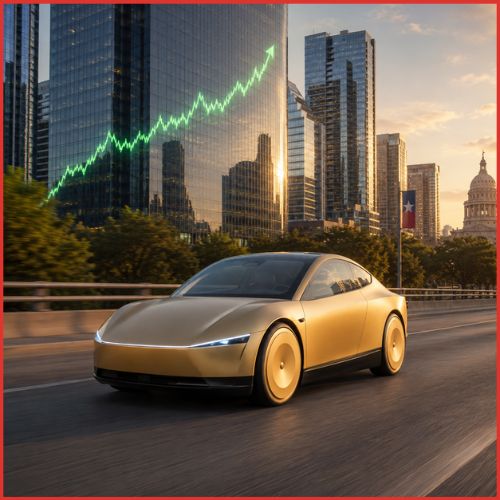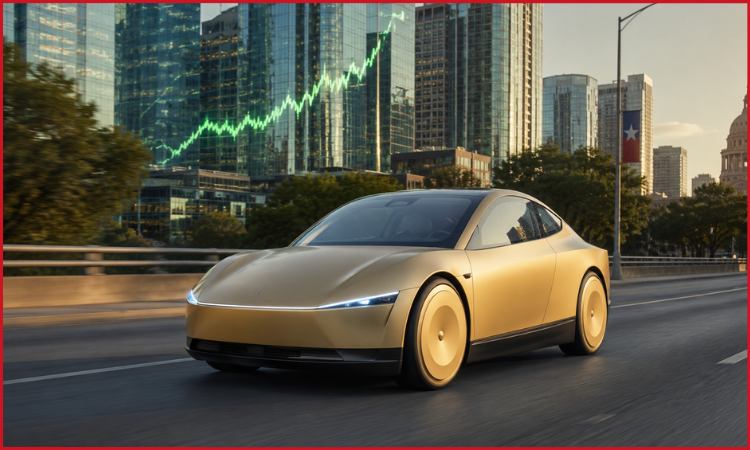
Tesla shares climbed to their highest level in four weeks as investors responded to fresh signs that the electric vehicle maker is preparing to bring its Cybercab onto public roads in Austin.
The stock rose 4.3% to $351.12, after touching an intraday high of $351.85. Trading volume reached more than 36 million shares, while Tesla’s market value stood at approximately $1.24 trillion.
The latest gain followed reports that Tesla could begin an initial Cybercab rollout before the end of August. Employees are expected to be among the first passengers before access is expanded to selected members of the public.
Tesla has also promoted an invitation-only Cybercab event in Austin. Customers using the company’s existing robotaxi service through August 23 can reportedly enter a draw for invitations, with winners expected to be selected on August 25.
The company has not publicly confirmed the complete rollout schedule.
Cybercab Could Join Austin Robotaxi Fleet
Cybercab is Tesla’s purpose-built autonomous vehicle. The two-seat electric car does not have a steering wheel or pedals and is designed to operate through the company’s self-driving system.
Tesla currently uses modified Model Y vehicles for its robotaxi service. Adding Cybercab would allow the company to begin testing a vehicle developed specifically for autonomous ride-hailing instead of adapting an existing consumer model.
Reports indicate that the first Cybercab rides could be offered to Tesla employees in Austin. A limited public launch may follow once the company has collected operational data from those initial journeys.
Tesla confirmed in its second-quarter update that Cybercab production had begun at Gigafactory Texas. The company has installed annual manufacturing capacity of more than 125,000 units, although current output has not been disclosed.
Chief Executive Elon Musk has previously warned that early Cybercab production would be slow because the vehicle uses several new components and manufacturing processes. Production is expected to increase as Tesla resolves technical and supply-chain constraints.
Moving Cybercab from factory testing to passenger service would provide investors with a clearer measure of Tesla’s progress in autonomous transport. The company has placed robotaxis at the centre of its long-term growth strategy, even as vehicle manufacturing remains its main source of revenue.
AI Business Drives Tesla’s Valuation Story
The share-price gain also reflects renewed attention on Tesla’s wider artificial intelligence strategy.
Tesla is investing in self-driving software, AI computing infrastructure, custom chips and the Optimus humanoid robot. The company wants these businesses to generate revenue beyond traditional electric vehicle sales.
Active subscriptions to Tesla’s Full Self-Driving software reached approximately 1.48 million during the second quarter, an increase of 56% from a year earlier. The system remains classified as supervised driver-assistance software in consumer vehicles and requires the driver to remain attentive.
Tesla’s autonomous ride-hailing operations use a separate deployment model, including remote support and restricted operating areas. The company has expanded the service to several US cities, but its network remains considerably smaller than established rival Waymo.
Cybercab is intended to support a larger robotaxi fleet if Tesla secures the required regulatory approvals and demonstrates that its technology can operate safely at scale.
That challenge remains central to the company’s AI plans. A short demonstration or limited employee rollout would not establish whether Tesla can operate thousands of autonomous vehicles across multiple markets.
Financial Performance Remains Mixed
Tesla’s second-quarter results showed stronger sales but continued pressure on profitability.
Revenue rose 26% from a year earlier to $28.24 billion, supported by record second-quarter deliveries of 480,126 vehicles. The company produced 451,758 vehicles during the period.
Net income fell 5% to $1.11 billion, while operating income dropped 57% to $398 million. Tesla’s operating margin narrowed to 1.4%.
Spending increased as the company directed more money towards AI, robotics and manufacturing projects. Capital expenditure reached $5.79 billion during the quarter, while research and development expenses rose 49% to $2.37 billion.
Higher spending pushed free cash flow to negative $1.1 billion. Tesla expects its full-year capital expenditure to exceed $25 billion as work continues on Cybercab, Optimus, autonomous-driving software and AI infrastructure.
The financial figures show why investors are watching the robotaxi programme closely. Tesla is committing substantial capital to AI-led projects before those operations make a meaningful contribution to earnings.
The company’s share price remains sensitive to signs that these projects are moving from development into commercial use.
Regulatory Questions Remain
Cybercab’s design creates additional regulatory challenges because the vehicle has no conventional driving controls.
Tesla will need federal and state approvals before deploying the vehicle widely. Regulators are also examining autonomous-driving systems more closely following reported incidents involving robotaxis and driver-assistance software.
In Nevada, Tesla applied for permission to operate 5,000 robotaxis but initially received approval for only 10 vehicles, subject to human-supervision requirements. The decision showed that deployment could proceed more slowly than Tesla’s production ambitions.
Competition is also increasing. Waymo already operates paid driverless services across several American cities and has accumulated substantially more autonomous mileage. Amazon-backed Zoox is developing its own purpose-built robotaxi without traditional controls.
Tesla’s advantage is its large vehicle fleet and the driving data collected through customer cars. Its challenge is converting that scale into an autonomous service that satisfies safety standards and performs consistently in everyday traffic.
Bottom Line
Tesla shares reached a four-week high as investors returned their attention to the company’s Cybercab and autonomous-driving plans. Reports of employee rides and a possible Austin launch event have created a near-term catalyst for the stock.
The next test will be operational. Tesla must show that Cybercab can move beyond limited demonstrations, obtain regulatory clearance and carry passengers reliably on public roads.
Until then, the latest rally reflects improving sentiment around Tesla’s AI ambitions rather than a confirmed financial contribution from Cybercab or its robotaxi network.