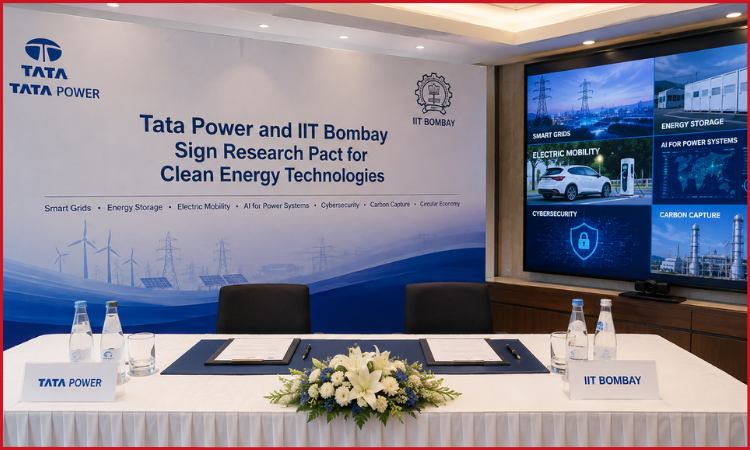
Tata Power has signed a Master Research Agreement with the Indian Institute of Technology Bombay to jointly develop technologies for clean energy and modern power systems.
The Tata Power-IIT Bombay partnership will cover smart grids, energy storage, electric mobility, power electronics and artificial intelligence for power systems. The two organisations will also work on cybersecurity, digital grid technologies, carbon capture and circular economy solutions.
The agreement is intended to connect IIT Bombay’s research capabilities with Tata Power’s experience in testing and deploying energy technologies at an industrial scale.
Agreement Signed at IIT Bombay
The agreement was signed at the IIT Bombay campus by Tata Power Chief Executive Officer and Managing Director Praveer Sinha and IIT Bombay Dean of Research and Development Shrikrishna V Kulkarni.
Tata Power said the arrangement would support research into next-generation energy systems and advanced clean energy solutions. Projects developed under the agreement will be assessed for their potential to move from laboratory research to practical deployment.
The company has not disclosed the financial terms, duration or number of projects planned under the agreement. Timelines for the first research projects have also not been announced.
A Master Research Agreement generally provides an operating framework under which the two organisations can identify projects, assign research teams and set development goals. Individual initiatives can then be taken forward under the broader arrangement.
Research to Cover Nine Technology Areas
The collaboration includes nine major research areas:
- Smart grids
- Power electronics
- Energy storage
- Electric mobility
- Cybersecurity
- Artificial intelligence for power systems
- Digital grid technologies
- Carbon capture
- Circular economy
Smart-grid research will focus on technologies that can improve the monitoring and operation of electricity networks. Digital grid systems use connected equipment, sensors and software to track power flows and respond to changing demand.
Power electronics and energy storage are also part of the agreement. These technologies are used in renewable-energy systems, battery installations, electric vehicles and electricity-distribution networks.
The inclusion of electric mobility gives the partnership scope to study charging systems and the effect of rising electric-vehicle adoption on power networks. Tata Power already operates in the electric-vehicle charging segment through its EZ Charge business.
Cybersecurity has been included because electricity networks increasingly depend on connected control systems and digital platforms. The agreement will allow researchers to work on protecting grid infrastructure, operational systems and power-sector data.
AI to Be Applied to Power Systems
Artificial intelligence will form a separate area of work under the clean energy research agreement. Possible applications within power systems include load forecasting, equipment monitoring, fault detection and the management of distributed energy resources.
The companies have not announced any specific AI product or research model under the partnership.
Digital grid technologies will be developed alongside AI-led systems. The work may involve software and computing platforms used to monitor generation, transmission, distribution and consumer demand. Exact projects will be identified by Tata Power and IIT Bombay through the research framework.
Carbon capture and the circular economy complete the initial list of research areas. Carbon-capture work will examine technologies connected with controlling industrial emissions. Circular-economy research will focus on the recovery, reuse and recycling of materials used across the energy sector.
Tata Power Plans to Take Research Into Industry
Praveer Sinha said Tata Power would combine IIT Bombay’s research capabilities with the company’s experience in deploying technologies at scale.
According to Sinha, the partnership is expected to support the development of an electricity system that is more resilient, secure, intelligent and sustainable.
IIT Bombay Director Shireesh Kedare said the agreement was aligned with the institute’s objective of turning advanced laboratory research into technologies that can be used by industry.
IIT Bombay has research capabilities across energy science, electrical engineering, artificial intelligence, materials, power systems and environmental technologies. Its National Centre for Photovoltaic Research and Education also conducts work in solar power and related technologies.
February Visit Preceded the Agreement
The formal agreement follows a visit by a Tata Power delegation to IIT Bombay earlier in 2026.
Sinha and other company officials visited the National Centre for Photovoltaic Research and Education and the Power Electronics and Technology Innovation Centre on February 10. The visit was held to identify possible areas of cooperation in solar and advanced power technologies.
The delegation included Tata Power officials working in innovation, engineering, research and business collaboration. The August agreement provides a wider framework for taking selected research areas forward.
No Project-Specific Targets Announced
Tata Power and IIT Bombay have not named the researchers who will lead the individual projects. They have also not announced commercialisation targets, pilot locations or expected completion dates.
The partnership currently covers the research and development stage. Technologies that produce suitable results may later be tested through Tata Power’s generation, distribution, renewable-energy, storage or electric-mobility operations.
Further announcements are expected when the two organisations finalise the first group of projects under the Master Research Agreement.
Reference: