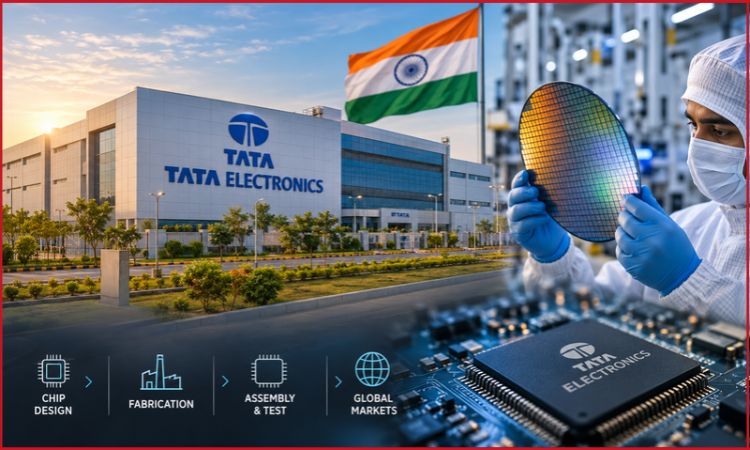
For most of the last two decades, India’s electronics story was about assembly, not invention. Tata Electronics is one of the clearest signs that this pattern is breaking. Set up in 2020 as a Tata Group company, Tata Electronics has moved past its original manufacturing mandate and now touches chip design, fabrication and testing too. This piece covers the Tata Electronics business model, the Tata Electronics products coming out of its plants, and why its semiconductor push matters so much for Tata Electronics India.
Quick Glance
| Parameter | Detail |
| Parent company | Tata Sons |
| Founded | 2020 |
| Business segments | EMS, Semiconductor Assembly & Test, Semiconductor Foundry, Design Services |
| Employees | 75,000+ |
| Key states | Gujarat, Assam, Tamil Nadu, Karnataka |
| Dholera fab investment (original estimate) | Up to ₹91,000 crore (~$11 billion) |
| Dholera fab planned capacity | Up to 50,000 wafers/month |
| Dholera fab process nodes | 28nm to 110nm |
| Assam OSAT investment | ₹27,000 crore |
| Fab technology partner | PSMC (Taiwan) |
| Equipment partner (2026 MoU) | ASML |
What Is Tata Electronics?
Tata Electronics Private Limited is a wholly owned subsidiary of Tata Sons, carved out in 2020 young by Tata Group standards. Its mandate was narrow and sharp: build real capability in electronics manufacturing and semiconductors, fast enough to matter globally. Four business lines make up the current Tata Electronics business model:
- Electronics Manufacturing Services
- Semiconductor Assembly and Test
- Semiconductor Foundry
- Semiconductor Design Services
According to Tata Group, Tata Electronics now employs more than 75,000 people across Gujarat, Assam, Tamil Nadu and Karnataka. The ambition doesn’t stop at India’s borders Tata Electronics wants to offer end-to-end manufacturing solutions worldwide. That’s the Tata Electronics business model in one line: build Tata Electronics India capacity at home, sell globally.
The Tata Electronics Business Model in Practice
Electronics Manufacturing Services (EMS)
The EMS arm is the oldest, most established part of Tata Electronics manufacturing, covering everything from high-precision components to premium personal electronic devices for global brands that would rather outsource production than run their own factories. Two acquisitions expanded this fast: in 2024, Tata Electronics bought Wistron’s India operations and rebranded them Tata Electronics Systems Solutions (TESS); in 2025, it took a majority stake in Pegatron Technology India, folding that capacity into its EMS division and scaling up Tata Electronics manufacturing without building every line from scratch.
Semiconductor Assembly and Test (OSAT)
Fabricating a wafer is only half the job chips still need cutting, packaging and testing before they fit a phone, a car or a data centre. This OSAT stage is where Tata Electronics is building a large facility at Jagiroad, Assam, approved in 2024 with a ₹27,000 crore outlay. The plant will focus on Wire Bond, Flip Chip and Integrated Systems Packaging, serving chips for automotive systems, mobile devices, AI hardware and consumer electronics.
Tata Electronics Semiconductor Business
The Tata Electronics semiconductor business draws the most attention, and for good reason India has long imported most of the chips it consumes, and building fabrication capacity at home touches design, materials, equipment, packaging and testing all at once. Tata Electronics is building across nearly that whole chain: chip design, wafer fabrication, assembly, packaging, testing. The centrepiece is the Tata semiconductor plant taking shape in Gujarat.
The Dholera Semiconductor Plant
Tata Electronics is developing this Tata semiconductor plant at Dholera with Powerchip Semiconductor Manufacturing Corporation (PSMC) of Taiwan a 300mm wafer facility for analog and logic chips on 28nm to 110nm nodes, with planned capacity of up to 50,000 wafers a month. The original investment estimate was up to ₹91,000 crore (~$11 billion), among the largest manufacturing commitments India has seen. Chips from this Tata semiconductor plant are meant for automotive, computing, wireless communication and AI-related markets.
Key Semiconductor Applications
| Application | Potential Use |
| Power Management ICs | Power control in electronic devices |
| Microcontrollers | Automotive and embedded electronics |
| Display Drivers | Smartphones, displays and other screens |
| High-performance computing logic | Computing and data-intensive applications |
Why 28nm to 110nm Nodes Matter
Tata Electronics isn’t chasing the smallest, most cutting-edge nodes. It’s targeting 28nm to 110nm technologies that remain the backbone of automotive electronics, industrial systems, power management, microcontrollers and communications gear. For a country still building its semiconductor base, mature nodes create room for a wider ecosystem packaging houses, materials suppliers, equipment makers and chip designers around Tata Electronics India rather than one narrow, hyper-advanced slice of the market.
Tata Electronics Manufacturing Locations
Tata Electronics manufacturing spans four key sites. Hosur, Tamil Nadu was an early base, built in 11 months and operational for EMS in 2021. Vemgal, Karnataka houses semiconductor assembly work, with design on the first commercial Assembly and Test facility beginning in 2023 and products already shipped using in-house packaging technology. Dholera, Gujarat is home to the flagship Tata semiconductor plant, an AI-enabled 300mm fab built with PSMC. Jagiroad, Assam rounds out the map with the large OSAT project, complementing rather than competing with the Gujarat fabrication work.
Tata Electronics Products and Solutions
Unlike Tata Motors or Titan, Tata Electronics is not a consumer-facing brand it operates largely as a B2B manufacturer, supplying components and finished electronics to other companies. Its range of Tata Electronics products can include electronic components, precision components, custom electronic devices, semiconductor packages, tested semiconductor products, integrated circuits, power management ICs, microcontrollers, display drivers and high-performance computing logic, depending on the customer, platform and facility involved. Tata Electronics products sit inside other companies’ devices part of the manufacturing infrastructure behind electronics, not a rival consumer brand.
Semiconductor Design Services
Manufacturing chips is only one piece of the puzzle. Tata Electronics also runs a Design Services business helping customers create customised chips and migrate designs onto newer process technologies entering the relationship earlier, at the design stage. Partnerships with firms such as Synopsys and institutions such as C-DAC tie Tata Electronics into India’s broader chip-design ecosystem rather than leaving it solely a manufacturing partner.
Global Partnerships Behind the Tata Semiconductor Plant
No fab gets built alone. Semiconductor manufacturing needs specialised equipment, materials, talent and design tools that no single company supplies by itself, so Tata Electronics has leaned on global partners. The most notable is ASML: in May 2026, Tata Electronics and ASML signed an MoU to support the Dholera fab, covering lithography tools, talent development, supply-chain resilience and research infrastructure. Beyond ASML, partnerships across design, equipment, packaging and materials back the Tata semiconductor plant and its wider supply chain.
Why Tata Electronics Matters for India
India has long imported most of its advanced electronic components and semiconductors, so building that capacity at home means more supply-chain resilience and a domestic base of engineers and suppliers. Tata Electronics India sits at the centre of that shift, backed by the government’s semiconductor programme in April 2026, the Government of India notified a special economic zone for Tata Semiconductor Manufacturing Private Limited at Dholera, calling it the country’s first chip fabrication plant.
The Road Ahead
Tata Electronics has moved from a standing start in 2020 into electronics manufacturing, semiconductor assembly, chip design and fabrication within a handful of years. The real test is turning that investment into large-scale, commercially competitive production yields have to hold up, talent has to be trained, suppliers have to deliver. Partnerships announced through 2026 in materials, packaging, equipment, design and talent suggest the Tata Electronics semiconductor business understands that expanding Tata Electronics manufacturing capacity is only half the job; building the ecosystem around it is the other half.
Conclusion
Tata Electronics has grown from an electronics contract manufacturer into an integrated semiconductor business, spanning design, fabrication, assembly and testing within a few years. The Dholera fab and the Assam OSAT facility push Tata Electronics deeper into the semiconductor value chain than any other Tata Group business has gone.
Whether that becomes commercially sustainable manufacturing at scale depends on execution yields, talent, and a growing ecosystem of suppliers. For India’s chip ambitions, Tata Electronics is currently one of the clearest bets on the table.
Frequently Asked Questions
What does Tata Electronics do?
Tata Electronics operates across electronics manufacturing services, semiconductor assembly and test, semiconductor foundry, and chip design services, working mainly as a B2B manufacturer for global technology customers.
Is Tata Electronics a consumer brand?
No. Tata Electronics products are largely used inside other companies’ devices rather than sold directly to consumers under the Tata Electronics name.
Where is the Tata semiconductor plant located?
The flagship Tata semiconductor plant is being built at Dholera, Gujarat, with PSMC of Taiwan, alongside a semiconductor assembly and test facility at Jagiroad, Assam.
What process nodes will the Dholera fab use?
The plant is designed for analog and logic chips on 28nm to 110nm process nodes, with planned capacity of up to 50,000 wafers per month.
How many people does Tata Electronics employ?
According to Tata Group, Tata Electronics India employs more than 75,000 people across facilities in Gujarat, Assam, Tamil Nadu and Karnataka.
Why is Tata Electronics important for India’s manufacturing sector?
It represents one of the largest Tata Electronics India investments to date, reducing reliance on imports and creating demand for engineers, suppliers and equipment makers across the ecosystem.