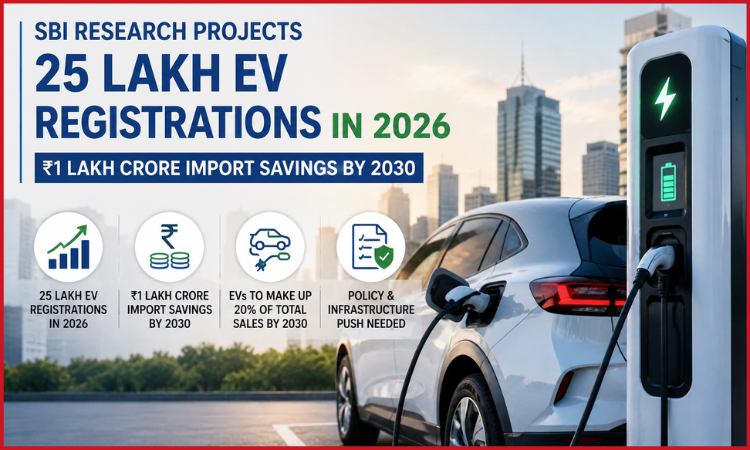
India’s electric vehicle registrations are set to cross 25 lakh in calendar year 2026, driven by a surge in adoption following the escalation of the West Asia crisis, according to a report released by SBI Research on Thursday.
The bank’s economic research wing projected that EVs could account for 20% of total vehicle registrations by 2030, up from under 10% currently, a shift that could save the country Rs 1 lakh crore in import bills.
The report, titled “The story of India’s declining oil intensity,” said EV registrations averaged 2.3 lakh a month between March and June 2026, a jump of nearly 1 lakh over the 2025 monthly average of 1.3 lakh. SBI Research attributed the acceleration directly to the West Asia conflict, which began in February 2026 and pushed fuel prices higher, prompting buyers across passenger vehicles, two-wheelers and three-wheelers to shift toward electric options.
Oil intensity has halved over the past decade
The report’s central finding is that India’s oil consumption as a share of GDP has declined from 1.4% in FY14 to 0.7% in FY26, while crude oil imports to GDP fell from a peak of 8.6% in Q2FY14 to 3.1% in Q2FY26. A Bai-Perron structural break test conducted by the researchers identified a statistically significant break in March 2026, which the report said “coincides with the March 2026 escalation of the West Asia crisis,” pointing to how geopolitical shocks are reshaping India’s energy consumption patterns.
SBI Research listed multiple structural factors behind the decline, including the replacement of diesel irrigation pumps with solar-powered alternatives in agriculture, expansion of India’s metro network from 248 km in 2014 to 1,143 km across 29 cities, and renewable energy now accounting for 40% of the country’s installed power generation capacity.
Infrastructure gaps persist despite momentum
Despite the registration surge, the report flagged that India’s charging infrastructure remains a bottleneck, with only 30% of the country’s 29,151 charging stations classified as fast chargers. States such as Odisha carry a burden of up to 243 EVs per charging station, compared with roughly 20 in Telangana. The report also noted that battery-operated vehicle registrations have fallen from 15.8 lakh in 2023 to 7.9 lakh in 2025, even as pure EV adoption climbs, and that India continues to lag in electric truck sales despite the PM E-DRIVE Scheme’s subsidies of up to Rs 9.6 lakh per vehicle.
Policy roadmap recommended
To sustain the momentum, SBI Research recommended a 10 to 15-year EV policy framework with clear targets across vehicle segments, charging infrastructure and battery manufacturing. Other suggestions included a government-backed EV Credit Guarantee Fund, viability gap funding for public charging stations, and classifying EV financing under Priority Sector Lending. The report cited Delhi’s new EV policy, which offers cumulative incentives of up to Rs 1.2 lakh for three-wheelers and full road tax waivers, as a potential model for other states.