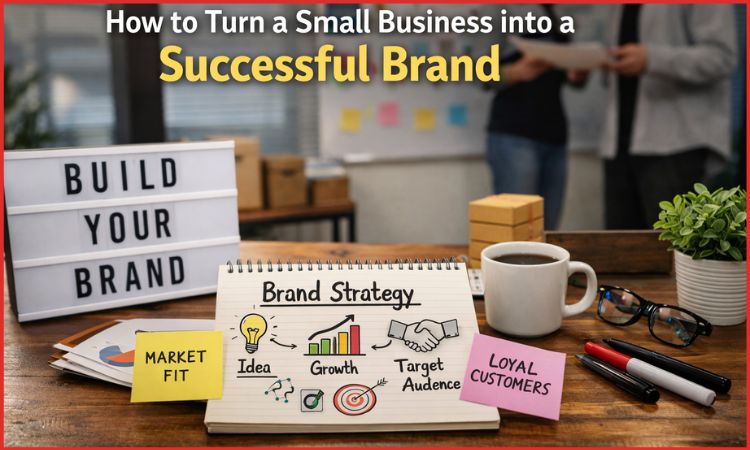
Walk into any business school classroom, and someone will eventually say it: products can be copied, prices can be undercut, but a real brand is almost impossible to replicate. That’s not just textbook wisdom — it’s the only durable protection a small business actually has.
The proof is everywhere around us. Two founders pooled ₹30 lakh in savings in 2016, started with a single Apple charging cable on Amazon, and named their company boAt. Less than a decade later, boAt commands over 29% of India’s wearable market. Or look at Raymond — a small woollen mill started in Thane in 1925 that became so embedded in Indian culture that millions associate it with weddings, with fathers, with what it means to be a good man.
There’s a logic to how a small business becomes something like that. This article unpacks it — step by step.
1. Understand What a Brand Actually Is
Most people confuse a brand with a logo or a tagline. It’s neither. A brand is what lives in the customer’s mind — the feeling, the memory, the expectation they carry about you before and after every transaction.
Economically, this matters because of one thing: differentiation. When your product feels the same as your competitor’s, the only fight left is on price. And that’s a race nobody wins comfortably. Brands escape this trap. They compete on trust, on feeling, on meaning — things that are extremely hard to copy.
India’s government has taken this seriously too. As of January 2025, the Startup India initiative under DPIIT had recognised over 1.59 lakh startups, generating 17.2 lakh direct jobs. DPIIT recognition itself brings real benefits for qualifying businesses: a three-year income tax holiday under Section 80-IAC, an 80% rebate on patent filing fees, angel tax exemption, and access to the ₹10,000 crore Fund of Funds.
2. Product–Market Fit Always Comes First
No logo, no influencer, and no brand strategy will save a product that people don’t genuinely want. Before you think about branding, you need to confirm that real customers will pay for what you make.
Y Combinator’s Startup School — the programme that shaped Airbnb, Stripe, and DoorDash in their early days — is unambiguous on this point. Find a hidden need. Build a basic version. Test it with real people. Watch what breaks. Fix it. Repeat. As YC’s Managing Director, Michael Seibel has put it: scale before you’ve actually served your customers’ needs, and you’ll reach your failure faster.
The boAt Proof
Aman Gupta had a specific advantage when he co-founded boAt. He had spent years at JBL as India Sales Director. He had seen the gap clearly: Indian consumers were stuck choosing between expensive international brands and low-quality Chinese imports, with nothing credible in between. So they started with a durable Apple charging cable, sold directly on Amazon. Their first Facebook ad showed a broken cable with the line: ‘tired of buying Apple charging cables, switch to boAt.’ Revenue went entirely back into the business. No mood boards, no brand vision decks — just confirmed demand and reinvestment.
3. Position Sharply — or Prepare to Be Ignored
Once you know people want what you make, the real branding work begins. Positioning means deciding, deliberately, what you want to mean in the customer’s mind — and to whom. Vague positioning is almost as bad as none. ‘Great products at good prices’ is not a brand position. It’s something every business says about itself.
Raymond’s Hundred-Year Bet on One Idea
In its early decades, Raymond was a respected fabric manufacturer but not emotionally resonant for most Indian families. That changed in the 1980s with ‘The Complete Man’ campaign — one of the longest-running brand campaigns in Indian advertising history. While most menswear advertising showed men as commanding and career-driven, Raymond’s ads portrayed them as loving fathers, present husbands, caring sons. That single emotional shift — held consistently for over three decades — built a brand valued at over ₹7,000 crore with 1,500+ stores across 600 cities.
Raymond didn’t sell suits. They sold the promise of becoming complete — and held that promise for a hundred years.
4. Build a Community, Not Just a Customer Base
The old marketing model was broadcast: make something, advertise it loudly, and buyers arrive. That still works, but it’s expensive. What works better — and boAt’s journey proves this clearly — is community. When buyers start to identify with each other through a shared brand, loyalty deepens, acquisition costs fall, and users create content that functions as free advertising.
boAt made this concrete by naming their customers: boAtheads. Their influencer strategy was equally deliberate — not chasing the biggest follower counts, but picking creators with genuine connections to the audience they wanted: college musicians, fitness creators, young artists. By 2018, boAt was the top-ranked audio accessories brand on Amazon India. That wasn’t luck. It was community before scale.
5. Your Price Tag Is a Brand Statement
Pricing is one of the most underestimated brand decisions a founder makes. Most small businesses treat it as a cost-plus calculation. But price also works as a quality signal. In markets where buyers can’t evaluate quality before purchase, they use price as a proxy.
Aman Gupta described boAt’s approach plainly: ‘We are like the Zara of electronics — not highly-priced like luxury brands, not cheap like Chinese products.’ That one sentence contains an entire strategy. Their Airdopes 141, priced under ₹1,500, became the highest-selling true wireless product on Amazon India during the Republic Day Sale in 2025, with 2.1 lakh units sold in three days. That result didn’t happen despite the pricing. It happened because of it.
6. Expand Without Losing Yourself
At some point, every growing brand asks: what else can we do? The risk is that expansion dilutes the identity that made you matter. The principle here is simple — every new product or category should feel like it could only have come from your brand, given what your brand stands for.
Raymond managed this across a century. Park Avenue for office wear. ColorPlus for weekends. Parx for younger buyers. Ethnix for traditional occasions. Raymond Realty is leveraging a century of trust for residential development. Each extension served the same core customer. boAt followed similar logic: cables to earphones to headphones to smartwatches to gaming accessories, each step serving the same young, tech-comfortable Indian buyer. FY2023 operating revenue reached ₹3,376.7 crore — up 18% year-on-year.
7. Measure Brand Health, Not Just Revenue
Brand-building can feel abstract because it accumulates slowly and isn’t always visible month-to-month. The most useful single metric is Net Promoter Score (NPS): Would you recommend this brand to a friend? YC’s Startup School identifies NPS and returning usage rates as the clearest early signals of brand trust — because a genuinely loyal customer is worth many times what a one-off transaction buyer is worth.
Beyond NPS, brand leaders track share of voice, organic search growth, and customer lifetime value. These numbers tell you whether you are building something or just selling something.
The Bottom Line
Turning a small business into a successful brand is a series of deliberate choices held together long enough that customers eventually choose for you. boAt chose to serve a specific Indian consumer that nobody else was taking seriously. Raymond chose an emotional truth about Indian identity and held it for a century. Both of those are repeatable decisions, not strokes of luck.
India now has the third-largest startup ecosystem in the world, with over 1.59 lakh DPIIT-recognised startups and government infrastructure that simply didn’t exist a decade ago. The businesses that become brands are the ones that decide early — and seriously — that they’re in the business of standing for something. That decision, more than capital or timing, is what separates the vendors from the institutions.
Frequently Asked Questions
Q1. How long does brand-building actually take?
Expect three to seven years of consistent effort before meaningful recognition kicks in — and that’s a reasonable estimate, not a guarantee. boAt reached category dominance in roughly five years. Raymond built a national institution over the decades. The variable that matters most isn’t time but consistency of positioning across that time.
Q2. What’s the most cost-effective brand-building approach for small budgets?
Content marketing tied to community-building tends to give the best return. Focus on specific, long-tail search terms — ‘how to build a lifestyle brand in India’ or ‘affordable brand strategy for small businesses’ — to attract high-intent audiences at a fraction of paid advertising costs. Micro-influencer partnerships, where the creator genuinely uses and believes in the product, consistently outperform expensive celebrity campaigns at the early stage.
Q3. Should a small business pursue DPIIT recognition under Startup India?
If your business qualifies — incorporated in India, under ten years old, turnover below ₹100 crore, working on something innovative or scalable — yes. The direct benefits are substantial: three-year income tax exemption, 80% reduction in patent filing fees, angel tax exemption, and access to the ₹945 crore Startup India Seed Fund Scheme. The application is free, processed through nsws.gov.in, and DPIIT recognition also signals credibility to investors and partners.
Q4. How do I find the right brand positioning?
Ask three things: what exact problem do you solve better than anyone else? For which specific type of customer? And what does solving that problem mean to them emotionally — not just functionally? Most founders answer the first question well and skip the other two. Customer conversations — real ones, not surveys — usually surface the language that becomes a genuine brand position.