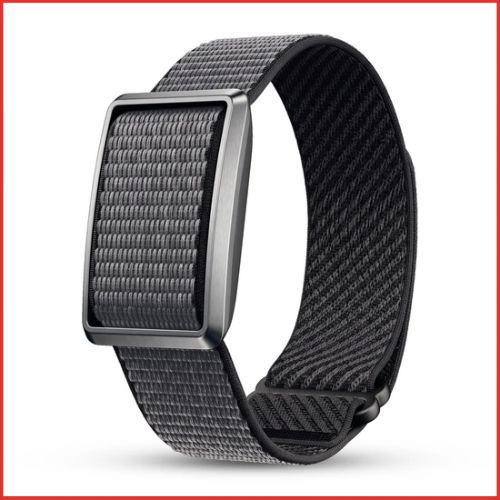
Google has officially launched the Fitbit Air, a display-free fitness band that prioritises passive health tracking over flashy notifications — and it starts at just $99.99.
Google made a bold move in the wearables market on May 7, 2026, unveiling Google’s Fitbit Air — its smallest and most affordable fitness tracker to date. With no screen, no buzzing alerts, and a design barely noticeable on the wrist, the device marks a clear strategic shift for the company, moving closer to the subscription-based recovery tracker model popularised by brands like WHOOP.
A Device Built to Disappear on Your Wrist
The defining feature of Google’s Fitbit Air is what it lacks: a display. The device is built around a pill-shaped plastic pebble that can be detached from its band mechanism, weighing just 12 grams with the strap and a featherlight 5 grams on its own. Google designed the device to target users who find existing wearables too bulky, complicated, or expensive, describing the Fitbit Air as “simple, affordable and comfortable enough to wear 24/7.”
Compared to its Fitbit siblings, the Air is noticeably more compact — 25% smaller than the Fitbit Luxe and 50% smaller than the Inspire 3. The screenless design, Google says, is intentionally built to let users “live in the moment” rather than constantly glance at their wrist.
What It Tracks — And How
Despite its minimal build, Google’s Fitbit Air packs a full suite of health sensors under the hood. It features an optical heart rate sensor for around-the-clock monitoring, along with red and infrared sensors for SpO2 blood-oxygen tracking. Additional capabilities include heart rhythm monitoring with atrial fibrillation (AFib) alerts, resting heart rate, heart rate variability, sleep stages and duration, steps, estimated calorie burn, and skin temperature.
The tracker stores up to seven days of minute-by-minute movement data and one day of workout data locally before syncing everything to the companion app over Bluetooth. It also automatically detects workouts without requiring the user to manually start a session.
The device is water-resistant up to 50 metres, making it suitable for swimming and intense workouts alike.
Battery Life That Keeps Up
One of the Fitbit Air’s most practical advantages is its endurance. Battery life stretches up to seven days, and the fast-charging system can replenish enough power for a full day of use in just five minutes. For users who wear their tracker overnight for sleep tracking, this kind of charging speed removes a major friction point.
The Software Side: Google Health and Gemini AI
All health data from Google’s Fitbit Air is routed through the Google Health app — a rebranded version of the Fitbit app that Google also officially unveiled alongside the hardware. The app delivers personalised fitness insights, sleep analysis, and wellness summaries based on continuously tracked data.
Google also announced the availability of Google Health Coach, a Gemini-powered AI assistant that functions as an all-in-one fitness trainer, sleep coach, and wellness advisor for Google Health Premium subscribers. The AI coach can help build custom workout plans based on individual goals and available equipment, and analyse sleep patterns over time.
Pre-orders are now live at $99.99, and the purchase includes a three-month trial of Google Health Premium.
Band Options and iPhone Support
The Fitbit Air launches with three band styles: a breathable “Performance Loop Band” made from recycled materials, a waterproof “Active Band,” and a sleek “Elevated Modern” option for more discreet everyday wear. Notably, the device also supports iPhones, broadening its appeal beyond the Android ecosystem.
The Bigger Picture
With Google’s Fitbit Air, the tech giant is making a calculated bet on the growing “quiet wearables” category — devices that track health continuously without demanding the user’s constant attention. At $99.99 with no mandatory subscription, it positions itself as an accessible entry point into serious health monitoring, and a direct answer to the premium-priced, subscription-heavy competitors currently dominating the space.