How did Brazil do it?
After the 1973 oil crisis, Brazil — heavily dependent on imported crude — launched Proálcool in 1975, a nationwide government programme to replace fossil fuel with ethanol produced from sugarcane. It came with mandatory targets for car manufacturers, loans for sugarcane farmers and distillers, and tax breaks for buyers. By 1985, over 95% of new cars in the country ran exclusively on ethanol.
Then oil prices fell, ethanol supply wobbled, and consumers walked away. Between 1996 and 2002, ethanol-only car production collapsed to practically zero. The fix came in 2003: Volkswagen launched the Gol 1.6 Total Flex, the first mass-produced car capable of running on petrol, ethanol, or any mixture of the two. By 2005 — just two years later — flex-fuel technology was present in 80% of light vehicles sold in Brazil.
The lesson was simple. Asking consumers to commit to one fuel is a gamble. Giving them a car that accepts any blend removes the risk entirely.
India is now attempting the same transition, half a century later, with the same underlying logic.
What just happened in India?
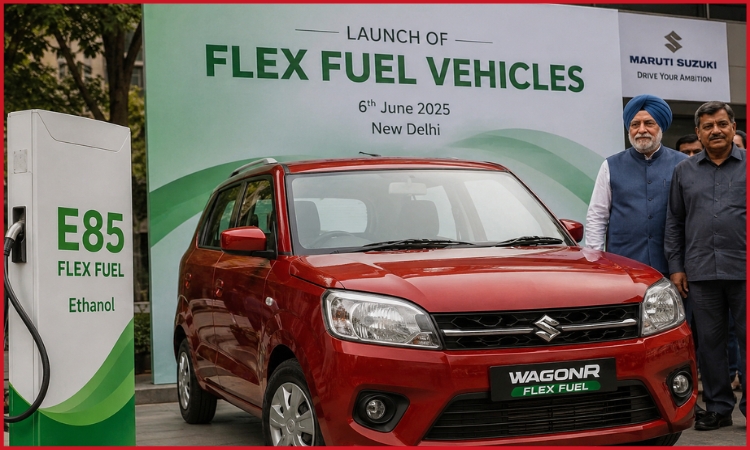
On June 4, Maruti Suzuki unveiled the WagonR Flex Fuel — India’s first mass-market passenger car capable of running on E85, an ethanol-petrol blend containing up to 85% ethanol. Union Ministers Nitin Gadkari and Hardeep Singh Puri were at the launch. Hero MotoCorp launched flex-fuel versions of the Splendor+ and HF Deluxe at the same event. For context, WagonR is one of India’s most consistently popular hatchbacks.
What is E85, and can your current car use it?
Your petrol today already has some ethanol in it. India completed its nationwide E20 rollout on April 1, 2026 — meaning 20% of what is in your tank is already ethanol. E85 pushes that to 85%.
A flex-fuel vehicle can run on any blend from 0% ethanol to 85% without any hardware change. Your current car almost certainly cannot. Existing vehicles built for E10 or E20 cannot run on E85 — the high alcohol content is corrosive to standard seals, hoses, and fuel systems.
Will it actually save you money?
That depends on a number that the government has not yet announced. Minister Puri said E85 will be priced significantly below conventional petrol. “Consumer economics is the most important factor,” he said. Government studies suggest consumers can recover the cost of a flex-fuel vehicle in about three years — but only if E85 is priced appropriately lower than E20.
The catch: ethanol has lower energy density than petrol, and data suggests a mileage drop of 27% to 30% on high-ethanol blends. Analysts say the price gap needs to be at least 30% for monthly fuel costs to actually come down. A lower sticker price at the pump does not automatically mean a lower fuel bill.
Where will you find E85, and when?
“In the beginning, we will have about 50-100 dispensing station outlets in Delhi-NCR, Mumbai, Pune, and Nagpur corridor. These will expand to 500 by December this year, and approximately, God willing, to 5,000 outlets across major cities by end of next year,” Puri said.
For most of the country, E85 will simply not be available for some time. For now, the WagonR Flex Fuel itself will only be sold to fleet operators and aggregators like Ola and Uber. Retail buyers cannot walk into a showroom and buy one yet.
What is the government’s larger goal?
India currently imports nearly 89% of its crude oil requirements. Ethanol is made domestically — from sugarcane and maize — which means every litre of E85 burned is a litre of imported crude not purchased. Ethanol blending has already risen from under 1.5% in 2013-14 to 20% in 2025-26, five years ahead of schedule. E85 is the next push on that same curve.