Running social media management for multiple clients sounds straightforward until you are actually doing it. One account gets flagged. Another triggers a verification loop. A third simply stops reaching its audience after a team member logged in from a different location. These are not edge cases: they are the routine friction of agencies and freelancers doing this work seriously.
The core problem is not the content or the strategy. It is the infrastructure. Platforms have become increasingly precise about how they read device behavior, location consistency, and session patterns. When multiple client accounts share the same device or network environment, those signals bleed into each other, and the platform draws conclusions that nobody intended.
This is what makes the cloud phone such a meaningful shift for professional social media teams. It is not just a technical upgrade. It is a way of rethinking how accounts are structured and maintained over time.
The real problem with managing multiple client accounts
Most social media management problems that look like strategy issues are actually environment issues. When a post underperforms or an account loses trust with a platform, the first question is usually about the content. But the actual cause is often far more mundane: two accounts were accessed from the same phone, a proxy changed unexpectedly, or a session was interrupted and resumed from a different device.
Platforms do not evaluate accounts in isolation. They build a picture over time based on how a device behaves, how consistent the access patterns are, and whether the signals match what a genuine user would produce. When something breaks that pattern, the account gets scrutinized. Not always visibly, but the effects show up in reach, in verification requests, and in gradual restrictions.
For agencies handling ten, twenty, or fifty client accounts, this is a structural challenge. The tools that made sense for managing a single brand do not scale without risk. And the cost of getting it wrong is paid by the client.
What is a cloud phone for social media marketing
A cloud phone for social media marketing is a real Android device running in the cloud. This distinction matters: it is not a simulator or an emulator. It has genuine hardware identifiers, a persistent operating system, and behavior that platforms read as a normal physical phone.
Each cloud phone operates independently. It has its own device identity, its own installed apps, its own session history. When you log into an Instagram or TikTok account on one of these devices, the platform sees a consistent, stable phone being used from a specific location. The session does not reset between visits. The behavior history builds naturally over time.
For social media management teams, instead of managing accounts through browser tabs or shared devices, each client account lives inside its own self-contained device. One account, one phone, one clean identity. There is no bleed between clients, no shared signals, no inherited risk.
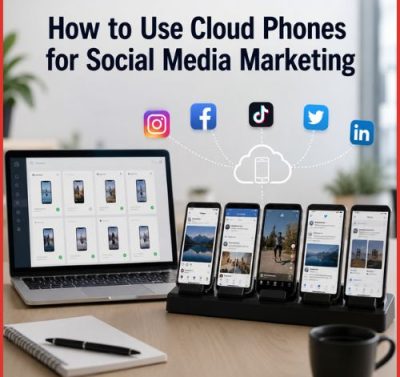
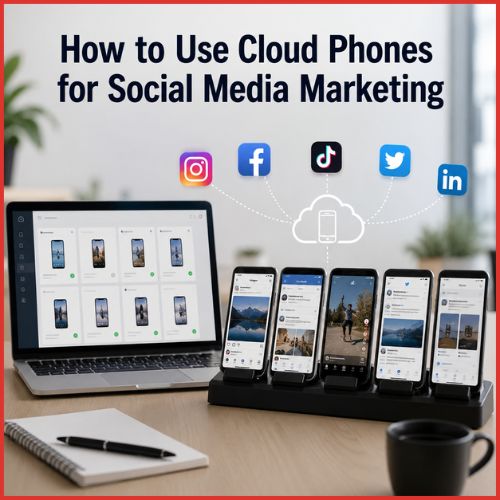
This is the foundation of a properly isolated cloud phone system: each unit behaves independently, while the team controls everything from a single dashboard.
How to structure client account management with Cloud Phones
Assign one cloud phone per client or per account
The principle is simple: isolation. Every client account gets its own device environment. This means separate app data, separate login history, and separate location and connection settings. Nothing shared. This is not just a best practice for mobile marketing at scale. It is the baseline for operating without constant operational fires.
Keep the location consistent
Platforms pay close attention to where an account is accessed from. If a client account is managed by a team spread across different cities or countries, using consistent geolocation settings on each cloud phone removes that variability. The device appears to operate from one stable location, session after session, which matches the behavior of a genuine local user.
Use the device the way the platform expects
One of the limitations of managing accounts through web browsers is that many features, formats, and ad interactions are only available inside the native app. A cloud phone runs the full Android app experience. Reels, Stories, TikTok native formats, and other mobile-only behaviors are all accessible as they would be on a physical device, without compromise.
Build a stable session history
New accounts and recently recovered accounts need time to establish trust. A cloud phone supports this because sessions persist. When a team member works on an account, logs out, and comes back the next day, the platform sees continuity: the same device, the same patterns, the same location. This kind of consistency builds account health gradually but reliably.
Collaborate without creating cross-account risk
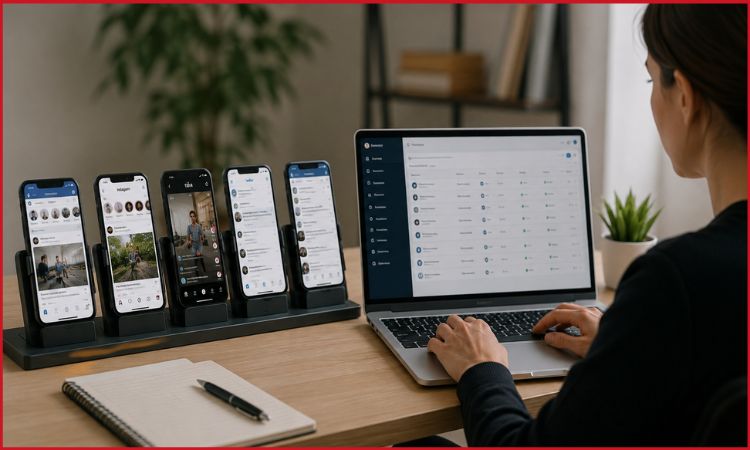
In most agency setups, multiple people need access to multiple client accounts. When this happens on shared devices, the account signals are contaminated by the team’s collective activity. With a cloud phone system, team members access individual cloud phones remotely from their own computers. The phone stays consistent; only the operator changes. Platforms see the device, not the individual, and the device is always stable.
Why Multilogin’s Cloud Phones are the right infrastructure
There are several options in the market for managing accounts in isolated environments, but most of them require assembling pieces that were not designed to work together: a separate anti-detect browser, a proxy service, an automation layer, a team management tool. Each connection is a potential point of failure. Each dependency adds complexity.
Multilogin’s Cloud Phone was built as a complete cloud phone system for professional social media management operations. The infrastructure is unified, which means teams are not piecing together external tools. Everything lives in one place, managed from a single dashboard, designed to work together.
Key features for client account management
- Real Android Cloud Phones with more than 30 device model options, including Samsung, Xiaomi, OPPO, Vivo and Motorola.
- Strict account isolation — one cloud phone per account or client, with no shared cache, app data, or system signals.
- Built-in residential and mobile proxies — connect and manage accounts with consistent location signals from over 150 locations.
- Automation-ready infrastructure — integrations with Selenium, Puppeteer, Playwright, Postman, and the Multilogin API without disrupting mobile identity.
- Team collaboration with role management — assign roles and securely share cloud phones across team members, with unlimited seats on Business plans.
- Mobile and browser profiles in one ecosystem — manage Android cloud phones and web workflows from the same interface.
The result is a setup designed for teams that manage multiple social media accounts as their core work. The operational overhead that typically comes with scale — fixing blocks, managing verifications, rebuilding trust after account flags — decreases significantly when the environment is properly isolated from the start.
Try Multilogin for just €1.99 and use the platform for 3 days.
Final thoughts
Social media management has become a technical discipline as much as a creative one. The platforms that teams work with every day evaluate behavior, consistency, and device signals alongside content quality. Ignoring the infrastructure side of this work leads to friction that is hard to diagnose and costly to fix.
A cloud phone for social media marketing changes the operational foundation for agencies handling multiple clients. Each account lives in its own isolated environment, with consistent signals, persistent session history, and no risk of cross-account contamination. Teams can collaborate without creating new vulnerabilities, and the work scales without proportional complexity.
Multilogin built its cloud phone solution for exactly this kind of work. Real Android devices, strict isolation, built-in proxy management, and a unified dashboard give social media teams the infrastructure to operate seriously, not just at launch, but over time as accounts grow and client rosters expand.
For any agency or freelancer managing multiple client accounts today, this is the kind of foundation worth building on.