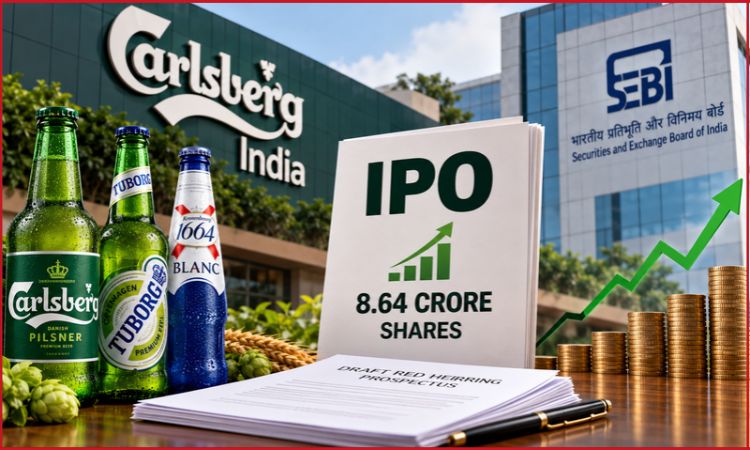
Carlsberg India’s long-discussed stock market debut is beginning to take a more definite shape. The brewer has filed updated IPO documents with the Securities and Exchange Board of India (SEBI), revealing plans for an offer for sale of up to 8.64 crore equity shares.
Carlsberg India won’t issue new shares. The sale proceeds will go to the shareholder selling its stake, not into the brewer’s accounts. That’s a central feature of the Carlsberg India IPO.
A Quiet Filing in July, a Public Prospectus in October
The process started on July 1, when Carlsberg India submitted its initial documents through SEBI’s confidential pre-filing route. Under that arrangement, a company can have its proposal reviewed without immediately putting commercially sensitive details in the public domain.
SEBI gave its approval on October 1. Nearly four weeks later, the company made its updated draft available, providing the first public look at the structure of the offering.
The proposed offer for sale will be conducted by promoter shareholder South Asian Breweries. Because the issue contains no fresh equity component, Carlsberg India will not receive the sale proceeds.
Rather than funding new factories or debt repayment, the transaction allows an existing shareholder to sell part of its holding.
A final valuation cannot be worked out from the share count alone. The offer price is still missing, although previous reports have indicated that the transaction could raise as much as $700 million. That remains a reported possibility, not the confirmed value of the issue.
Profit Has Improved, but Sales Tell a More Complicated Story
The latest annual numbers give prospective investors something more concrete to study.
In the financial year ended March 2026, Carlsberg India revenue slipped 2.2% to ₹8,708.8 crore. Profit moved the other way, rising 22% to ₹534.51 crore.
Lower revenue alongside higher profit is a striking combination, though the figures alone don’t explain what drove the improvement.
The following quarter offered a different picture. For the three months ended June 2026, net revenue increased 21.5% from a year earlier to approximately ₹1,366 crore, according to figures cited in the updated prospectus. Profit fell 3.9% to roughly ₹158 crore.
So there is no single, neat growth story to take away from the numbers. The annual profit increase is encouraging, while the softer quarterly earnings make margins and expenses important areas to examine.
Once listed, those numbers will face scrutiny every quarter, not merely during the IPO.
Tuborg Gives the Indian Business a Familiar Face
Carlsberg does not arrive at the Indian market as an unfamiliar name. Its portfolio includes Tuborg, Carlsberg Elephant and Kronenbourg 1664 Blanc, brands already sold across parts of the country.
The company operates seven breweries of its own and also relies on third-party manufacturers. The updated filing puts its market share at 21.9% across 16 important states and union territories.
That figure applies to the specified markets, not the whole of India. The distinction is worth keeping in mind when considering Carlsberg’s position against other brewers operating across the country.
That regional footprint is significant because beer is not a straightforward nationwide business in India. Each state has its own rules covering alcohol sales, duties and distribution. A company can be well established in one market and face a quite different commercial environment next door.
Manufacturing arrangements matter for the same reason. Having both owned facilities and external production partners gives Carlsberg several ways to supply different regions, although the benefits depend on actual capacity use and operating costs.
For investors comparing Carlsberg India shares with those of listed beverage businesses, brand recognition is only part of the equation. The prospectus also needs to be read for geographic concentration, regulatory exposure and financial performance.
India’s Market Offers Another Route for Global Parents
The planned listing follows a route already taken by other multinational groups. Hyundai Motor and LG Electronics have brought their Indian subsidiaries to the stock market through sales of existing shares.
These deals make it possible for overseas parent groups to unlock part of the value of Indian operations without necessarily asking those businesses to raise new capital.
Carlsberg’s proposal belongs in that wider picture. An Indian listing would give public investors access to an established brewing operation while creating a market for its equity.
It would also put the business alongside listed beverage companies such as United Breweries, United Spirits, Radico Khaitan and Allied Blenders and Distillers. They are not identical businesses, but their valuations and financial results provide points of reference.
Kotak Mahindra Capital Company, Citigroup Global Markets India and JPMorgan India have been appointed as the book-running lead managers. The proposed shares are expected to list on the BSE and NSE.
The Date and Price Are Still Missing
For now, the Carlsberg India stock market listing remains a proposed transaction, not an open offer. Prospective investors still need the price band, bidding window and final issue details before they can judge the terms.
Those announcements will tell the market far more about the valuation being sought. Until then, the updated prospectus provides the clearest available picture: a sizeable share sale by an existing promoter, a well-known beer portfolio and financial results that deserve a careful reading beyond the headline profit growth.