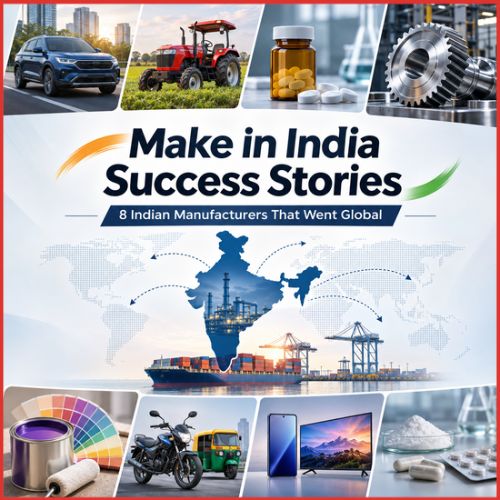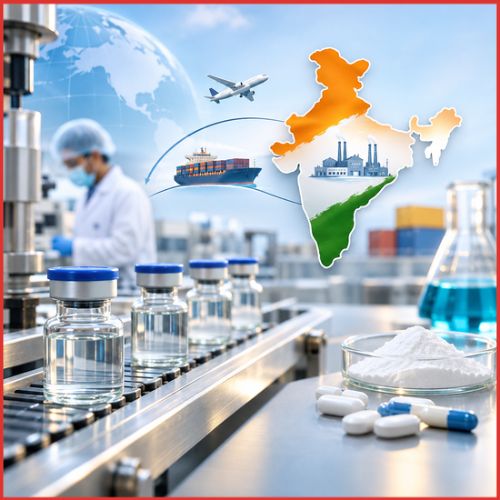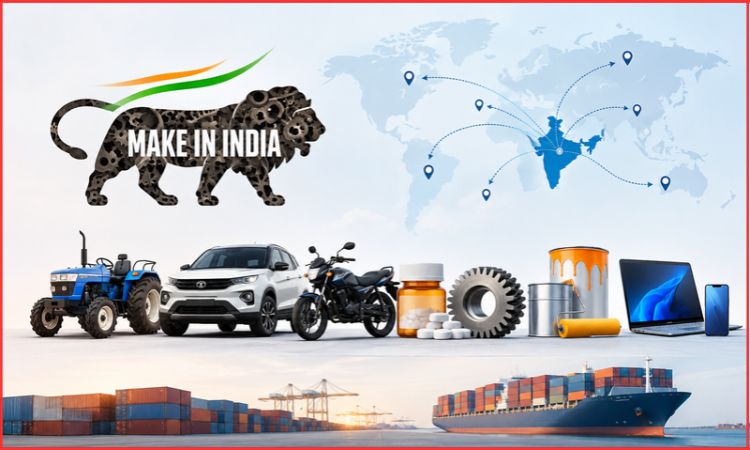
Ten years ago, “Made in India” mostly meant cheap and local. Today it also means a Mahindra tractor working a farm in the United States, a Sun Pharma tablet sold in over 100 countries, and a Bajaj motorcycle on a road in Nigeria. The Make in India success stories of the last decade show how far Indian manufacturers going global have come, and how quickly.
The country’s manufacturing industry has grown in ways that are easy to see in everyday life. Cars, medicines, phones, paint, forged steel parts and home appliances are all produced here, and a growing share of them leaves the country. Many successful Indian manufacturing companies now run plants abroad, buy foreign rivals and supply some of the most demanding customers in the world. These are Made in India global brands, and some of them are names the average buyer in Europe or America never realises are Indian.
The Make in India programme was launched on September 25, 2014. Its goal was to turn the country into a hub for manufacturing, design and innovation, and it leaned on investment, infrastructure, technology and local production to get there. Indian manufacturing industry growth since then has been uneven, but the direction is clear.
The numbers back this up. Government data puts India’s electronics production at roughly ₹1.9 lakh crore in FY2014-15 and ₹13.11 lakh crore in FY2025-26. Electronics exports in FY2025-26 came to about ₹4.24 lakh crore.
But production volume is only half the story. The harder question is whether Indian companies expanding internationally can build brands, plants and supply relationships that last. Here are eight manufacturing success stories in India that suggest they can, and a look at how each one did it.
1. Tata Motors: Indian Automotive Engineering on a Global Stage
Tata Motors, set up in 1945, began as a maker of commercial vehicles for the home market. It is now one of the most recognisable examples of an Indian company expanding internationally. Its range covers passenger cars, trucks, buses, electric vehicles and mobility services, and it sells through exports, overseas operations and partnerships.
The defining move came in 2008, when it bought Jaguar Land Rover. Two British luxury marques ended up under Indian ownership, and the group’s global footprint grew overnight. Since then the company has put money into electric vehicle technology, battery development and cleaner transport.
Global success factor: Tata Motors paired home-grown engineering with ownership of established international brands, which gave it reach that organic growth alone would have taken decades to build.
2. Mahindra & Mahindra: A Tractor Maker That Won Over Farmers Abroad
Mahindra & Mahindra was founded in 1945 and started out in steel trading before moving into vehicles. Over time it added tractors, SUVs, farm machinery and other industrial products, and it became a serious name in agricultural equipment and commercial mobility.
Tractors are the heart of its international story. Mahindra tractors are sold in several countries, including the United States, where the company has built a real presence among farmers. It has also grown its manufacturing and distribution overseas, and acquisitions in tractor and farm machinery have added to that.
What stands out is how closely it studies the buyer. Farming practices, soil and land conditions, and the way equipment is actually used differ from one country to the next, and Mahindra designs for those differences instead of exporting one product everywhere.
Global success factor: Localisation, deep agricultural know-how and patient customer relationships.
3. Sun Pharma: Making Indian Medicines Globally Competitive
Sun Pharmaceutical Industries was founded in 1983 by Dilip Shanghvi. It began as a small operation and is now one of India’s largest drugmakers and a major international supplier of medicines.
The company says it operates in more than 100 countries, runs 40 manufacturing facilities and reports global revenue above $6.5 billion. Its portfolio spans generics, specialty medicines and innovative healthcare products. Growth came from acquisitions, research spending, regulatory compliance and steady investment in plants.
The 2015 acquisition of Ranbaxy Laboratories was a turning point, widening both its portfolio and its global presence. The shift towards specialty medicines matters too, since it gives Sun Pharma room to grow beyond the crowded generics market.
Global success factor: Quality standards, research and well-chosen acquisitions, combined with affordable healthcare.
4. Bharat Forge: Precision Engineering for Global Industry
Bharat Forge, part of the Kalyani Group, was established in 1961. It makes forged and machined components for automotive, aerospace, defence, energy, construction and industrial customers, and it is one of the clearest examples of India’s strength in precision engineering.
The company supplies major international customers and has extended its reach through overseas facilities and acquisitions. Its edge comes from engineering skill, advanced processes and the ability to make complex parts at scale.
It has also moved beyond traditional automotive work into aerospace and defence. That diversification is sensible: the global auto industry is shifting towards electric vehicles, while demand for specialised engineering products keeps changing shape.
Global success factor: Technology investment and diversification helped an Indian manufacturer enter demanding international supply chains.
5. Asian Paints: A Household Brand That Crossed Borders
Asian Paints started in 1942 as a small paint maker and grew into a leader in decorative and industrial paints. It is among the best examples of a consumer manufacturing brand building an international business.
According to its FY2025-26 annual report, the company serves more than 60 countries and operates 25 in-house paint manufacturing facilities worldwide. Its overseas business has been built through acquisitions, local manufacturing, product innovation and strategies tailored to each market, across Asia, the Middle East, Africa and beyond.
Its real strength is reading the local customer. Colour preferences, weather, housing styles and buying habits all change from country to country, and the company adjusts its products and distribution to match. It has since moved into home décor, waterproofing, adhesives and related services.
Global success factor: Manufacturing muscle plus a close understanding of customers, and a willingness to diversify.
6. Bajaj Auto: Indian Two-Wheelers on Roads Around the World
Bajaj Auto, established in 1945, became known for scooters and motorcycles and then built a large export business. Its motorcycles, three-wheelers and mobility products sell especially well in Africa, Latin America and South Asia.
The formula is simple to say and hard to copy: vehicles that are affordable, durable and fuel-efficient. The Pulsar range gave the brand an identity among younger riders, and its three-wheelers became everyday workhorses in several developing economies.
Partnerships helped it climb the ladder. Its association with KTM opened the door to international technology, engineering expertise and premium motorcycle markets, and a controlling stake in KTM’s parent company, completed in 2025, strengthened that position further. The company continues to invest in electric three-wheelers and premium motorcycles.
Global success factor: Affordable engineering, strong distribution and smart partnerships.
7. Dixon Technologies: A Behind-the-Scenes Player in Electronics
Dixon Technologies, established in 1993, is a newer kind of manufacturing success story in India. It is an electronics manufacturing services (EMS) provider, making mobile phones, televisions, lighting products, home appliances and other electronic goods.
Unlike Tata or Bajaj, Dixon mostly works for other brands. They use its factories, engineering and supply-chain know-how instead of building their own. The model has grown with India’s electronics ecosystem, rising domestic demand and government incentives for local production, and Dixon has added partnerships and joint ventures aimed at components and mobile phone manufacturing.
The wider industry shows the scale. Government figures put mobile phone production at roughly ₹6.27 lakh crore in FY2025-26, against around ₹18,000 crore in FY2014-15.
Global success factor: Indian firms can become vital links in global supply chains without owning a consumer brand.
8. Dr. Reddy’s Laboratories: Affordable Medicines, Global Standards
Dr. Reddy’s was founded in 1984 by Dr. Kallam Anji Reddy with a clear aim: develop affordable medicines. It has since built a business in generics, active pharmaceutical ingredients (APIs), biosimilars and other healthcare products.
It sells in the United States, Europe, India and other emerging markets. That reach depends on its manufacturing plants, its research capability and its ability to meet each country’s regulatory rules. The US matters most for Indian generic makers because of its size and its appetite for cheaper alternatives to branded drugs.
The company has kept investing in research, product development and manufacturing quality to hold its ground in tough markets.
Global success factor: Affordable medicines backed by science and strict quality compliance.
What Makes Indian Manufacturers Successful Globally?
The eight companies work in very different industries, yet their stories share a few habits. Anyone studying manufacturing success stories in India will spot the same six themes again and again.
| Growth factor | How it supports global expansion |
|---|---|
| Product innovation | Helps companies build for changing international markets |
| Quality standards | Earns trust from overseas buyers and regulators |
| Technology investment | Improves efficiency and product performance |
| Strategic acquisitions | Opens up foreign markets, brands and capabilities |
| Localisation | Fits products to each country and its customers |
| Supply-chain development | Raises production capacity and speeds up delivery |
Policy has helped too. Production Linked Incentive (PLI) schemes cover 14 sectors, among them electronics, pharmaceuticals, automobiles, solar modules and textiles. The Ministry of Commerce and Industry says these schemes had drawn investments above ₹2.16 lakh crore and supported incremental production and sales worth more than ₹20.41 lakh crore by December 31, 2025.
The aim is to encourage local production, strengthen supply chains, raise competitiveness and bring in investment.
The Role of Make in India in Building a Global Manufacturing Presence
Make in India has pushed domestic manufacturing and attracted foreign investment, but its purpose goes past raising output. It tries to build an ecosystem where companies can make products, improve technology, create jobs and take part in global value chains. That is what gives India’s global manufacturing presence a chance to last.
Five government initiatives carry most of the weight:
- Production Linked Incentive (PLI) scheme: rewards manufacturers for incremental output and sales.
- National Industrial Corridor Development Programme: builds industrial infrastructure and manufacturing hubs with better connectivity.
- Foreign Direct Investment (FDI) reforms: easier rules for global firms that want to set up manufacturing in India.
- PM Gati Shakti: joins up infrastructure planning so factories, ports and markets are better connected.
- National Single Window System: one digital platform for business approvals.
Together, these steps give Indian manufacturers a better shot at competing with established international players.
Challenges Indian Manufacturers Still Face
Progress is real, but India’s manufacturing industry has some distance to go before it becomes a dominant production centre.
- Technology gaps: some sectors still rely on imported machinery, specialised components and advanced technology.
- Infrastructure costs: logistics, transport and industrial infrastructure can eat into competitiveness.
- Skilled workforce: advanced manufacturing needs specialised technical skills and industry-specific training.
- Global competition: Chinese, German, Japanese and South Korean manufacturers are well established.
- International compliance: exporters must meet different quality, environmental and safety rules in every market.
Fixing these will take sustained spending on research, automation, workforce training and domestic component manufacturing.
The Future of Indian Manufacturing
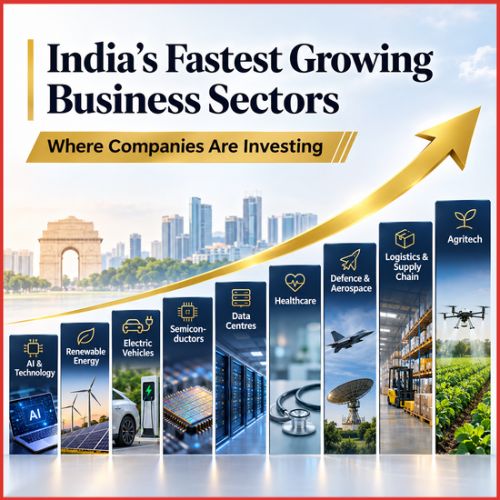
The next phase of Indian manufacturing industry growth depends on moving from sheer volume to high-value work. Electronics, semiconductors, electric vehicles, renewable energy equipment, aerospace, defence and advanced pharmaceuticals look like the biggest openings.
Artificial intelligence, robotics and smart factory systems will also change how Indian plants run. Another opportunity is building home-grown component ecosystems. Assembling a finished product is useful, but making the semiconductors, batteries, precision parts and machinery inside it keeps far more value in the country.
For Indian companies expanding internationally, the long-term bet is to become technology-led businesses rather than compete only on low cost.
Conclusion
Tata Motors, Mahindra, Sun Pharma, Bharat Forge, Asian Paints, Bajaj Auto, Dixon Technologies and Dr. Reddy’s Laboratories took different routes. Some bought foreign brands, some built overseas plants, some grew through exports and research, and one became a quiet link in other companies’ supply chains.
Together they point to a change in India’s industrial identity. The country is turning into a place where products are engineered, made and shipped to the world, and where global partners come to build. The next job is to deepen local value addition, sharpen technology and produce more internationally recognised Indian brands.
In the end, the success of Make in India will be judged less by how much India makes and more by how many of its products, technologies and companies compete worldwide.