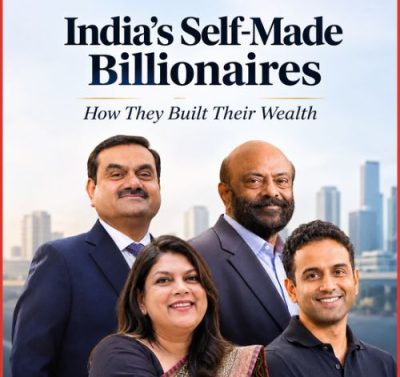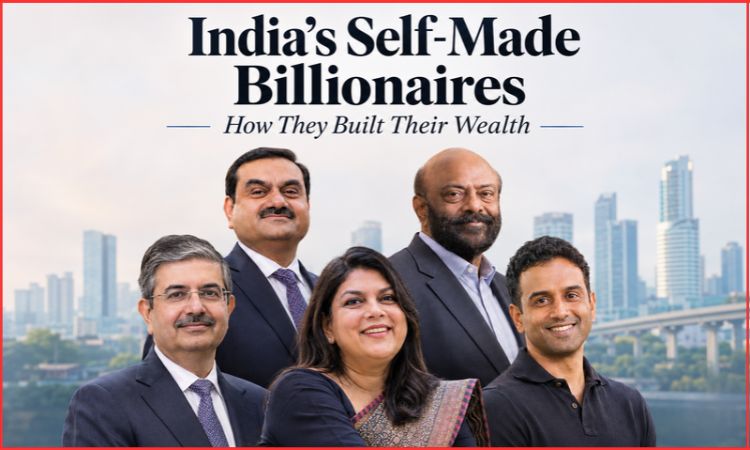
No one wakes up to a billion-dollar company overnight. The richest self-made billionaires in India got where they are through years of risky bets, painful lessons and a knack for spotting openings that everyone else called too small or too early. A few started behind a trading counter. Others began in a corporate job with an idea they couldn’t shake.
The self-made billionaires of India 2026 belong to different generations and different industries, but their stories rhyme. Infrastructure, pharmaceuticals, technology, retail and finance have each produced Indian business tycoons who began with limited resources and ended up reshaping entire markets. Put these Indian billionaire success stories next to one another and a pattern shows up: vision, patience and plain execution.
The data backs this up. As per the M3M Hurun India Rich List 2026, India now has a record 391 dollar billionaires. The list features 1,810 individuals worth at least ₹1,000 crore, of whom 1,266 (70%) are self-made entrepreneurs. Together, they hold roughly ₹187.5 lakh crore. Numbers like these show just how many self-made entrepreneurs in India are building businesses that last.
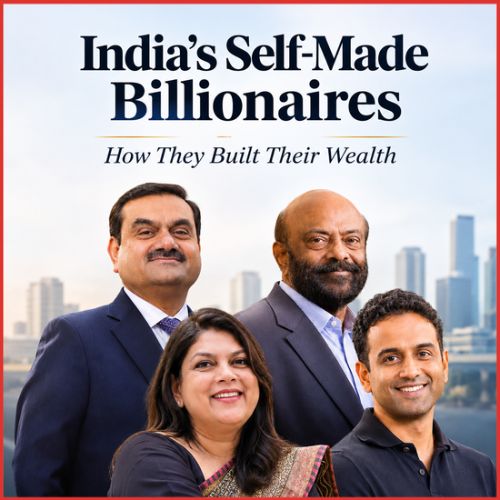
In this guide, we walk through eight prominent Indian business leaders, from Gautam Adani’s infrastructure empire to Radhakishan Damani’s no-frills retail chain. One question runs through all of it: how Indian entrepreneurs built their wealth, and what the rest of us can borrow from their billionaire business journeys.
India’s Self-Made Billionaires in 2026: An Overview
India’s billionaire class is a blend of old-economy builders and new-age technology founders. Most of their fortunes sit inside the companies they own, so net worth rises and falls with company valuations and the stock market. The table below gives a quick snapshot of eight prominent Indian business tycoons whose billionaire business journeys are worth studying closely.
| Entrepreneur | Company/Business | Industry |
|---|---|---|
| Gautam Adani | Adani Group | Infrastructure and Energy |
| Shiv Nadar | HCL Technologies | Information Technology |
| Dilip Shanghvi | Sun Pharmaceutical | Pharmaceuticals |
| Radhakishan Damani | DMart | Retail |
| Uday Kotak | Kotak Mahindra Bank | Banking and Finance |
| Falguni Nayar | Nykaa | Beauty and Retail |
| Vijay Shekhar Sharma | Paytm | Fintech |
| Nithin Kamath | Zerodha | Financial Services |
Note: This is a selection of prominent entrepreneurs, not a definitive ranking of India’s richest people. Net worth and billionaire status can change with market valuations, and some wealth rankings include family holdings.
1. Gautam Adani: Building an Infrastructure Empire
Business: Adani Group
Industry: Infrastructure, Energy, Ports and Logistics
Ask people to name one of the best-known Indian business tycoons and Gautam Adani is usually the first answer. He began in diamond trading and went on to build a sprawling infrastructure conglomerate. It is easily one of the most talked-about Indian billionaire success stories.
In 1988, he set up Adani Exports, a commodity trading business. As the years went by, one thing became clear to him: a growing economy needs ports, power and logistics before almost anything else. That realisation pulled the company towards infrastructure.
The group later stepped into power generation, renewable energy, airports and natural resources, with Mundra Port acting as a turning point in that expansion. The M3M Hurun India Rich List 2026 places Adani and his family at the top, with estimated wealth of ₹9.23 lakh crore, making him a prominent example of how Indian entrepreneurs built their wealth at scale.
How he built his wealth:
- Started in commodity trading before shifting to infrastructure.
- Invested in ports and logistics to support international trade.
- Spread into energy, airports and other infrastructure businesses.
- Backed large projects with long-term capacity expansion.
Business lesson: Spot the infrastructure gap early and invest where the economy has to grow. The payoff is slow, but it is large.
2. Shiv Nadar: Turning Technology into a Billion-Dollar Business
Business: HCL Technologies
Industry: Information Technology
Among self-made entrepreneurs in India’s technology sector, Shiv Nadar is a true pioneer. The country’s IT industry was barely taking shape when he figured out where computing was heading.
In 1976, he co-founded HCL with a group of colleagues. The company started with hardware and computing products, then widened into software services, enterprise technology and digital transformation. Over time, HCL became a major IT services firm with clients across the world.
His approach stayed fairly steady: build technical capability, hire and train strong teams, and look beyond the home market. It is a big reason he features among India’s wealthiest business leaders today.
How he built his wealth:
- Saw the early demand for computing technology.
- Launched HCL while India’s IT sector was still young.
- Moved from hardware into software and IT services.
- Built lasting relationships with global enterprise clients.
Business lesson: Entering an emerging industry early helps, but staying adaptable as technology changes is what keeps a company ahead.
3. Dilip Shanghvi: Building India’s Pharmaceutical Powerhouse
Business: Sun Pharmaceutical Industries
Industry: Pharmaceuticals
Dilip Shanghvi shows how one of India’s prominent self-made billionaires found his opening in an essential industry. He founded Sun Pharmaceutical Industries in 1983 as a modest operation focused on psychiatric medicines. Over the years, the company added many more therapeutic segments.
Pharma is not a forgiving business. It demands steady spending on research, manufacturing, quality standards and distribution. Shanghvi built a strong product portfolio and kept widening the company’s reach.
A big moment came in 2014, when Sun Pharma agreed to acquire Ranbaxy Laboratories, a deal that lifted its standing in the global pharmaceutical market. In the 2026 Hurun ranking, Shanghvi sits among India’s ten wealthiest individuals, and his billionaire business journey remains a favourite case study for founders in healthcare.
How he built his wealth:
- Began with a focused pharmaceutical business.
- Expanded into several therapeutic categories.
- Invested in manufacturing and research.
- Used acquisitions to strengthen the company’s position.
Business lesson: A focused model, steady innovation and well-chosen acquisitions can turn a small enterprise into a global one.
4. Radhakishan Damani: The Retail Strategy Behind DMart
Business: DMart
Industry: Retail
Radhakishan Damani made his fortune by paying attention to something very ordinary: people like to shop affordably. Before retail, he spent years in the stock market, and that experience taught him how to read valuations, allocate capital and think long term.
The first DMart store opened in Powai, Mumbai, in 2002. The pitch was simple: everyday products at competitive prices. Rather than leaning on a premium store experience, DMart built its model around cost efficiency, tight inventory control and value-led pricing.
The chain has since spread across India and is now one of the most recognised names in organised retail. That makes it a textbook answer whenever someone asks how Indian entrepreneurs built their wealth without flashy strategies, and one of the quieter Indian billionaire success stories on this list.
How he built his wealth:
- Learned financial markets and long-term investing first.
- Spotted demand for affordable organised retail.
- Kept operations efficient and prices competitive.
- Grew through a disciplined store network.
Business lesson: You don’t always need a complicated plan. Solving an everyday customer problem well can be a powerful growth engine.
5. Uday Kotak: Creating a Banking Empire
Business: Kotak Mahindra Bank
Industry: Banking and Financial Services
Uday Kotak turned a small financial services start-up into one of India’s best-known private-sector banks. He launched Kotak Capital Management Finance in 1985 with a small initial investment. Early work centred on bill discounting and related services, and later grew to cover investment banking, insurance and other products.
The major milestone arrived in 2003, when Kotak Mahindra Finance received a banking licence and became Kotak Mahindra Bank. That change put the company in the front row of Indian banking.
Among India’s wealthiest business leaders, Kotak is often linked with financial discipline, close customer relationships and a steady widening of services across segments. Of all the self-made entrepreneurs in India on this list, he is probably the one most associated with trust.
How he built his wealth:
- Started with a financial services business.
- Found openings in India’s growing credit market.
- Moved into banking and investment services.
- Built a diversified financial platform.
Business lesson: In finance, trust and discipline matter more than speed. Long-term customer relationships hold the whole structure up.
6. Falguni Nayar: Building a Beauty and Retail Business Through Nykaa
Business: Nykaa
Industry: Beauty, Fashion and E-commerce
Falguni Nayar’s story proves that professional experience can be the foundation of a new business. After years in investment banking, she founded Nykaa in 2012. She had noticed that Indian shoppers had little access to a wide range of authentic beauty and personal care products, and she built a company to fill that gap.
Nykaa began as an online beauty store and later moved into fashion, physical stores and private-label products. It mixed digital convenience with product discovery, brand partnerships and customer engagement.
The 2021 stock market listing was a landmark moment. It made Nayar one of the most visible self-made women entrepreneurs in India, and her billionaire business journey has inspired a new generation of founders.
How she built her wealth:
- Identified an underserved beauty and personal care market.
- Built an online-first retail platform.
- Developed strong relationships with beauty brands.
- Expanded into physical retail and private labels.
Business lesson: Understand how customers behave and earn their trust. A strong brand can win even in a crowded market.
7. Vijay Shekhar Sharma: Making Digital Payments Mainstream
Business: Paytm
Industry: Fintech and Digital Payments
Vijay Shekhar Sharma helped change the way India pays. He founded One97 Communications in 2000, and the company later turned Paytm into a household name in digital payments.
It began with mobile content and services, then moved into recharges, wallets, merchant payments and wider financial services. Demonetisation in 2016 nudged many people towards digital payments and gave platforms like Paytm a big jump in public awareness.
The road hasn’t been smooth, though. Paytm has dealt with business and regulatory challenges, a reminder that fast-moving fintech is as risky as it is rewarding. Few Indian billionaire success stories show both sides as clearly, and few Indian business tycoons have been so openly tested in public.
How he built his wealth:
- Entered mobile and digital services early.
- Expanded into digital wallets and merchant payments.
- Rode the growing shift to cashless transactions.
- Built partnerships across the financial ecosystem.
Business lesson: Timing, technology and a big consumer problem can open huge doors. Lasting growth, however, needs strong governance and financial discipline.
8. Nithin Kamath: Building a Low-Cost Stockbroking Platform
Business: Zerodha
Industry: Financial Technology and Stockbroking
Nithin Kamath built Zerodha on one plain idea: investing in the stock market should be cheaper and easier. He and Nikhil Kamath founded the company in 2010 and introduced a discount broking model that challenged the old brokerage structure.
Zerodha focused on technology-led trading platforms, transparent pricing and investor education. Its rise coincided with a surge in retail participation in India’s markets, especially among younger investors.
Plenty of start-ups depend on outside funding to survive. Zerodha took a different route and became known for running a profitable, capital-efficient business. That is exactly why it stands out among India’s self-made business leaders: it never followed the usual playbook.
How he built his wealth:
- Saw that high brokerage costs were a real problem.
- Introduced a technology-led discount broking model.
- Prioritised customer experience and platform reliability.
- Kept the business focused on profitability.
Business lesson: Aggressive expansion and heavy funding aren’t the only route. A strong product and a sustainable model can be just as powerful.
What Makes India’s Self-Made Billionaires Successful?
The industries differ, but when you study how Indian entrepreneurs built their wealth, the same habits keep turning up.
1. Solving problems nobody had solved: Most of these founders started with a gap. DMart went after affordable retail, Nykaa filled a hole in beauty retail, and Zerodha attacked high brokerage costs. Listening closely to customers gave each company a model that competitors couldn’t copy easily.
2. Thinking long term: A billion-dollar company takes patience, and it often means picking the harder, slower path. Shiv Nadar and Gautam Adani both invested in sectors where capability took years to build, a trait common to many Indian business tycoons.
3. Diversifying with care: Many of India’s wealthiest business leaders grew by moving into related industries once their core business was stable. Adani went from commodity trading into ports, logistics and energy. Sun Pharma built a wider portfolio through organic growth and acquisitions. Diversification opens new revenue streams, but it also brings operational and financial risk.
4. Using technology: From digital payments and online retail to broking and enterprise software, technology has helped self-made entrepreneurs in India cut costs, improve access and reach more customers.
5. Staying financially disciplined: Revenue alone isn’t enough. A growing business needs healthy cash flow, efficient operations and sensible capital allocation. Zerodha’s lean model and DMart’s operational focus show how discipline supports growth over decades, and why so many billionaire business journeys last longer than a single market cycle.
Conclusion
The stories of the self-made billionaires of India 2026 make one thing clear: wealth follows people who find real opportunities, understand their markets and build companies that can scale.
Adani’s infrastructure bets, Shanghvi’s pharmaceutical expansion, Nayar’s digital retail strategy and Kamath’s discount broking model are very different routes to the same destination. Every one of these billionaire business journeys also carries setbacks, and the Paytm story is a good example.
They point to a bigger shift as well. The richest self-made billionaires in India no longer come only from manufacturing or old business families. Technology, financial services, consumer brands and healthcare are opening doors for a new group of self-made entrepreneurs in India.
For anyone dreaming of building a business, the takeaway is practical. Solve a meaningful problem, build a model that can sustain itself and keep adapting. Becoming a billionaire is an exceptional outcome, but the principles behind these Indian billionaire success stories are useful for businesses of any size, and they explain how Indian entrepreneurs built their wealth one decision at a time.