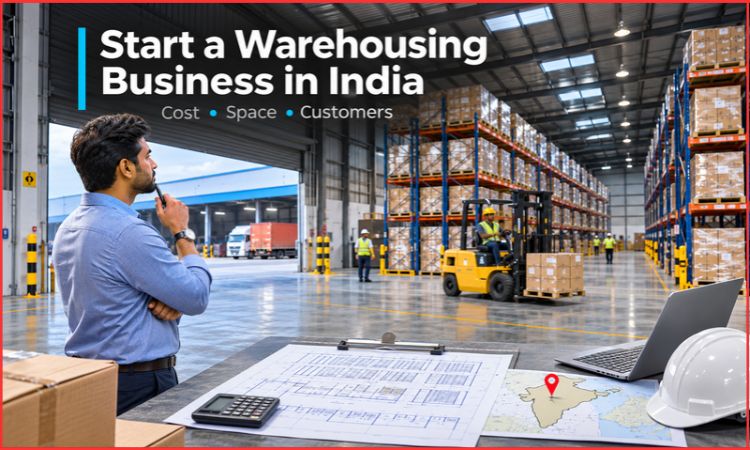
If you have been wondering how to start a warehousing business in India, growing e-commerce demand, manufacturing activities and organised storage requirements present significant opportunities. More companies now prefer professional storage facilities, making the logistics and warehousing business an attractive option for first-time entrepreneurs.
However, starting a warehouse business is not as simple as renting a large property. Before investing, you need to consider the location, storage capacity, warehouse space requirements, operating costs, legal permissions and customer demand.
A well-managed warehouse can generate recurring income through storage fees, inventory handling, order fulfilment and additional services. The key is choosing the right business model, securing customers and making efficient use of available space.
This guide explains the warehousing business investment, space requirements, licences, profitability and customer acquisition strategies you need to develop a practical warehouse business plan in India.
Warehousing Business in India at a Glance
| Factor | Details |
|---|---|
| Business Model | Storage, inventory management, distribution and order fulfilment |
| Initial Investment | A few lakh rupees to several crores |
| Space Requirements | Starting from 1,000–5,000 sq. ft., depending on the business model |
| Target Customers | E-commerce sellers, manufacturers, wholesalers, retailers and distributors |
| Income Sources | Storage charges, handling fees and fulfilment services |
| Operating Costs | Rent, staff, equipment, electricity, insurance and software |
| Expansion Opportunities | Cold storage, third-party logistics and industrial warehousing |
The actual warehouse setup cost in India depends on the location, condition of the building, storage capacity and services offered.
Decide Which Type of Warehouse You Want to Run
The first step is choosing the type of warehouse you want to operate. Each business model requires a different budget, workforce, equipment and customer base.
General Storage Warehouse
A general storage warehouse provides short-term or long-term storage for raw materials, finished products, packaging materials and other commercial goods. Revenue is typically generated based on the space occupied and storage duration.
Third-Party Logistics (3PL) Warehouse
A 3PL warehouse offers additional services such as inventory management, order packing, dispatch coordination and distribution. While it offers additional revenue opportunities, it also requires trained staff, technology and operational expertise.
Cold Storage Warehouse
Cold storage facilities are designed for temperature-sensitive products such as fruits, vegetables, dairy products, medicines and frozen foods. These warehouses require refrigeration equipment, temperature monitoring, backup power and additional compliance measures.
Industrial and Distribution Warehouse
Industrial warehouses store bulk inventory for manufacturers, wholesalers and distributors. These facilities generally require excellent road connectivity, adequate loading facilities and proximity to industrial areas.
For first-time entrepreneurs, a leased general storage warehouse or a small fulfilment facility may be easier to establish than a specialised storage facility.
Research the Market and Identify Warehouse Customers in India
Before investing in a warehouse property, understand which businesses in your target location regularly require storage facilities.
Potential warehouse customers in India include:
- E-commerce sellers: Businesses requiring inventory storage, packing and order dispatch.
- Manufacturers: Companies storing raw materials, components and finished goods.
- Wholesalers and distributors: Businesses managing bulk inventory for retailers.
- Retail chains: Companies requiring centralised storage and distribution facilities.
- Agricultural businesses: Traders and producers requiring seasonal storage.
- Pharmaceutical and food companies: Businesses requiring specific storage conditions.
Explore industrial areas, manufacturing clusters, wholesale markets and logistics corridors. Speak directly with business owners to understand their storage requirements, preferred contract terms and existing challenges.
A warehouse near a manufacturing cluster may be suitable for industrial goods, while a facility near an urban market may work better for e-commerce fulfilment and retail distribution.
Try to secure preliminary commitments from potential customers before signing a long-term warehouse lease.
Warehousing Business Investment: What Will It Cost?
The warehouse setup cost in India depends on whether you lease an existing property, purchase land, construct a warehouse or offer specialised logistics services.
Leasing an existing warehouse generally requires less initial capital because it eliminates the immediate cost of land acquisition and construction.
| Warehouse Type | Estimated Initial Investment |
|---|---|
| Small leased storage unit | ₹5–15 lakh |
| Small commercial warehouse with basic equipment | ₹15–50 lakh |
| Mid-sized warehouse with racking and inventory systems | ₹50 lakh–₹2 crore |
| Large industrial warehouse built from scratch | ₹2–10 crore or more |
| Specialised cold storage facility | ₹1 crore to several crores |
These figures are indicative planning estimates. Actual investment varies depending on location, property size, infrastructure and operational requirements.
Major Expenses Involved in Starting a Warehouse
Your warehousing business investment should account for:
- Lease and security deposit: Advance rent, security deposit and brokerage.
- Renovation: Flooring, electrical wiring, lighting, ventilation and loading facilities.
- Storage equipment: Racks, pallets, trolleys and forklifts.
- Technology: Computers, barcode scanners and inventory management software.
- Staff: Supervisors, security personnel, loaders and inventory operators.
- Compliance and insurance: Business registrations, safety equipment and insurance premiums.
- Working capital: Funds for rent, salaries, electricity and other recurring expenses.
For example, someone leasing a 3,000 sq. ft. warehouse may spend a significant portion of their initial investment on security deposits, repairs, storage equipment and working capital.
Maintain sufficient working capital to cover several months of operating expenses, as acquiring customers and achieving consistent occupancy can take time.
Warehouse Space Requirements and Choosing the Right Location
Selecting the right warehouse space directly affects operational efficiency, customer accessibility and profitability.
A large warehouse may not be suitable if trucks cannot access the property easily or maintenance expenses are excessively high.
How Much Space Do You Need to Start a Warehouse?
The required space depends on the type of goods, inventory volume, storage methods and number of customers.
| Warehouse Size | Suitable For |
|---|---|
| 1,000–2,000 sq. ft. | Small sellers, packaging supplies and limited inventory |
| 2,000–5,000 sq. ft. | E-commerce sellers, wholesalers and small distributors |
| 5,000–20,000 sq. ft. | Regional distribution and multi-client storage |
| 20,000+ sq. ft. | Large distributors, manufacturers and 3PL operations |
These are indicative space requirements rather than mandatory minimum sizes.
Remember that the entire built-up area cannot be used for storage. Space must also be allocated for loading, unloading, packing, office operations, safety access and inventory movement.
What to Check Before Finalising a Warehouse Property
Consider the following factors when choosing a warehouse:
- Road connectivity: Ensure adequate access for commercial vehicles and trucks.
- Proximity to customers: Choose a location near factories, markets or distribution centres.
- Building condition: Inspect the roof, flooring, drainage, ventilation and electrical systems.
- Safety and security: Check fire exits, CCTV coverage and access control.
- Expansion potential: Consider whether additional space will be available as demand grows.
- Legal permissions: Confirm that the property is approved for warehousing activities.
Warehousing opportunities are not limited to metropolitan cities. According to JLL, emerging Tier II and Tier III cities accounted for approximately 100 million sq. ft. of the 533.1 million sq. ft. of warehousing stock across India’s top 20 markets in 2024.
However, local demand and infrastructure should remain the primary considerations when selecting a property.
Registrations and Licences Required for a Warehousing Business in India
There is no single licence that applies to every warehouse in India. Registration and compliance requirements depend on the location, type of goods stored and services offered.
Common requirements to evaluate include:
- Business registration: Register as a proprietorship, partnership, LLP or private limited company.
- PAN and bank account: Obtain relevant tax registrations and open a business current account.
- GST registration: Check applicable GST registration and invoicing requirements.
- Local permissions: Verify land-use approvals and applicable trade licences.
- Building and fire approvals: Ensure compliance with building permissions and fire-safety requirements.
- Labour compliance: Follow applicable employment, wage and workplace safety regulations.
- Sector-specific permissions: Check food safety, environmental and pharmaceutical regulations where applicable.
Warehouses storing hazardous materials, temperature-sensitive products or regulated goods may require additional approvals.
Registration with the Warehousing Development and Regulatory Authority (WDRA) is relevant for warehouses intending to issue Negotiable Warehouse Receipts. It is not automatically mandatory for every general storage warehouse.
Customs-bonded warehouses must also comply with applicable customs licensing requirements.
Consult a qualified professional and relevant local authorities before signing a lease or starting construction.
Set Up Your Warehouse Operations
Once you have secured the property and necessary permissions, prepare the warehouse for daily operations.
Create dedicated areas for receiving, inspection, storage, picking, packing and dispatch. A well-planned layout improves operational efficiency and reduces workplace accidents.
Essential warehouse equipment and systems include:
- Storage racks and pallets
- Weighing scales and handling equipment
- Barcode labels and scanners
- CCTV and access control systems
- Fire-safety equipment
- Computers and inventory management software
- Warehouse management system (WMS)
- Standard operating procedures for inventory handling
A small warehouse can initially use basic inventory software or well-maintained spreadsheets. As business volume increases, a warehouse management system can help improve inventory visibility, order accuracy and reporting.
Maintain accurate records of incoming shipments, stock movements and outgoing orders. If you serve multiple customers, keep their inventory records separate to avoid billing and ownership disputes.
How Does a Warehousing Business Make Money?
Warehouses generate revenue through multiple services beyond traditional storage charges.
The right revenue model depends on customer requirements, available infrastructure and operational capabilities.
| Revenue Source | How It Works |
|---|---|
| Storage Charges | Fees based on space occupied, quantity or storage duration |
| Inbound Handling | Charges for receiving, unloading and inspecting goods |
| Outbound Handling | Fees for picking, sorting and loading goods |
| Pick-and-Pack Services | Per-order or per-item fulfilment charges |
| Inventory Management | Fees for stock monitoring and reporting |
| Value-Added Services | Labelling, repacking and product bundling |
| Distribution Coordination | Charges for arranging transportation and logistics |
Depending on the service, customers can be billed monthly, per pallet, per square foot or per transaction.
Warehousing Business Profit: An Example
Consider a 3,000 sq. ft. warehouse charging an assumed average storage rate of ₹20 per sq. ft. per month.
| Particulars | Amount |
|---|---|
| Assumed Billable Warehouse Space | 3,000 sq. ft. |
| Monthly Storage Rate | ₹20 per sq. ft. |
| Gross Monthly Revenue | ₹60,000 |
| Monthly Operating Expenses | ₹45,000 |
| Estimated Monthly Operating Surplus | ₹15,000 |
This example assumes full occupancy and that the entire stated area is billable. The operating surplus excludes interest, depreciation, taxes and other unspecified expenses.
Actual warehousing business profit depends on occupancy, rental rates, operating expenses and additional services.
Calculate your break-even point before setting storage prices. Include rent, salaries, electricity, maintenance, insurance, software and applicable financing costs in your calculations.
How to Find Customers for Your Warehouse
Customer acquisition is one of the most important factors in building a successful warehousing business in India.
Even a well-equipped warehouse cannot generate revenue without consistent occupancy.
Connect With Local Manufacturers and Wholesalers
Approach businesses in nearby industrial areas and wholesale markets. Offer storage solutions based on their inventory requirements and invite potential customers for property visits.
Partner With Logistics Companies
Third-party logistics providers, transporters and freight forwarders often require additional warehouse capacity. Partnerships with these businesses can generate new customer opportunities.
Target E-commerce Sellers
Growing online businesses frequently require professional storage, inventory management, packaging and dispatch services.
Build a Strong Online Presence
Create a professional website and an eligible Google Business Profile displaying your warehouse location, storage capacity, facilities, photographs and contact information.
Use LinkedIn to connect with procurement managers, supply chain professionals and business owners.
Use Industrial Property and Business Platforms
List your warehouse and services on relevant industrial real estate platforms, business directories and procurement platforms to generate enquiries.
Offer Transparent Service Packages
Clearly communicate storage charges, minimum contract periods, handling fees, safety arrangements and additional services.
Avoid depending entirely on a single customer. A diversified customer base helps reduce financial risks and maintain stable revenue.
Risks to Consider Before Starting a Warehousing Business
Although warehousing can generate recurring income, profitability is not guaranteed. Understanding potential risks helps you prepare a more sustainable business plan.
| Risk | Potential Impact |
|---|---|
| Low Occupancy | Reduced revenue while fixed expenses continue |
| Customer Dependency | Cash flow problems when a major customer leaves |
| Inventory Damage or Theft | Financial losses and customer disputes |
| Rising Operating Costs | Reduced profit margins |
| Delayed Payments | Working capital challenges |
| Compliance Issues | Operational delays and potential penalties |
You can reduce these risks by negotiating flexible lease terms, maintaining suitable insurance, implementing security measures and clearly defining customer responsibilities in written agreements.
Starting with a manageable leased facility and expanding gradually can help reduce initial investment risks.
Conclusion
Starting a warehousing business in India requires more than finding a large storage property. A successful business depends on the right location, realistic investment planning, efficient warehouse operations and a reliable customer base.
Before committing to a warehouse, evaluate local demand, calculate your setup and operating costs, understand applicable legal requirements and identify potential customers.
Choosing the right warehouse space from the beginning can help reduce unnecessary expenses, improve operational efficiency and create opportunities for long-term business growth.
Start with a business model that matches your budget and market demand, and expand as your occupancy, customer retention and cash flow improve.