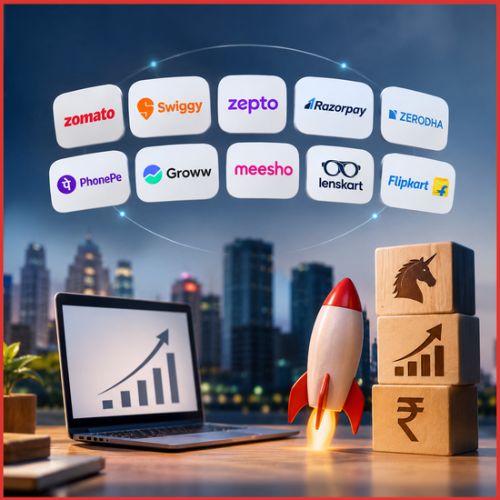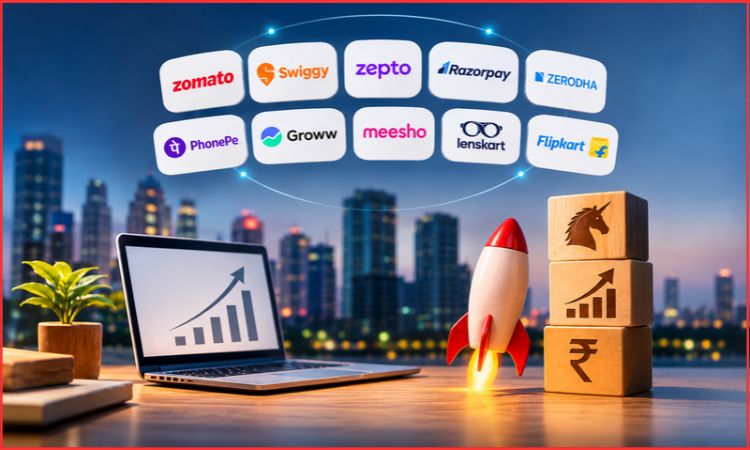
From digital payments and stockbroking to e-commerce and quick commerce, these successful Indian startups have built billion-dollar enterprises. Their growth reflects changing consumer habits, technology adoption and a new generation of ambitious Indian entrepreneurs.
India’s startup ecosystem has evolved into a major force in the digital economy. Some of the most successful Indian startups began with simple ideas, such as delivering food, selling eyewear online or simplifying digital payments. Today, these businesses serve millions of customers and compete across major industries.
But a billion-dollar valuation does not necessarily mean a business is profitable. This report examines 10 leading Indian startups through their founders, CEOs, business models, latest valuations, financial performance and recent developments.
Top 10 Indian startups: Founders, CEOs and latest valuations
| Company | Founder(s) and co-founders | Current CEO | Latest reported valuation or market value |
|---|---|---|---|
| Eternal (Zomato and Blinkit) | Deepinder Goyal, Pankaj Chaddah | Albinder Dhindsa | ₹3.12 lakh crore market cap, October 16, 2026 |
| Swiggy | Sriharsha Majety, Nandan Reddy, Rahul Jaimini | Sriharsha Majety | ₹63,211 crore market cap, October 16, 2026 |
| Zepto | Aadit Palicha, Kaivalya Vohra | Aadit Palicha | $7 billion, October 2025 funding round |
| Razorpay | Harshil Mathur, Shashank Kumar | Harshil Mathur | Reported IPO valuation target of $5–6 billion in 2026 |
| Zerodha | Nithin Kamath, Nikhil Kamath | Nithin Kamath | $8.2 billion, Hurun’s 2025 unicorn estimate |
| PhonePe | Sameer Nigam, Rahul Chari, Burzin Engineer | Sameer Nigam | $9–10.5 billion reported IPO target, March 2026 |
| Groww | Lalit Keshre, Harsh Jain, Neeraj Singh, Ishan Bansal | Lalit Keshre | ₹1.26 lakh crore market cap, October 16, 2026 |
| Meesho | Vidit Aatrey, Sanjeev Barnwal | Vidit Aatrey | ₹1.04 lakh crore market cap, October 16, 2026 |
| Lenskart | Peyush Bansal, Amit Chaudhary, Neha Bansal | Peyush Bansal | ₹1.12 lakh crore market cap, October 16, 2026 |
| Flipkart | Sachin Bansal, Binny Bansal | Kalyan Krishnamurthy | $38.2 billion reported employee-share buyback valuation, July 2026 |
A comparison of India’s leading billion-dollar startups, their founders, current CEOs and latest reported market valuations.
1. Eternal: The company behind Zomato and Blinkit
Zomato was established in 2008 as an idea of Deepinder Goyal and Pankaj Chaddah. Since then, Zomato has diversified its offerings to include food delivery, quick commerce, and restaurant supplies. Zomato rebranded itself as Eternal in 2025.
Its primary business units are Zomato, Blinkit, and Hyperpure. Zomato competes with Swiggy in multiple consumer delivery services and is among the top food delivery and quick commerce players in India.
Recent development: Albinder Dhindsa succeeded Goyal as CEO in February 2026. Blinkit’s rapid expansion has strengthened Eternal’s growth, but competition and the cost of opening new fulfillment stores remain important challenges.
Financial performance: Revenue and profit
| Revenue | Profit after tax | Other metric |
|---|---|---|
| ₹24,138 crore | ₹125 crore | Adjusted EBITDA: ₹666 crore |
| Q2 FY2026–27 | Q2 FY2026–27 | Q2 FY2026–27 |
Revenue increased approximately 78% year on year. The figures reflect the September 2026 quarter, not the full financial year.
2. Swiggy: Expanding beyond food delivery
Swiggy was established in 2014 by Sriharsha Majety, Nandan Reddy, and Rahul Jaimini. The platform of food delivery of the firm has diversified into quick commerce using Instamart.
The firm is one of the significant Indian online food delivery startups in competition with companies like Swiggy, Zomato, and Blinkit. The strategy of the firm enables Swiggy to cater to more customer requirements, but the costs in food delivery and grocery delivery differ.
Recent development: Swiggy’s public listing in 2024 increased scrutiny of its financial performance. Its quick-commerce expansion continues to compete directly with Blinkit and Zepto, while losses remain substantial.
Financial performance: Revenue and profit
| Revenue from operations | Net loss | Other metric |
|---|---|---|
| ₹23,053 crore | ₹4,154 crore | Food-delivery adjusted EBITDA exceeded ₹1,000 crore |
| FY2025–26 | FY2025–26 | FY2025–26 |
Revenue grew approximately 51% year on year, but the consolidated business remained loss-making.
3. Zepto: The quick-commerce startup challenging established players
Zepto is a company founded in 2021 by Aadit Palicha and Kaivalya Vohra that offers grocery items, everyday items, and other goods via a chain of local fulfillment centers. Its attraction is its fast deliveries and convenience. Being one of India’s rapidly growing quick-commerce companies, its business model involves making investments in inventory, warehouses, and deliveries.
Recent development: Zepto raised $450 million at a reported $7 billion valuation in October 2025. Its financial results show that fast growth has come with significant losses, raising questions about long-term profitability.
Financial performance: Revenue and profit
| Revenue from operations | Net loss | Other metric |
|---|---|---|
| ₹22,623.6 crore | ₹5,905 crore | Revenue more than doubled year on year |
| FY2025–26 | FY2025–26 | FY2025–26 |
Zepto’s FY26 results illustrate the challenge of scaling a capital-intensive delivery business while controlling costs.
4. Razorpay: A fintech startup powering digital payments
Razorpay was founded by Harshil Mathur and Shashank Kumar in 2014. It is involved in helping businesses make online payments and has diversified into point-of-sales solutions and business banking products among others.
As one of the major fintech companies in India, Razorpay caters to merchants that require effective payment processing.
Recent development: Razorpay has prepared for a potential IPO. Reports in 2026 suggested an IPO valuation target below its earlier private-market valuation, highlighting how public investors may assess growth and profitability differently from private investors.
Financial performance: Revenue and profit
| Revenue from operations | Net loss | Other metric |
|---|---|---|
| ₹3,783 crore | ₹1,209 crore | Gross profit: ₹1,277 crore |
| FY2024–25 | FY2024–25 | FY2024–25 |
The loss was affected by employee stock-option expenses and costs associated with shifting the company’s domicile to India.
5. Zerodha: A profitable, bootstrapped startup
Zerodha was co-founded by brothers Nithin Kamath and Nikhil Kamath in 2010. Their relatively cheap brokerage services played a key role in increasing the participation of retail customers in the Indian stock market.
Contrary to many other tech start-ups worth over a billion dollars, the growth of Zerodha did not require huge investments raised from venture capitalists. Zerodha is one of the most successful bootstrapped Indian start-ups.
Recent development: Regulatory changes and weaker trading activity have put pressure on its core brokerage business. Income from margin trading helped offset some of that slowdown in FY26.
Financial performance: Revenue and profit
| Revenue | Net profit | Other metric |
|---|---|---|
| Approximately ₹8,847 crore | ₹4,283 crore | Brokerage income: ₹2,738 crore |
| FY2025–26 | FY2025–26 | FY2025–26 |
Zerodha remains one of India’s clearest examples of a large startup generating substantial profits while maintaining a comparatively lean business model.
6. PhonePe: India’s digital-payments giant
PhonePe was formed by Sameer Nigam, Rahul Chari, and Burzin Engineer in 2015. It started off with the offering of digital payments and grew its range of services to include merchant services, lending distribution, and other financial services.
The vast number of users makes it one of the most successful digital payment platforms in India.
Recent development: PhonePe has pursued an IPO, but its timetable and valuation expectations have shifted amid market uncertainty. Regulatory changes affecting payment-related revenue and real-money gaming have also influenced its financial performance.
Financial performance: Revenue and profit
| Revenue from operations | Net loss | Other metric |
|---|---|---|
| ₹7,920.48 crore | ₹2,791.59 crore | Revenue growth: 11.5% |
| FY2025–26 | FY2025–26 | FY2025–26 |
Revenue continued to grow, but the net loss widened as expenses increased and some revenue streams were affected by regulatory changes.
7. Groww: Making online investing accessible
The four founders of Groww are Lalit Keshre, Harsh Jain, Neeraj Singh, and Ishan Bansal. It was founded in 2016 and provides its users access to stocks, mutual funds, and other investment options.
There was a change in investing behavior in India, whereby people opted to invest online.
Recent development: Groww’s public listing made its financial performance more transparent to investors. Its challenge is to sustain growth while responding to market volatility and regulatory changes affecting brokerage businesses.
Financial performance: Revenue and profit
| Revenue | Net profit | Other metric |
|---|---|---|
| Approximately ₹4,644 crore | Approximately ₹2,083 crore | Revenue growth: approximately 14% |
| FY2025–26 | FY2025–26 | FY2025–26 |
Groww remains profitable and continues to compete with Zerodha and other established brokerage platforms.
8. Meesho: An e-commerce startup targeting affordable shopping
Meesho was started in 2015 by Vidit Aatrey and Sanjeev Barnwal. The platform connects the consumer with sellers who provide budget-friendly products in fashion, home, and many other product categories.
The wide customer base shows how the Indian startup e-commerce space goes way beyond high-end urban consumers.
Recent development: Meesho’s FY26 results reflected continued growth in orders and users. However, increased investment in customer acquisition, technology and logistics contributed to pressure on profitability.
Financial performance: Revenue and profit
| Revenue from operations | Net loss | Other metric |
|---|---|---|
| ₹12,626.35 crore | ₹1,357.74 crore | 264 million annual transacting users |
| FY2025–26 | FY2025–26 | FY2025–26 |
The company must translate its large user base into sustainable marketplace economics.
9. Lenskart: Transforming eyewear retail
The co-founders Peyush Bansal et al launched Lenskart in the year 2010. The firm provides online services along with offline outlets, eye tests and growing international operations.
This model of multi-channel business solves one major drawback of ordering eyewear through the Internet i.e., consumers require professional help for a good fit. Lenskart is an Indian consumer company with an online and offline retail channel.
Recent development: Lenskart went public in November 2025. Its expansion into stores and overseas markets creates growth opportunities, but also requires investment in inventory, staff and retail infrastructure.
Financial performance: Revenue and profit
| Revenue from operations | Net profit | Other metric |
|---|---|---|
| ₹8,814.04 crore | ₹500.96 crore | Revenue growth: approximately 32% |
| FY2025–26 | FY2025–26 | FY2025–26 |
Lenskart’s results show that a digitally founded company can scale into a substantial retail business while maintaining profitability.
10. Flipkart: An Indian e-commerce pioneer
Flipkart was established in the year 2007 by two individuals named Sachin Bansal and Binny Bansal. The company, which started off as a bookstore website, now deals with electronic goods, clothing and much more.
The Walmart group acquired its majority share in the year 2018. The group now also comprises companies like Myntra and Cleartrip.
Recent development: Flipkart’s 2026 financial update reported improved gross margins and narrowing operating losses. Its redomiciliation to India also brought consolidated reporting into sharper focus ahead of potential future capital-market activity.
Financial performance: Revenue and profit
| Revenue | Profit or loss | Other metric |
|---|---|---|
| FY26 group revenue grew 18% year on year | Net loss narrowed by approximately ₹180 crore | Adjusted operating margin improved from −7.7% to −5.4% |
| FY2025–26 | FY2025–26 | FY2025–26 |
Flipkart’s latest public summary does not state the absolute consolidated revenue figure. The growth and margin metrics above are from its group-level update, rather than the financial statements of one subsidiary.
Three more notable Indian startups to know
CRED
CRED, founded in 2018 by Kunal Shah, established its financial services firm on the basis of credit card payments and rewards. What makes this firm stand out is that they targeted a specific consumer group initially.
Nykaa
Nykaa, founded in 2012 by Falguni Nayar, created a big marketplace for beauty and personal care products before moving into fashion. The listing of Nykaa proved the possibilities of digital brands in India.
OYO
Founded by Ritesh Agarwal in 2013, OYO developed a technology-led hospitality platform. Its international expansion and continuing efforts to improve hotel-network economics make it an important example of the challenges of scaling a service business.
The Indian startup ecosystem: Growth versus profitability
The rise in startups in India has been driven by affordable mobile data, digital payment systems, better logistics and a large consumer base. UPI has played a key role in incorporating digital transactions into our everyday lives.
The next hurdle for Indian startups and unicorns is the issue of profitability. Venture capital funding helps in faster growth, but companies need to generate revenues, profits and keep their cash flow needs manageable.
The most recent financials reveal a somewhat uneven situation. Eternal and Lenskart are making profits, whereas Swiggy, Zepto and Meesho are making losses. On the other hand, Zerodha shows that a bootstrapped business can be highly profitable despite having a different approach compared to its venture-backed competitors.
The strongest companies will be those that convert customer growth into durable businesses while maintaining responsible governance and adapting to competition and regulation.
Conclusion: What makes India’s billion-dollar startups successful?
India’s billion-dollar startups have redefined shopping, payments, investments, and delivery. The success stories of these startups indicate what is possible through tech-focused businesses in an increasingly digitised economy.
Yet, valuations reveal only a partial picture. Profitability, revenue growth, cash flows, and customer trust help to understand the bigger picture.
Frequently asked questions about Indian startups
1. What are the top Indian startups valued at billions of dollars?
Prominent examples include Eternal, Swiggy, Zepto, Razorpay, Zerodha, PhonePe, Groww, Meesho, Lenskart and Flipkart. Their valuations differ depending on whether they are publicly listed or privately held.
2. Which Indian startups are profitable?
Zerodha has historically been highly profitable. Eternal and Lenskart have also reported profits, while several other companies continue to invest heavily in expansion. The latest audited financial statements provide the most reliable comparison.
3. What is a unicorn startup in India?
An Indian unicorn is generally a privately held startup valued at $1 billion or more. The term refers to valuation, not necessarily revenue or profitability.
4. Which industries produce the most successful Indian startups?
E-commerce, fintech, digital payments, food delivery, quick commerce and online investment platforms have produced several of India’s most prominent startup businesses.
5. What challenges do Indian startups face?
Some of the problems that exist are competition, increase in operating cost, changes in regulations, lack of funds, and the ability to make profits sustainably.