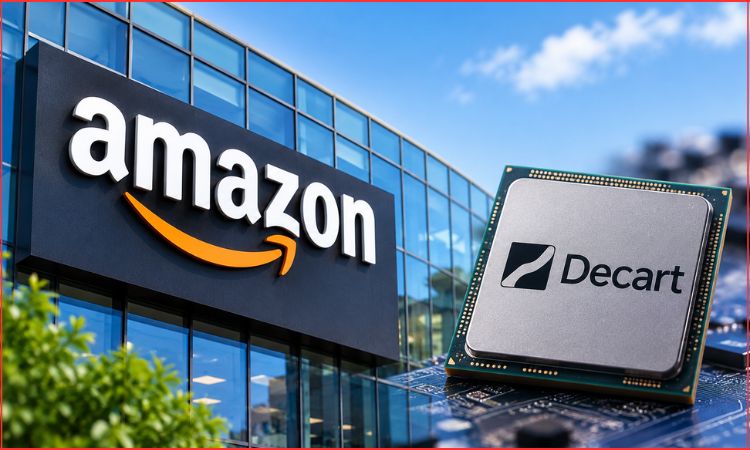
Three years after setting up Decart, its founders are preparing to join one of the world’s largest technology companies. Amazon announced on November 23 that it had reached an agreement to acquire proprietary technology from the Israeli business and bring its engineering team on board.
The reported price? Around $7.5 billion, although Amazon has kept the financial details private.
For anyone unfamiliar with Israeli AI startup Decart, the figure might seem unusually high. The company is relatively young and does not have anything close to the public recognition enjoyed by OpenAI or Anthropic.
But Amazon has something quite specific in mind. It wants its own chips to do more work, consume resources more efficiently and become a viable alternative to the Nvidia processors widely used across the industry.
From A $4 Billion Valuation To A Reported $7.5 Billion Deal
Dean Leitersdorf, Orian Leitersdorf and Moshe Shalev founded Decart in 2023. The startup made a name for itself through AI-generated visual experiences that could respond to user inputs in real time.
Behind those applications was some rather complicated engineering. Getting AI models to generate content quickly, without compromising too much on quality, meant finding better ways to use the available computing hardware.
That work eventually became a valuable part of Decart’s business.
As recently as May 2026, the startup reportedly raised $300 million at a valuation of $4 billion. Barely six months later, the Amazon Decart deal is being valued at almost twice that figure.
There is an important distinction in the announcement, however. Amazon is acquiring Decart’s proprietary technology and bringing its founders and engineers into the organisation. The precise financial structure of the transaction has not been publicly disclosed.
Amazon And Decart Have Worked Together Before
Monday’s announcement did not come entirely out of the blue. Amazon had been working with Decart since 2025, giving the two companies an opportunity to understand each other’s technology before entering acquisition discussions.
Their work involved Trainium, Amazon’s custom processor for AI workloads.
Building a chip is one thing. Getting developers to achieve consistently good results with it is another matter altogether.
Nvidia has spent years making its hardware easier for programmers to work with. Developers know its tools, have experience using its architecture and can draw upon a considerable amount of existing technical documentation.
Amazon faces the difficult task of convincing some of those developers to switch platforms.
That is where the Decart Optimization Stack comes into the picture. Known as DOS, the software helps improve the way AI workloads run across different computing architectures.
Having the people who developed that technology working alongside Amazon’s chip designers could shorten the time needed to improve processor performance.
The Cost Of Running AI Is Becoming Difficult To Ignore
Ask an AI chatbot a question, and somewhere in a data centre, a processor gets to work. Generate a video, and the computing requirements become considerably more demanding.
For individual users, these activities may cost very little. For companies handling millions of requests every day, the bills can quickly mount.
This is one reason Amazon Web Services (AWS) has invested so heavily in developing its own hardware.
Amazon already has Trainium for AI workloads and Inferentia for running trained models. Improving the software surrounding those processors could make them a more practical choice for businesses concerned about their monthly cloud expenditure.
Even relatively small efficiency gains matter at Amazon’s scale. If an existing processor can handle more requests within the same period, the company may be able to serve additional customers without immediately expanding its hardware capacity.
There is also the matter of electricity. Building new data centres requires enormous amounts of power, and securing an adequate energy supply has become a challenge in several markets.
Getting more work out of installed equipment would help address part of that problem.
Nvidia And Anthropic Were Also Interested
Amazon was apparently not the only company looking closely at Decart.
According to Israeli business publication Calcalist, Nvidia had previously shown interest in the startup. Anthropic, the company behind Claude, subsequently entered advanced negotiations over a potential deal worth around $6 billion.
Those discussions reportedly fell apart in September.
Amazon remained interested, and negotiations eventually produced the agreement announced on Monday.
The competition for Decart says quite a bit about where technology companies are spending their money these days.
Researchers who understand chip architecture, software optimisation and AI inference are difficult to recruit. Putting together an experienced team from scratch could take years, particularly when rival companies are pursuing the same people.
For Amazon, the reported purchase price covers something that cannot easily be ordered from a semiconductor manufacturer: the technical knowledge needed to improve how those processors perform.
Should Nvidia Be Worried?
Amazon is both a customer and a competitor of Nvidia. That makes its growing investment in custom chips particularly interesting.
AWS customers can currently access Nvidia-powered computing services alongside Amazon’s proprietary processors. Businesses select between them according to their budgets, technical requirements and existing software.
Nvidia remains in a strong position because switching hardware is rarely as simple as changing a supplier. Applications may need modifications, engineers require training, and performance must be tested before companies commit to a different platform.
Better AI infrastructure software could make that transition less troublesome.
Amazon does not necessarily need to replace Nvidia hardware across its data centres. Convincing more customers to choose Trainium for suitable workloads would already help reduce its reliance on externally manufactured AI accelerators.
That represents a commercial opportunity in its own right.
Another Major Technology Deal For Israel
Israel is already an important location for Amazon’s semiconductor research.
The company acquired Annapurna Labs in 2015, establishing a foundation for much of its subsequent work on custom computing hardware. Decart’s engineers would bring further expertise into an organisation that has spent more than a decade developing its own processors.
For Israel’s startup community, the proposed agreement is notable for another reason. Decart reached a reported multibillion-dollar transaction value without becoming a household name or building a mass-market consumer business.
Its value came largely from solving difficult engineering problems.
When Will The Transaction Be Completed?
Amazon has not announced a completion date. The agreement remains subject to regulatory clearance and other customary closing conditions.
Once the transaction goes through, attention will turn to what Decart’s technology can actually deliver.
Customers using cloud computing infrastructure will want to see improvements in processing speeds, operating costs and software compatibility before reconsidering their existing hardware choices.
Amazon has spent years giving businesses reasons to try its custom processors. With Decart, it is hoping to give them a financial reason to stay.