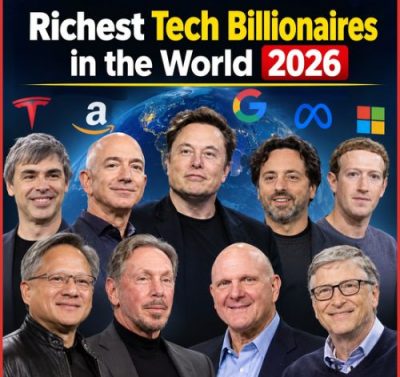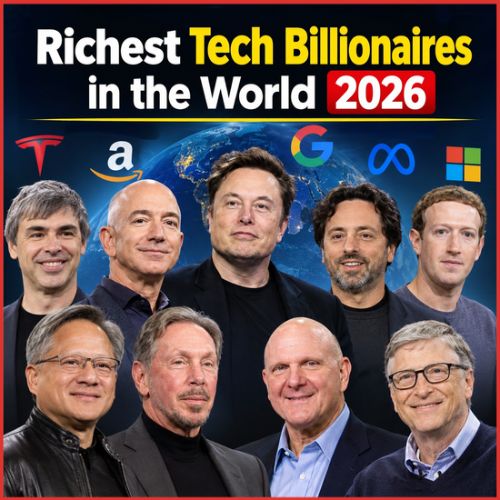
Elon Musk crossed $1 trillion in June, slipped below $700 billion in July, climbed back above $900 billion in August, and stood near $877 billion on November 20 (Forbes, 2026).
Swings like that explain why the richest tech billionaires in the world 2026 list rewrites itself almost monthly. The world’s ten richest people lost a combined $273 billion in October alone as AI-spending worries pushed the Nasdaq down nearly 5% (Forbes, Nov 1, 2026), and Jensen Huang has since dropped down the table after leaving the Nvidia CEO role.
Rankings are based on live net worth from Forbes’ Real-Time Billionaires list as of November 20, 2026 (8:05 a.m. ET), limited to fortunes built mainly in technology.
The list matters now because AI spending, rocket valuations and chip demand are moving wealth faster than any annual tally can record.
How We Ranked
This technology billionaires ranking is not built on one figure in isolation. Placement follows current Forbes net worth, the size of each person’s holding in the underlying company, and whether the fortune comes chiefly from technology rather than retail, finance or luxury. Bloomberg’s index is used as a cross-check, since it values some fortunes differently.
The ten span social media, e-commerce, search, chips, hardware, enterprise software, electric vehicles and space, so this is a broad comparison of wealth rather than company size. The aim is to spotlight the richest technology entrepreneurs and executives whose holdings shape the sector in 2026.
Quick Glance
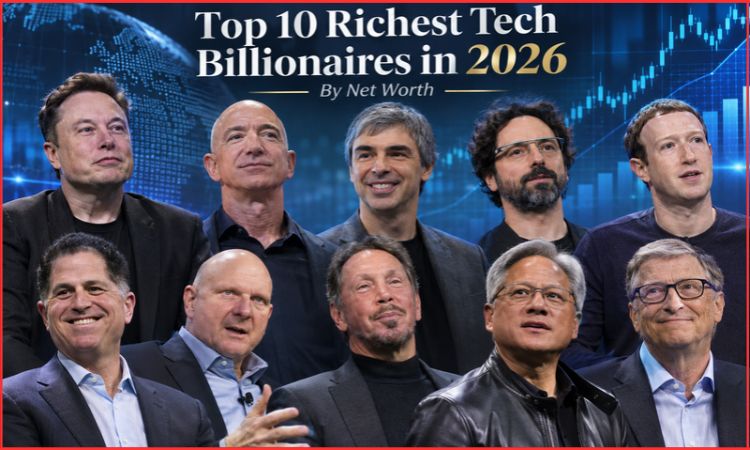
| Name | Founded | Sector | Net Worth | Core Strength |
|---|---|---|---|---|
| Elon Musk | 2002 (SpaceX) | Space, EVs | $877.4B | Reusable rockets |
| Jeff Bezos | 1994 (Amazon) | E-commerce, Cloud | $376.2B | Marketplace scale |
| Larry Page | 1998 (Google) | Search, AI | $227.1B | Alphabet stake |
| Sergey Brin | 1998 (Google) | Search, AI | $209.1B | Alphabet stake |
| Mark Zuckerberg | 2004 (Facebook) | Social Media | $205B | Voting control |
| Michael Dell | 1984 (Dell) | Hardware | $199B | Enterprise servers |
| Steve Ballmer | 1980 (joined Microsoft) | Software | $155.7B | Microsoft shares |
| Larry Ellison | 1977 (Oracle) | Enterprise Software | $148.8B | Databases, cloud |
| Jensen Huang | 1993 (Nvidia) | Chips | $127.5B | AI processors |
| Bill Gates | 1975 (Microsoft) | Software | $118.9B | Founder equity |
Source: Forbes Real-Time Billionaires, Nov 20, 2026, 8:05 a.m. ET.
The Top 10 Richest Tech Billionaires in 2026
1. Elon Musk
Elon Musk founded SpaceX in 2002 and leads Tesla; those two holdings carry nearly all of his fortune. He became the first trillionaire in June, when SpaceX went public. He has held the top spot since May 2024 (Forbes, 2026), and second place sits about $500 billion behind.
His wealth is also the most volatile on the list. SpaceX shares fell to $134 in early November from an October high of $176.56 amid AI-bubble worries, and Tesla dropped nearly 11% in a single session on November 5. Supporters point to SpaceX’s rocket lead and its growing AI business; sceptics point to how much of his fortune rests on two richly valued stocks.
- Net Worth: $877.4 billion (Forbes, Nov 20, 2026)
- Main Source: SpaceX, Tesla
- Why Ranked Here: Largest fortune on the list by a distance
2. Jeff Bezos
Jeff Bezos launched Amazon in 1994 from a garage in Bellevue, Washington.
This year’s surge came from beyond Amazon: his fortune rose $102 billion in a month to October 1, after Blue Origin’s first outside funding round valued it at around $140 billion (Forbes, 2026). The flip side is that private-company valuations are estimates, and estimates differ widely between trackers.
- Net Worth: $376.2 billion (Forbes, Nov 20, 2026)
- Main Source: Amazon, Blue Origin
- Why Ranked Here: Clear second place
3. Larry Page
Larry Page co-founded Google in 1998 and ran Alphabet as CEO until 2019. Almost all of his wealth is Alphabet stock. Together with Brin, he controls most of the company’s voting power while owning a much smaller share of the total equity.
- Net Worth: $227.1 billion (Forbes, Nov 20, 2026)
- Main Source: Alphabet
- Why Ranked Here: Third-largest fortune, tied to one share price
4. Sergey Brin
Born in Moscow, Brin met Page at Stanford and built Google’s first search engine with him. He remains involved in Google’s AI work.
He sits only $4.1 billion ahead of Zuckerberg, so one strong trading day can flip the order.
- Net Worth: $209.1 billion (Forbes, Nov 20, 2026)
- Main Source: Alphabet
- Why Ranked Here: Fourth on Forbes, holding the same company as Page
5. Mark Zuckerberg
Facebook began in a Harvard dorm in 2004. Today it is Meta, and Zuckerberg still controls it through shares that carry extra votes. That control lets him make long-term bets without shareholder pressure, though critics argue it also limits investor oversight.
His fortune moves with Meta’s share price, which has been caught up in the recent tech pullback.
- Net Worth: $205 billion (Forbes, Nov 20, 2026)
- Main Source: Meta Platforms
- Why Ranked Here: Fifth, with control of one of the largest social platforms
6. Michael Dell
At 19, Dell began selling upgraded PCs from a University of Texas dorm room in 1984.
He took the company private in 2013 and relisted it in 2018. He still serves as chairman and CEO, and his fortune is tied closely to demand for enterprise and AI servers, which makes it sensitive to any slowdown in data-center spending.
- Net Worth: $199 billion (Forbes, Nov 20, 2026)
- Main Source: Dell Technologies
- Why Ranked Here: The highest hardware fortune, ranked sixth
7. Steve Ballmer
Ballmer joined Microsoft in 1980 and ran it as CEO from 2000 to 2014. He did not found the company, but his Microsoft shares anchor a fortune of about $155.7 billion. He also owns the Los Angeles Clippers. Forbes noted in November that Microsoft’s share-price slide pulled his fortune lower.
- Net Worth: $155.7 billion (Forbes, Nov 20, 2026)
- Main Source: Microsoft
- Why Ranked Here: Seventh, the only non-founder on the list
8. Larry Ellison
Ellison co-founded Oracle in 1977 and, at 82, still shapes its technology strategy as chairman and chief technology officer.
Yet Bloomberg’s index shows his fortune down about 48% over the past year. He owns around 40% of Oracle and has pledged roughly a third of his shares as collateral against personal debt, which adds risk when the stock falls. Supporters counter that Oracle’s cloud and AI contracts keep its long-term case intact.
- Net Worth: $148.8 billion (Forbes, Nov 20, 2026)
- Main Source: Oracle
- Why Ranked Here: Eighth, after a steep year-over-year slide
9. Jensen Huang
Huang co-founded Nvidia in 1993 and led it as CEO for 33 years, taking it to a $5 trillion valuation. In March 2026 he entered Forbes’ annual top ten for the first time, at $154 billion (Forbes, 2026).
November brought a sharp reversal. Huang resigned as CEO after reports of an affair with a woman U.S. intelligence officials suspect of spying for China, which China denies. Nvidia’s board has said it will not reinstate him, and CFO Colette Kress is interim CEO. California’s attorney general has subpoenaed Nvidia, and Huang is due before congressional committees on December 1. No findings have been announced, and the investigations are ongoing. Nvidia’s business results remain strong, but his fortune is tied to the share price, which is now under pressure.
- Net Worth: $127.5 billion (Forbes, Nov 20, 2026)
- Main Source: Nvidia
- Why Ranked Here: Ninth, and the highest-placed chip founder, after a steep fall
10. Bill Gates
Gates co-founded Microsoft with Paul Allen in 1975. He fell out of Bloomberg’s top ten for the first time in July 2025 (Bloomberg, 2025).
He has pledged nearly all of his wealth to the Gates Foundation, which plans to close in 2045. His ranking is lower partly because he gives money away rather than because his holdings have collapsed.
- Net Worth: $118.9 billion (Forbes, Nov 20, 2026)
- Main Source: Microsoft
- Why Ranked Here: Tenth among tech fortunes, steady rather than rising
What These Richest Technology Entrepreneurs Have In Common
Every fortune here rests on equity held for decades, whether in a company built from scratch or one led for years. The mix of founders, executives and a hardware maker makes this a cross-segment comparison, and net worth is the shared yardstick.
A tech fortune is a stock price wearing a founder’s name.
Conclusion
Technology wealth at this scale is concentrated, and it is volatile.
For founders and investors, the useful reading of this technology billionaires ranking is that equity ownership, patient holding periods and exposure to AI infrastructure explain most of the movement, and that leadership and governance events can matter just as much, as Huang’s case shows. Anyone benchmarking against tech billionaires net worth figures should treat each number as a dated snapshot.
The next reshuffle is probably weeks away.
Frequently Asked Questions
1. Who is the richest tech billionaire in 2026?
Elon Musk, with $877.4 billion on Forbes’ real-time list on November 20, 2026. Jeff Bezos follows at $376.2 billion, so even the richest tech CEOs and founders behind Musk trail him by roughly $500 billion.
2. How was this ranking decided?
The order follows live Forbes net worth on November 20, 2026, counting only fortunes sourced mainly from technology. Bloomberg’s index served as a cross-check on the top tech billionaires 2026.
3. Why do Forbes and Bloomberg show different orders and figures?
Each values stakes and private holdings by its own method and updates on its own schedule. For example, Bloomberg’s index had Ballmer near $176 billion on November 19, while Forbes had him near $156 billion on November 20, a gap far wider than one day’s move. The top six names appear in the same order on both lists.
4. Which of the world’s richest tech founders still run their companies?
Musk, Zuckerberg and Dell still hold chief executive roles. Huang resigned as Nvidia’s CEO in November 2026, and Page, Bezos, Gates and Ballmer have stepped back from the top job. Ellison remains at Oracle as chairman and chief technology officer.
5. How much can a tech fortune change in a year?
A great deal. Bloomberg’s November 2026 data shows Musk up 90.5% year over year and Ellison down 47.7%.