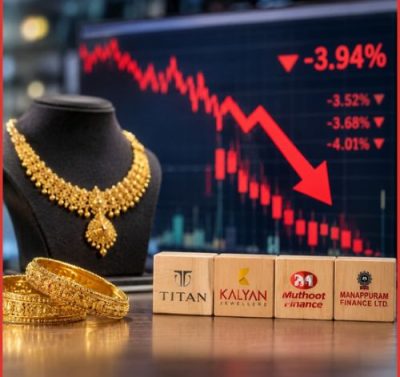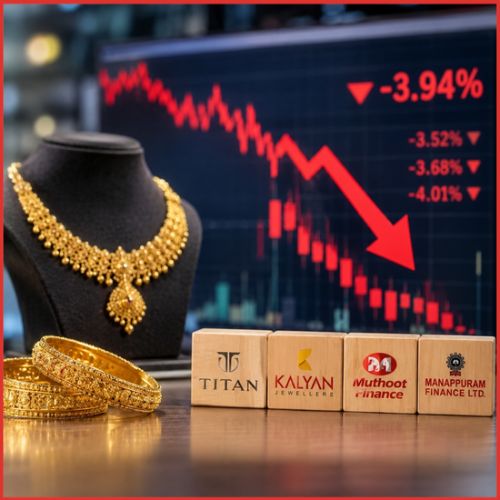
Shares of jewellery retailers and gold-loan companies declined on November 20 as a sharp fall in bullion prices prompted investors to reassess inventory values and lending safeguards.
Titan, Kalyan Jewellers, Muthoot Finance and Manappuram Finance were among the stocks under pressure during morning trading. Several gold-related companies fell approximately 3% to 4%, compared with a smaller decline in the broader Sensex.
The immediate backdrop was a steep drop in domestic gold futures.
At 9:04am, the MCX December gold contract traded at ₹1,22,435 per 10 grams, down ₹5,017, or 3.94%, according to the market report.
Those figures describe an intraday futures quotation. They are separate from a jeweller’s retail selling rate and from the session’s eventual closing prices.
One Commodity Move Affects Two Different Businesses
Jewellery companies and gold financiers both have exposure to gold, but the relationship works differently.
A retailer buys, holds and sells jewellery. Its earnings depend on factors including customer demand, inventory management, workmanship revenue and operating expenses.
A gold-loan company lends against pledged jewellery. Its concerns include the value of collateral, borrower repayments and the ability to recover an overdue loan.
A decline in gold therefore creates different questions for each business.
Grouping them as gold-related stocks explains why they can react to the same market event. It does not mean their financial outcomes will be identical.
The morning’s selling reflected concern across both groups, while the underlying risks require separate examination.
Retailers Face Questions About Existing Inventory
For a jeweller, falling gold prices can reduce the market value of inventory acquired when prices were higher.
That creates a potential mismatch between procurement cost and the price customers expect to pay.
The actual earnings effect depends on how the business manages its stock and exposure. Inventory turnover, purchasing arrangements and hedging can influence how much of a market movement reaches the accounts.
A lower gold price does not therefore establish an identical inventory loss for every company.
The relevant evidence will come from subsequent disclosures about margins and inventory management.
Investors reacting immediately to a commodity decline are pricing a possible consequence before the full accounting effect is known.
That timing helps explain why jewellery stocks can weaken even when cheaper gold may eventually attract more customers.
Lower Prices Can Improve Affordability
The demand side presents a different possibility.
A customer working within a fixed budget may be able to buy a heavier item when the underlying gold rate falls. Alternatively, the same item may become less expensive if other charges remain unchanged.
That can improve affordability, particularly for purchases tied to a specific occasion.
However, a falling market can also make buyers hesitate. Someone who expects another reduction may postpone a discretionary purchase.
The balance between those responses is uncertain.
A lower rate creates an opportunity for improved demand, but it does not guarantee that sales volumes increase immediately.
For retailers, the useful measure will be what customers actually buy after prices settle, rather than the theoretical benefit of cheaper metal alone.
Sales Value And Sales Volume Can Move Differently
Gold’s price also affects how revenue growth is interpreted.
A retailer can sell more grams of jewellery while recording slower growth in sales value if the gold component becomes cheaper.
The reverse can happen when prices rise: revenue may increase even without an equivalent improvement in physical volumes.
That makes customer numbers, product mix and quantities important companions to the headline sales figure.
For investors following Titan shares or other jewellery businesses, a moderation in revenue growth would not, by itself, establish weaker customer demand.
The company’s disclosures need to show how much of the change comes from price and how much comes from purchasing activity.
This is particularly relevant after a substantial movement in bullion.
Gold Lenders Watch The Collateral Cushion
For gold finance companies, the immediate issue is the relationship between the outstanding loan and the value of the pledged jewellery.
Consider a simplified example: a ₹75 loan secured against gold worth ₹100 has a 75% loan-to-value ratio.
If that gold’s value falls to ₹90 while the loan remains ₹75, the ratio rises to approximately 83.3%.
The borrower has not necessarily missed a payment. The example shows that the collateral cushion has narrowed.
Actual loan accounts involve contractual terms, interest, repayments and valuation procedures that this illustration excludes.
Still, the arithmetic explains why investors pay attention when gold prices fall sharply. A lender has less room between the amount owed and the value available to support recovery.
A Price Decline Does Not Automatically Mean Credit Losses
Lower collateral values are a risk factor, not proof of borrower default.
If customers continue making required payments, the lender’s outcome can differ substantially from a scenario involving widespread arrears.
Collections, repayment behaviour and account-level monitoring therefore remain central.
The terms and age of loans also matter. A loan originated at a lower gold valuation may have a different cushion from one made close to a price peak.
This makes it important to avoid treating the entire portfolio as though every account began on the same day.
The market can react quickly to falling gold. Evidence about the resulting credit performance emerges over a longer period.
Stock Prices And Gold Prices Need Separate Comparisons
A 4% decline in a gold-linked share is not equivalent to a 4% fall in bullion.
Equities reflect expectations about the company’s future earnings, balance sheet and valuation. Gold is one influence among several.
The same commodity movement can therefore produce different share-price reactions across businesses.
It is also important to compare quotations from matching times. A morning stock decline and an earlier futures reading describe related developments without providing a precise causal calculation.
The confirmed market event was a broad sell-off in gold-related shares alongside a sharp bullion decline.
The Next Evidence Will Come From Company Performance
Friday’s trading showed investors responding to immediate uncertainty.
For jewellery retailers, subsequent results will reveal how inventory exposure, customer purchases and product mix affect margins.
For gold lenders, repayment trends and collateral management will provide the more relevant evidence.
Cheaper gold may support jewellery affordability while simultaneously narrowing lending cushions. Those effects can coexist.
The morning decline captured that concern. It did not settle how much each company would ultimately gain or lose from the change in gold prices.
Source: Business Standard’s November 20 Market Report. Markets News – Business Standard