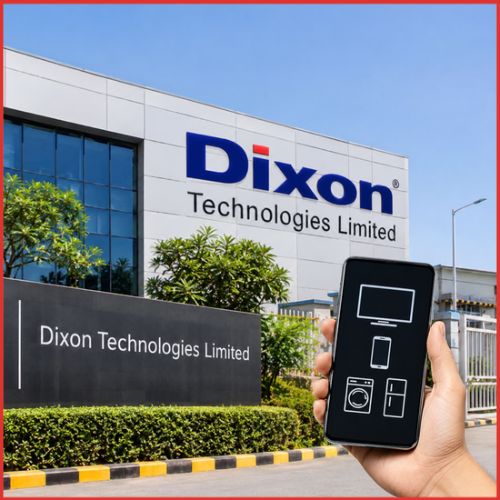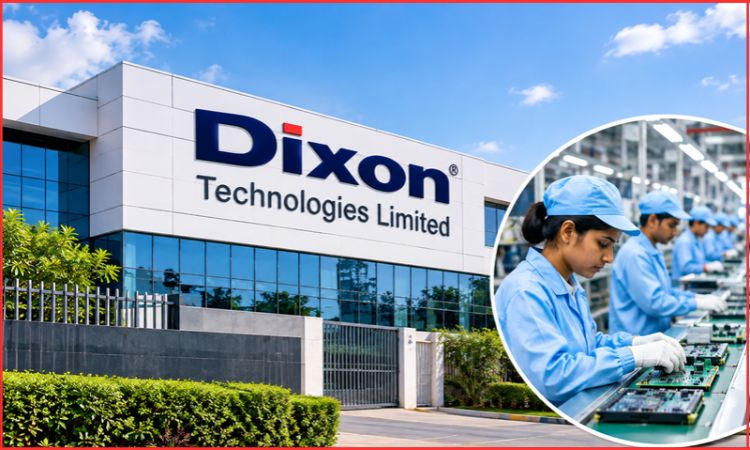
Most people have never heard of Dixon Technologies, yet there is a fair chance the television in their living room or the phone in their pocket came off one of its production lines. The company builds products for other brands and keeps its own name off the box. That choice sits at the centre of the Dixon Technologies success story, and it explains how a small Noida unit set up in 1993 grew into one of the biggest names in the Indian electronics manufacturing industry.
Here is the full picture: the Dixon Technologies history from the first television line, the Dixon Technologies business model, the numbers behind Dixon Technologies revenue, the policy support that helped, and the risks that still hang over the company. Where a figure comes from a filing or a brokerage note, the source sits right next to it.
Quick Glance
| Key Detail | Information |
| Founded | 1993 |
| Founder | Sunil Vachani |
| Headquarters | Noida, Uttar Pradesh |
| Industry | Electronics manufacturing services (EMS) |
| Business model | Contract manufacturing for established brands, with design work in selected products |
| Key segments | Mobile phones, televisions, lighting, home appliances, CCTV, telecom equipment, IT hardware |
| FY26 revenue from operations | About ₹48,873 crore (consolidated) |
| Growth drivers | Mobile volumes, government incentives, joint ventures, in-house components |
Dixon Technologies History: A Rented Shed in Noida
Sunil Vachani did not stumble into manufacturing. His father, Sundar Vachani, had built Weston, a television brand that led the black-and-white era in India, so the son grew up around the trade. After studying at the American College in London, he came home and, with some borrowed money from his father, started Dixon in 1993 in a small rented facility in Noida (EY Entrepreneur of the Year profile, 2021).
Dixon Technologies’ electronics manufacturing began with one customer and one kind of product. The customer was Goldstar, now LG Electronics, and the product was the television. Colour television production started in 1994, and a proper plant followed at Noida in 1996. Services were taking off across the country in those years, so a young man choosing a factory floor over an office was swimming against the current.
That patience is the core of Dixon Technologies’ history. The company stayed small for a long time, learned to run a plant cheaply and reliably, and kept its head down. It became a public limited company in May 2017 and listed on the stock exchanges the same year.
The Dixon Technologies Business Model, Explained
Dixon does not sell televisions or phones under its own name. It makes them for others. This is the EMS arrangement, short for electronics manufacturing services, and the Dixon Technologies business model rests on a simple bargain: the brand brings the design, the marketing and the buyers, and Dixon brings the factory, the workers and the testing lines.
For some products it goes a step further. In lighting, LED televisions and semi-automatic washing machines it works as an original design manufacturer, which means it helps design what it builds. It also runs a reverse-logistics service that repairs and refurbishes returned devices.
The customer list shows why the model holds up. LG came first. Flipkart signed a design, manufacture and supply agreement in October 2017 for its MARQ range, Xiaomi followed in 2018 for Mi LED TVs, and in December 2020 Padget Electronics, Dixon’s mobile subsidiary, signed up to make Nokia phones for HMD Global. Each contract keeps a production line busy that Dixon would otherwise have to fill alone.
The catch is margin. Contract work pays thinly. Dixon’s EBITDA margin was 3.9% in FY25 and 5.3% in FY26 (HDFC Sky, May 2026), which tells you how little room there is for error. What keeps the Dixon Technologies business model alive is speed and a tight grip on working capital, which the company puts at negative eight days (FY26 results release, as reported by Investywise).
Dixon Technologies Manufacturing: Widening the Product Range
For years, Dixon was a television maker. That was its identity and its risk. One product category can slump, and the people who place the orders know it.
So the company kept adding lines. The Dixon Technologies manufacturing base now covers televisions, lighting, washing machines, refrigerators, CCTV cameras, set-top boxes, wearables, telecom equipment, mobile phones and IT hardware. Every category asks for something different. A phone needs fine component placement. A refrigerator needs mechanical assembly and long test cycles. A CCTV camera needs a bit of both, plus software.
Dixon Technologies’ electronics manufacturing grew in steps, and the milestones are easy to line up:
| Year | Milestone |
| 1993 | Dixon starts at a rented Noida facility, serving Goldstar (now LG) |
| 1994 | Colour television production begins |
| 1996 | Noida manufacturing plant set up |
| 2008 | Lighting added to the product range |
| 2010 | Washing machines and LED televisions follow |
| 2016 | Mobile phones begin through Padget Electronics |
| 2017 | Stock market listing; Flipkart agreement for MARQ products |
| 2018 | CCTV and DVR production for CP Plus through the AIL Dixon joint venture in Tirupati; Xiaomi LED TVs |
| 2019 | Dixon takes full ownership of Padget, up from 50% |
| 2022 | Printed circuit board line for air conditioners starts in Noida |
| FY2025 | Refrigerator plant in Greater Noida begins operations |
| 2026 | Government approves the display-module joint venture with HKC |
Dixon also makes a lot of the phones that rarely make headlines. A brokerage note puts its share at nearly two-thirds of India’s feature phones (ICICI Direct, Q1 FY27 note).
Mobile Manufacturing: The Segment That Changed the Numbers
Mobile phones changed Dixon Technologies revenue more than any other product. The company entered handsets in 2016 through Padget Electronics, then a joint venture, and bought the other 50% in April 2019. As smartphone output in India climbed, the Indian electronics manufacturing industry began to look like a serious production base for global brands, and Dixon was already standing there with a factory.
Volume tells the rest of the story. Dixon shipped about 27 million phones in the first nine months of FY26 (ICICI Direct, Q3 FY26 note). Its chairman has talked about Dixon Technologies manufacturing capacity of 60 to 70 million phones a year, rising towards 100 million if the planned Vivo venture goes ahead (Sunil Vachani, as reported by Communications Today). That venture, announced in December 2024, gives Dixon 51% and Vivo India 49%. It needs government clearance, and investors have watched the timing closely.
Phones are a volume game with sharp edges. Orders are huge, but specifications change fast, memory and display prices swing, and the value of a contract rises and falls with the cost of the parts. A May 2026 brokerage report made the point plainly: a good part of Dixon’s reported revenue simply follows the bill of materials (Business Standard-hosted brokerage report, May 2026).
Dixon Technologies Revenue: Four Years in Numbers
Dixon Technologies revenue grew roughly four times between FY23 and FY26. The table below shows consolidated figures.
| Financial year | Revenue from operations (₹ crore) | Profit after tax (₹ crore) |
| FY23 | 12,192 | 256 |
| FY24 | 17,691 | 375 |
| FY25 | 38,860 | 1,233 |
| FY26 | 48,873 | 1,644 |
The FY23 and FY24 numbers come from Business Standard (Capital Market, May 2024), FY25 from the company’s BSE disclosure as reported by Bajaj Broking, and FY26 from a brokerage note hosted by Business Standard and HDFC Sky’s results coverage. The company’s own reported total for FY26, including other income and one-off gains, was ₹49,586 crore. FY26 profit also includes gains from a fair-value adjustment and the transfer of the lighting business. Stripping those out, Dixon reported revenue of ₹48,893 crore, up 26%, with profit growth of 20% (Angel One and Investywise coverage, May 2026).
The FY25 leap was 119.7%. The first quarter of FY26 alone brought in ₹12,836 crore, almost double the year before (AlphaStreet). Mobile volumes drove most of it.
Still, Dixon Technologies revenue is not the same as profit, and the last quarter of FY26 showed it. Profit after tax fell 36% to ₹298 crore while revenue rose about 2%, partly because the year-ago quarter had carried a ₹250 crore fair-value gain on Dixon’s stake in Aditya Infotech (HDFC Sky, May 2026). Investors who only watch the top line miss that kind of detail.
Government Policy and the Indian Electronics Manufacturing Industry
For years India imported most of its finished electronics. The Indian electronics manufacturing industry began to change when the government started rewarding companies for building at home. Under the Production Linked Incentive (PLI) schemes, eligible firms earn incentives on what they make locally. Dixon takes part in five of them, covering telecom, LEDs, air conditioners and IT hardware, and it has applied for support on components such as compressors and motors (Outlook Business, 2025).
The mobile PLI was due to expire on 31 March 2026, and brokerage notes through the year treated its extension or replacement as one of the biggest swing factors for the company (ICICI Direct, Q3 FY26 and Q1 FY27 notes). Dixon has also applied for display, camera and battery projects under the Electronics Component Manufacturing Scheme (brokerage note hosted by Business Standard, March 2026).
Policy alone does not explain the Dixon Technologies success story, though. A subsidy helps only while it lasts. Cost, quality and delivery still decide who wins the next contract, and Dixon Technologies’ manufacturing plants compete for those contracts with factories in other countries.
Partnerships and Backward Integration: Making the Parts, Too
Contract manufacturers run on trust. A brand that hands over a product line wants on-time deliveries and no quality surprises. Three decades of that reputation now help Dixon bring partners in on the component side:
- Vivo India: a phone-making venture with Dixon holding 51%, announced in December 2024.
- HKC Overseas: a display-module venture, approved by the electronics ministry (MeitY) in March 2026. Vachani has said Dixon would put about ₹400 crore into display modules alone (Communications Today).
- Kunshan Q Tech: a camera-module sub-assembly venture.
- Dixon Electroconnect: optical transceivers.
The logic is simple. A phone assembled in India still carries imported displays, cameras and chips. Every part Dixon makes itself is margin it keeps and a delay it avoids. That shifts the Dixon Technologies business model from pure assembly towards part assembler, part component maker. Management expects 70 to 80% of its mobile business to be component-integrated by FY28 (ICICI Direct, Q3 FY26 note), and one brokerage expects margins to widen by 40 to 50 basis points as local components scale up (Business Standard-hosted brokerage report, May 2026). Treat both as targets, not results.
There is a flip side. Vachani himself has said some of the technology Dixon wants is available only in China. Dixon Technologies electronics manufacturing in components therefore leans on foreign partners and on government approvals for foreign equity, and either can slow a project.
Key Takeaways
- The Dixon Technologies success story starts with a borrowed-money factory in Noida in 1993 and one customer, LG’s predecessor Goldstar.
- The Dixon Technologies business model is contract manufacturing: brands design and sell, Dixon builds.
- Dixon Technologies manufacturing now spans phones, televisions, lighting, appliances, CCTV, telecom gear and IT hardware.
- Dixon Technologies revenue rose from ₹12,192 crore in FY23 to about ₹48,873 crore in FY26, led by mobile phones.
- Dixon Technologies electronics manufacturing is moving into displays, camera modules and other components through joint ventures.
- Margins are thin, customers are concentrated and policy timing matters, so growth in sales is not the same as growth in returns.
Conclusion
Dixon grew by doing the unglamorous part of the electronics trade, and doing it well. It began with televisions for a single customer, added product after product, and rode the policy push that is reshaping the Indian electronics manufacturing industry. The Dixon Technologies success story is as much about patience and execution as it is about scale: a founder who chose factories when services were fashionable, and a company that kept winning contracts because brands could trust the delivery.
What happens from here depends on margins, components and keeping the new plants full. If Dixon can turn volume into steady profit, the next chapter of Dixon Technologies history may be bigger than the first.