Not long ago, selling T-shirts online meant buying a few hundred of them first, clearing a corner of the house for the boxes, and hoping the designs would sell. A print-on-demand business in India turns that order upside down. You sell the design first, and the product only gets made once a customer has paid for it.
That’s why print-on-demand India has caught on with designers, college students, freelancers and people launching their very first business. Nobody has to park their savings in stock just to find out whether an idea works. A good way to think about a zero inventory business is as hiring a factory for one order at a time. Your supplier prints, packs and ships, and you take care of the designs, the store and the marketing.
The POD business model does take the stock risk off your plate, and that matters a lot. It doesn’t take away every risk though, and most beginners discover that somewhere around month two. This guide looks at both sides: what makes it work, and where people usually slip.
Quick Glance
| Factor | Details |
| Business model | Made-to-order e-commerce |
| Inventory required | Zero or minimal |
| Initial investment | Relatively low |
| Popular print-on-demand products | T-shirts, mugs, hoodies, posters, phone cases |
| Main requirement | Original designs and steady online marketing |
| Production and shipping | Usually handled by the POD supplier |
| Target customers | Niche communities and online shoppers |
| Profit source | Selling price minus production, shipping and marketing costs |
| Biggest challenge | Competition and finding customers |
What Is a Print-on-Demand Business?
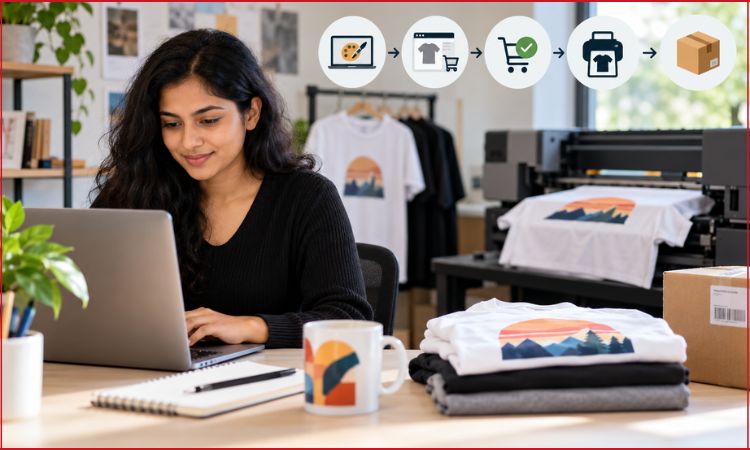
Put simply, you sell products that don’t exist yet. Compare it with the traditional way: you pay for 100 shirts, store them in a spare room and wait for buyers to turn up. With print-on-demand products, you upload a design to a platform and list the item in your store. When someone places an order, the supplier prints that one piece, packs it and sends it straight to the customer. The chain runs from design to listing, then order, printing and shipping, and whatever is left after costs is your margin.
Every print-on-demand India seller works through that same chain, and it changes how you run things. A zero inventory business doesn’t ask you to predict demand. The orders tell you what’s selling, one at a time. It’s also why the POD business model works for people on a small budget, since selling custom products online can begin with five designs rather than a bulk order of five hundred pieces.
How the POD Business Model Works
In practice, the POD business model comes down to five things: a niche, your designs, a supplier, a store and some way of getting people to visit it.
The niche comes first. Selling to everyone usually ends up as selling to no one, so decide who you’re talking to. It could be gym-goers, pet lovers, gamers, travellers, college students, office workers, book lovers or anime fans. Indian pop culture and regional-language communities work well too. A tight niche makes branding easier and gives your print-on-demand products a reason to exist.
Designs come next, and they carry the whole business. Typography, illustrations, patterns and personalised text can all work. Copyrighted characters, film logos, celebrity faces and other people’s artwork can’t, so stay away from them. Instead of a plain gym tee, you could try dry, funny fitness quotes for Indian gym-goers who keep promising to start leg day next Monday.
Then you need a supplier, who makes the product once an order lands. You might use one of the print-on-demand suppliers India has to offer, an international POD company, or one that plugs directly into your store. On the surface, most print-on-demand suppliers India sellers can choose from look pretty much the same. The differences show up in product quality, printing technology, base price, shipping charges, delivery time, return policy, branding options like custom labels and packaging, and how well they connect with your store. Order samples before you commit. Always. Spending a bit of time on print-on-demand suppliers India sellers genuinely rely on is cheaper than being stuck with a weak one.
Your store is where customers find you. You can build your own website or sell through marketplaces and social commerce. A website gives you control over branding, the buying experience and customer data, while marketplaces bring a ready-made crowd but take some of that control away. Many people selling custom products online start with one and add the other later.
Promotion is the last piece, and it’s the one beginners underestimate. Putting up a listing isn’t the same as selling. Instagram Reels, Pinterest, YouTube Shorts, influencer tie-ups, SEO and paid ads can all bring buyers in, but the real goal is to build an audience around your niche rather than post product photos and wait.
How to Start a Print-on-Demand Business in India With Zero Inventory
Starting doesn’t mean spending thousands of rupees on stock, but “zero inventory” is not the same as “zero cost”. Even a lean zero inventory business pays for website hosting, a domain name, design tools, product samples, payment processing fees, advertising, and branding and content. The sensible approach is to keep fixed costs low and avoid bulk buying altogether.
Step 1: Research the Market
Before you sketch 50 designs, find out what people already buy. Scroll through social platforms, marketplaces and Google results for your niche, and pay attention to repeating themes, price points, product types and customer complaints. People hunting for custom products online usually type something very specific into the search bar, so study the exact words they use.
Skip the question “What should I sell?” and ask which specific group of people has a reason to buy this. That answer shapes almost everything else in a print-on-demand business in India.
Step 2: Pick a Few Products
Launching with hundreds of items is a mistake. A starter range of five T-shirts, three hoodies, three mugs and three tote bags is plenty to test demand without turning your store into something you can’t manage.
Step 3: Build a Brand
It’s very easy for a POD store to become one more generic T-shirt website. A memorable name, a consistent look and a clear tone of voice help you avoid that. Your brand has to answer one simple question: why should someone buy from you and not from the dozens of similar stores? Anyone buying custom products online can compare five shops in five minutes. A brand for Indian office workers, for example, could build its whole identity on workplace humour, meeting-room pain and corporate-life jokes.
Step 4: Work Out Your Selling Price
Don’t price only off the supplier’s base rate. The real formula is selling price minus product cost, shipping, payment fees and marketing cost, and what remains is your profit. Say a T-shirt sells for ₹699, production costs ₹280 and shipping is ₹70. Before payment fees and marketing, you’re left with ₹349. Spend another ₹100 to win that customer and you’re down to roughly ₹249. These numbers are only examples, and your supplier’s actual rates will differ. This is exactly why pricing and customer acquisition sit at the centre of any POD business model.
Step 5: Order Samples
Supplier photos tell you very little about what the customer will actually hold in their hands. Order samples and check the fabric, print sharpness, colour accuracy, packaging, size consistency, delivery time and how the print holds up after a few washes. A poor product brings bad reviews and returns, however good your marketing is. Whichever print-on-demand suppliers India sellers trust make it onto your shortlist, put each one through the same sample test.
Best Print-on-Demand Products to Sell in India
The right print-on-demand products depend on your audience and your design style. T-shirts are the easiest way in for beginners because they allow endless design variety, and a niche graphic or a funny quote can make a plain tee feel personal. Hoodies sell at higher prices and suit streetwear, college and lifestyle brands, but production costs are higher too, so watch your margins.
Mugs are simple, giftable and easy to personalise, which makes them one of the easiest custom products online to launch. They do well for birthdays, office humour and corporate gifting. Tote bags suit lifestyle, sustainability and fashion-led brands. Phone cases are very visual and buyers like switching them, so they’re a good fit if you enjoy producing new artwork often. Posters and wall art tend to work well for artists, illustrators and home-décor stores.
How to Find a Profitable POD Niche
Competition is the biggest headache in print-on-demand India. A broad category like fashion is almost impossible to own, so shrink your audience on purpose. Fitness becomes women who enjoy strength training, which becomes funny gym designs for women. Travel becomes Indian travellers, which becomes Hindi-English travel quote merchandise.
A narrow audience makes your content more relevant and gives your marketing a direction. You can also test two or three micro-niches with small collections before settling on one. That flexibility is a real strength of a zero inventory business, because changing direction doesn’t leave you stuck with unsold stock.
Marketing Strategies for a POD Business
Marketing a print-on-demand India store mostly comes down to earning attention. Instagram suits visual products, so think product Reels, styling videos, behind-the-scenes clips, customer reviews, meme-based posts and design polls. Skip the constant “Buy this T-shirt” posts. Make things your audience would happily watch even if you weren’t selling anything.
Micro-influencers fit niche brands well. A fitness apparel store, for example, could partner with smaller fitness creators whose followers match its ideal buyer. SEO is slower, but it brings steady organic traffic over time. Write pages and articles around your niche, your products and buying-intent searches, such as customised birthday gifts or personalised mugs if you sell gifts. Sellers of custom products online often find that search traffic costs less than ads in the long run.
Paid ads on Meta and Google can speed up product testing, but beginners should hold back on heavy spending until they know which products and creatives convert. Start small and keep an eye on click-through rate, cost per click, add-to-cart rate, conversion rate, customer acquisition cost and return on ad spend.
Is a Print-on-Demand Business in India Profitable?
It can be, but profit isn’t guaranteed. Treat your first few months of print-on-demand India selling as a testing phase, not a payday. The big advantage of the POD business model is lower inventory risk, since you aren’t locking cash into stock that may never move.
Your margins still depend on supplier costs, shipping, discounts, returns, payment fees and ad spend. The strongest sellers in print-on-demand India rarely compete on price alone. They build a recognisable brand for one audience and offer designs people can’t easily find elsewhere.
Conclusion
A print-on-demand business in India lets you step into e-commerce without a warehouse or a pile of stock. The opportunity isn’t in slapping a quote on a T-shirt and uploading it. It comes from knowing a specific audience, understanding what they care about and making products for that community.
Start with a narrow niche and a short list of print-on-demand suppliers India sellers already trust. Launch a small set of print-on-demand products, order samples, test demand and track your numbers honestly. Once a few items sell steadily, widen the catalogue and put more into marketing.
If a zero inventory business appeals to you, print-on-demand is a practical place to begin. What decides the result is design sense, positioning, product quality and the knack for turning attention into paying customers.