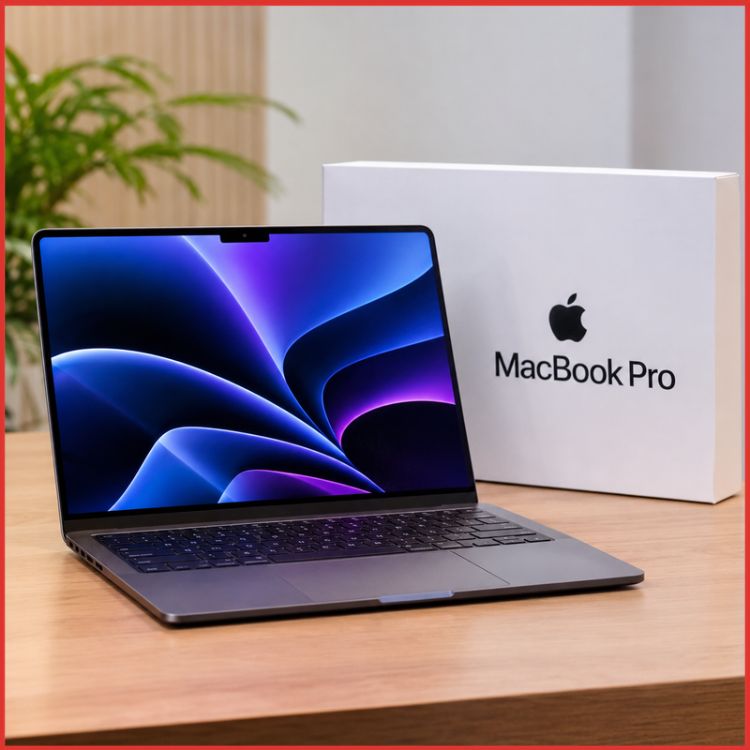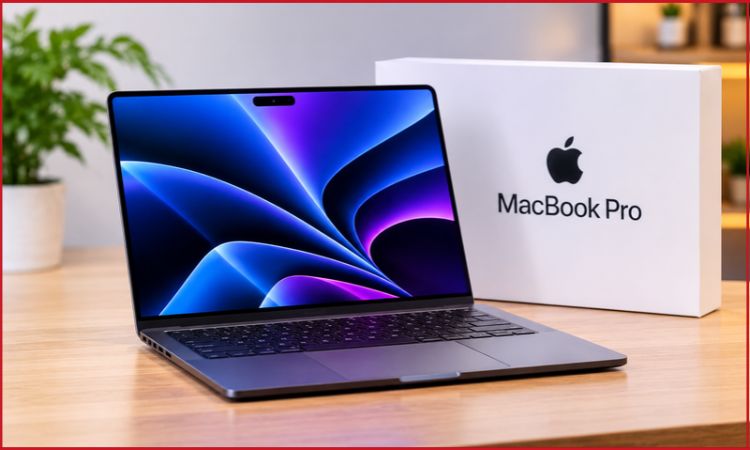
Apple has finally done something it resisted for years: put a touchscreen on a MacBook.
The company has launched new 14-inch and 16-inch MacBook Pro OLED models in India with a tandem OLED display, direct touch input and Dynamic Island. Prices start at ₹3,49,900, placing the new machines firmly above Apple’s existing MacBook Pro lineup.
The change is bigger than a routine display upgrade. Apple has spent years keeping touch interaction on the iPad while positioning the keyboard and trackpad as the correct way to use a Mac. The new MacBook Pro does not abandon those controls, but touch is now another option.
Apple Calls the New Screen PROLED XDR
The new display carries the PROLED XDR branding.
It uses tandem OLED technology, meaning two self-emitting pixel layers are combined rather than relying on the mini-LED backlight used in previous MacBook Pro models.
Apple claims peak HDR and SDR brightness of up to 2,000 nits, a 10,000,000:1 contrast ratio and adaptive refresh rates of up to 120Hz. The display supports both P3 and Adobe RGB colour spaces and covers more than 80% of Rec. 2020 for HDR workflows.
That specification is clearly aimed at video editors, photographers, colourists and designers rather than everyday laptop buyers.
The display also gets a new anti-reflective coating, while a nano-texture option remains available for users working under bright lighting.
Touch Comes to Mac for the First Time
The bigger change is the touchscreen itself.
Users can now tap buttons, swipe through webpages, pinch to zoom, move windows and drag items directly on the display.
Apple is also pitching touch for professional work.
Designers can draw directly on the screen, musicians can use onscreen instruments and developers can test touch behaviour in iOS and iPadOS apps from the Mac itself.
Importantly, Apple has not replaced the trackpad.
The touchscreen MacBook Pro still uses the usual keyboard-and-trackpad setup, with touch acting as another input method rather than forcing users into a tablet-style workflow.
That may prove important for longtime Mac users who never wanted the laptop interface redesigned around touch.
Dynamic Island Replaces the Notch
The notch is gone too.
Apple has brought Dynamic Island to MacBook Pro, using the space around the camera cutout for Spotlight, Live Activities and Siri AI.
Music controls and other system information can also appear there.
The approach is similar to the iPhone, although it serves a different purpose on a laptop. Rather than simply hiding the camera area visually, Apple is turning it into an interactive part of macOS.
That also helps explain why the company did not simply redesign the webcam cutout into a smaller hole.
Dynamic Island gives Apple another interface layer it can use across apps and system functions.
M5 Pro and M5 Max Power the New Models
The new machines use Apple’s M5 Pro and M5 Max processors.
They are configurable with up to 128GB of unified memory and as much as 16TB of SSD storage.
Apple is positioning the chips around demanding workloads such as 3D modelling, scientific computing, software development and local artificial-intelligence models.
Connectivity includes three Thunderbolt 5 ports, HDMI, MagSafe, an SDXC card reader and a headphone jack.
Wireless connectivity has also moved forward with Wi-Fi 7 and Bluetooth 6.
M5 Pro configurations support up to three external displays, while M5 Max models can drive as many as four.
The New MacBook Pro Is Lighter
OLED has also helped Apple reduce weight.
The 14-inch model now weighs about 3 pounds, or roughly 1.36kg, while the 16-inch version is around 4 pounds, or approximately 1.81kg.
That makes both noticeably lighter than the previous mini-LED generation.
The chassis is thinner as well.
Apple says it has redesigned the thermal system so the laptops can maintain M5 Pro and M5 Max performance despite the slimmer construction.
For the 16-inch version, the screen has grown slightly to 16.3 inches.
The 14-inch stays at 14.2 inches.
Battery Life Still Reaches 24 Hours
Adding OLED and touch has not forced Apple to give up one of the MacBook Pro’s biggest advantages.
The company claims up to 24 hours of battery life.
Fast charging can take the battery to around 50% in 30 minutes with the appropriate charger.
There is also a 12MP Center Stage camera, studio-quality microphones and a six-speaker system that Apple says now produces 50% deeper bass.
The laptops ship with macOS 27, where Apple has adjusted parts of the interface to recognise whether someone is using touch or the trackpad.
That software work may matter as much as the hardware.
Simply adding touch to a desktop interface can make buttons and menus awkward. Apple is trying to avoid that by adapting controls around how the user is interacting.
India Prices Start at ₹3,49,900
This is not a cheap upgrade.
The 14-inch MacBook Pro with M5 Pro starts at ₹3,49,900.
The 16-inch M5 Pro version begins at ₹4,09,900.
Move to M5 Max and the 14-inch price rises to ₹5,49,900, while the 16-inch starts at ₹5,89,900.
That puts the new OLED models roughly ₹50,000 above comparable mini-LED configurations.
Apple is therefore treating the touchscreen and display as premium features rather than replacing the rest of the MacBook Pro lineup immediately.
The laptops are available in Space Black and Silver.
Pre-orders have already opened in India, with retail availability scheduled for early November.
This Is Apple’s Biggest MacBook Pro Change in Years
The interesting part of this launch is not simply the specification sheet.
Apple spent years arguing, directly or indirectly, that a touchscreen did not belong on a traditional Mac.
The iPad was supposed to handle that type of interaction.
Now the company is bringing touch, OLED and Dynamic Island into its most expensive laptop family while leaving the conventional keyboard-and-trackpad experience intact.
That suggests Apple is not trying to turn the MacBook Pro into an iPad.
It is trying to make touch useful without rebuilding the entire Mac around it.
Whether professionals actually use the screen that way will become clearer once the laptops reach buyers.
But the debate over whether Apple would ever make a touchscreen MacBook Pro is finally over.
It has.