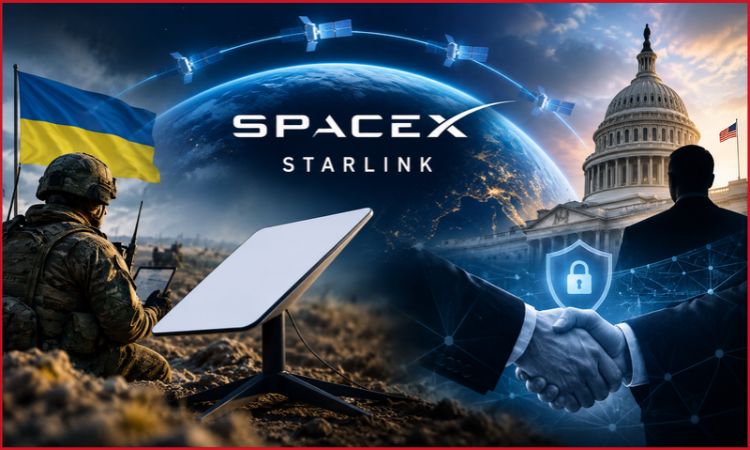
SpaceX has spent years proving that a private company can build a satellite network large enough to become important infrastructure.
That success is creating a new problem.
Governments are now asking what happens when the same privately operated network becomes essential to military communications, emergency response or other national-security systems—and access is later restricted.
Recent disruption involving Starshield services used by Ukraine has brought those questions back into focus. The issue is no longer whether SpaceX Starlink technology works. It clearly does.
The harder question is who ultimately controls it when the service becomes strategically important.
Ukraine Put the Dependence Problem Into Full View
Starlink became deeply embedded in Ukraine’s communications environment after the conflict with Russia began.
Satellite connectivity proved useful because terrestrial infrastructure could be damaged, jammed or otherwise disrupted.
Over time, Starlink and the military-focused Starshield service became important for communications, surveillance and drone-related operations.
That dependence looked very different when connectivity was reduced.
Reuters reported this month that restrictions affecting Starshield disrupted some Ukrainian military operations, including drone missions.
The episode exposed a simple weakness.
If a country’s battlefield communications depend heavily on infrastructure controlled outside its borders, changes to that infrastructure can immediately become a national-security issue.
The Argument Over Who Ordered the Restrictions Matters
The situation is complicated by disagreement over who was responsible.
Reuters reported that an instruction to limit aspects of Starshield service originated from within the White House, citing US and Western officials.
Elon Musk has said operational limits affecting Starshield are controlled by the US government.
Public accounts around authorisation and responsibility have nevertheless remained contested.
That distinction is important because the concern is not simply whether SpaceX independently switched something off.
The broader Starshield trust issue exists even when a government directs the restriction.
A country relying on foreign satellite infrastructure may still find that access is affected by decisions made somewhere else, under a legal and political system it does not control.
Satellite Connectivity Has Become Strategic Infrastructure
Starlink began as a broadband product.
That description now feels incomplete.
A global satellite network can connect homes, businesses, ships, aircraft and remote communities. The same infrastructure can also support defence operations, government systems and emergency communications.
Once that happens, reliability takes on a different meaning.
A streaming customer losing internet access for 20 minutes is inconvenient.
A military unit losing connectivity during an operation is something else entirely.
That is why satellite digital sovereignty is becoming a much larger policy question.
Governments increasingly need to think about who owns the network, where control systems sit, which laws apply and whether service continuity is contractually guaranteed.
SpaceX Still Has a Huge Technological Advantage
None of this removes what SpaceX has achieved.
Starlink operates at a scale few competitors can match.
SpaceX controls its own launch capability, manufactures satellites and has built an enormous low-Earth-orbit network. That vertical integration allows it to deploy and replace capacity more quickly than many rivals.
The company is also expanding into direct-to-phone connectivity.
Earlier this month, SpaceX announced an agreement to acquire an 800 MHz spectrum portfolio in the United States for about $8 billion, strengthening its plans for Starlink Mobile.
The technical ambition is getting larger, not smaller.
The problem is that greater capability also creates greater scrutiny.
Governments May Start Asking for Stronger Guarantees
A commercial customer normally accepts terms of service.
A government relying on satellite communications for critical infrastructure may eventually demand much more.
That can include guaranteed availability, clear rules around service restrictions, independent oversight and specific procedures governing when access can be altered.
Countries may also insist on greater operational visibility rather than depending entirely on decisions made by the network provider or another government.
Those requests could increase the cost and complexity of Starlink government contracts.
They could also slow market entry in countries where regulators already have national-security concerns.
For SpaceX, trust could therefore become as important as coverage or bandwidth when bidding for sensitive work.
India Shows Why This Question Is Broader Than Ukraine
India’s approach to Starlink offers a useful example.
SpaceX has received important approvals related to satellite communications, but commercial operations still depend on additional regulatory, security and spectrum requirements.
Indian authorities have been examining concerns around network control, data, security compliance and how satellite services operate during sensitive situations.
The government has not banned Starlink.
It has, however, been cautious about allowing commercial service before the security framework is settled.
That caution predates the latest Ukraine episode, but the episode gives regulators another real-world case to consider.
India Is Not Evaluating Starlink Alone
Starlink is also not the only company facing satellite regulation in India.
Reliance Jio and Bharti-backed satellite ventures are moving through their own regulatory processes.
India’s communications ministry has said satellite operators are being assessed through the country’s security and spectrum framework and has rejected claims that the process is designed to favour one operator.
That matters because the broader issue is not SpaceX versus one Indian rival.
It is how India wants satellite connectivity to fit into national infrastructure.
A foreign provider can offer technology and coverage that would take years to recreate locally.
The trade-off is the degree of dependence policymakers are willing to accept.
Countries May Decide One Network Is Not Enough
The most likely response may not be to reject foreign satellite systems entirely.
It may be diversification.
A government could use commercial networks while maintaining separate domestic or allied capabilities for the most sensitive functions.
Military organisations already think in terms of redundancy because relying on one communication route creates a single point of failure.
The same logic can apply to satellites.
If one network is jammed, restricted or unavailable, another should be able to take over.
That could create more demand for sovereign satellite networks and competing low-Earth-orbit systems rather than leaving critical operations dependent on a single provider.
The Trust Question Will Follow SpaceX Into New Markets
VARINDIA describes the current situation as a global trust crisis for SpaceX.
The eventual impact will depend on how governments respond.
Some may demand stronger contracts. Others may invest more heavily in domestic alternatives. Many are likely to keep using Starlink while avoiding complete dependence on it.
SpaceX still holds a formidable technical position.
Its satellite network is large, launch capability is difficult to match and its direct-to-device plans could extend Starlink into another huge communications market.
But the company is increasingly entering areas where technology is only one part of the purchase decision.
For SpaceX and Starlink, the next challenge is proving not just that the network can connect almost anywhere.
It is proving that governments can understand, predict and trust what happens to that connection when the stakes are highest.
Source: