DeepSeek and Huawei are working together on a new set of open-source programming tools for Huawei’s Ascend artificial intelligence chips, tackling one of the biggest challenges facing any company trying to compete with Nvidia: software.
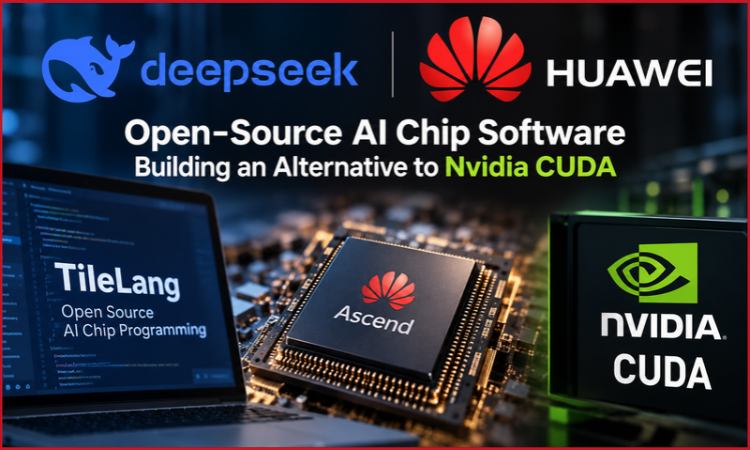
The Chinese AI developer has released infrastructure for Huawei’s Ascend platform that includes TileLang, a high-level programming language, alongside compute and communication libraries designed to make it easier for developers to use Ascend hardware.
The project is important because Nvidia’s advantage in artificial intelligence has never depended on chips alone. CUDA, its long-established software platform, gives developers a mature collection of tools for building and optimising applications around Nvidia GPUs.
DeepSeek and Huawei are now trying to make the software experience around Ascend chips considerably easier.
TileLang Is Designed to Simplify AI Chip Programming
Programming high-performance AI hardware usually requires developers to balance two competing goals.
They want a language that is simple enough to work with efficiently, but they also need enough low-level control to take full advantage of the underlying processor.
DeepSeek says TileLang programming language was created to address that problem.
The company describes it as a higher-level approach that can make code simpler while still allowing developers to access the performance of the hardware underneath.
For Huawei’s Ascend platform, TileLang sits above lower-level Ascend C instructions.
Instead of forcing developers to manage every hardware detail directly, the software aims to provide a more accessible programming layer.
DeepSeek says this can improve development efficiency while reducing complicated code logic.
Why CUDA Is So Important to Nvidia
Nvidia’s position in AI cannot be understood by looking only at processor specifications.
CUDA first appeared nearly two decades ago and has since become deeply embedded in scientific computing, machine learning and artificial-intelligence development.
Universities, companies and software developers have built tools and applications around the platform for years.
That creates a powerful ecosystem effect.
Even if another manufacturer produces capable hardware, developers may hesitate to move if doing so means rewriting software, learning unfamiliar tools or giving up libraries they already rely on.
This is why a CUDA alternative requires far more than producing a competing AI accelerator.
It needs programming languages, compilers, libraries, documentation and tools that make the hardware practical to use.
DeepSeek’s latest releases target exactly that gap.
DeepSeek Is Releasing More Than a Programming Language
TileLang is only one component of the open-source effort.
DeepSeek is also releasing related compute and distributed-communication libraries for Huawei’s Ascend platform.
Compute libraries provide optimised building blocks for operations that AI models repeatedly perform, while communication libraries help large groups of processors exchange data efficiently.
That second part becomes particularly important for modern AI.
Training or serving a large model may require hundreds or thousands of accelerators operating together. The speed of individual chips matters, but so does the efficiency with which they communicate across the wider computing system.
The DeepSeek Huawei partnership is therefore working on the broader software infrastructure rather than treating TileLang as a standalone project.
The Software Is Being Released as Open Source
Open sourcing the tools could help the platform gain users more quickly.
Developers can inspect the software, experiment with it and contribute improvements rather than waiting entirely for one company to add every feature.
That approach has already played an important role in DeepSeek’s rise.
The company has released major AI models and supporting technologies openly, allowing developers around the world to test, modify and deploy them.
Applying a similar strategy to AI-chip software could help Huawei attract more development activity around Ascend.
The immediate challenge will be making sure the open-source tools are mature enough for production workloads.
CUDA has had years to develop, so catching up will require much more than one software release.
Huawei’s Ascend Chips Are Becoming More Important
Huawei has been expanding the Ascend family as demand for computing power used by AI models continues to rise.
The company has also developed larger systems that combine many Ascend processors rather than relying entirely on individual chip performance.
DeepSeek has already been working closely with that hardware.
Earlier in 2026, Huawei said its Ascend supernode infrastructure would support DeepSeek’s V4 models.
More recently, DeepSeek has been linked with plans to deploy a very large number of Huawei accelerators in new computing infrastructure.
The new Ascend AI software makes that hardware relationship more practical for developers as well.
Better tools can reduce the difficulty of moving workloads to a different chip platform.
Software Could Matter More Than Raw Chip Speed
Chip comparisons often focus on processing power, memory bandwidth and benchmark results.
For businesses actually deploying AI, developer productivity can be just as important.
A faster processor offers limited value if engineering teams have to spend months rewriting software to make it work.
This is where Nvidia’s mature ecosystem has historically been particularly difficult to challenge.
DeepSeek says TileLang offers a simpler programming model than CUDA, but that claim does not mean the new platform already matches CUDA’s overall ecosystem.
CUDA includes a much wider collection of tools, libraries and software accumulated over many years.
TileLang should therefore be viewed as one part of an effort to reduce the programming gap rather than a complete replacement appearing overnight.
DeepSeek Could Help Huawei Attract AI Developers
DeepSeek brings something particularly valuable to the partnership: experience building and operating large AI models.
A chip company can design software tools internally, but feedback from a major model developer can help expose what programmers actually need when handling demanding AI workloads.
DeepSeek says operators used in its own training environment now have high-performance implementations for Ascend.
That means the collaboration is being informed by real model-development requirements rather than only theoretical hardware capabilities.
If other developers find the same tools useful, Huawei Ascend chips could become easier to adopt for a wider range of AI workloads.
Nvidia’s Ecosystem Will Not Be Easy to Displace
The latest announcement should not be interpreted as Nvidia suddenly losing its software advantage.
CUDA remains deeply established across the global AI industry.
Its value comes from years of developer familiarity, optimisation work and support across an enormous range of software.
Building a credible alternative will require sustained development.
Libraries must remain reliable, new hardware must be supported quickly and developers need confidence that software written today will continue working as the platform evolves.
DeepSeek and Huawei now have another piece of that puzzle.
By open sourcing TileLang and accompanying libraries, the companies are trying to lower one of the practical barriers to using non-Nvidia AI hardware.
The DeepSeek Huawei partnership therefore matters for more than one programming language.
It represents an attempt to build the software layer needed around an alternative AI-computing ecosystem.
Nvidia has demonstrated that great chips and great software reinforce one another. Huawei has been building the hardware. DeepSeek’s latest move shows the next battle may increasingly be about making that hardware just as straightforward for developers to program.
Source:
CNBC-TV18: China’s DeepSeek launches open-sourced software with Huawei that may rival Nvidia CUDA