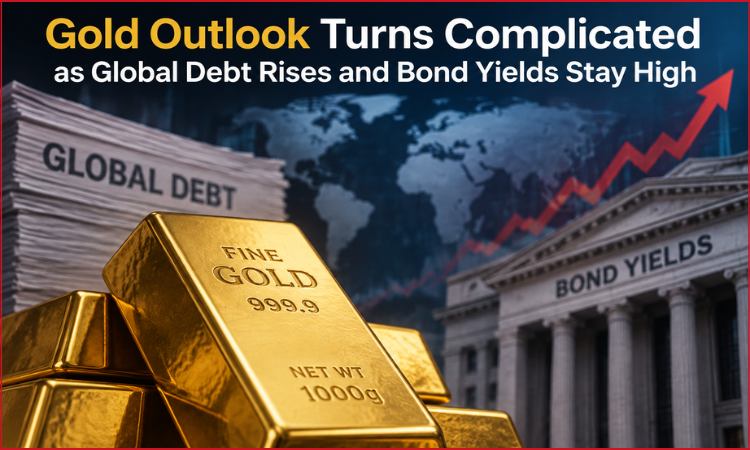
Gold is heading into another closely watched phase after a volatile year in which concerns over government borrowing have supported demand for the metal, while rising bond yields have repeatedly limited its upside.
The conflicting forces have made the gold price forecast for the remainder of 2026 less straightforward than it first appears. Growing public debt can strengthen gold’s appeal as an alternative store of value, but investors are also being offered increasingly attractive returns on government bonds.
Gold recently traded around the $4,350-an-ounce region after pulling back from higher levels. The market is now watching whether prices can hold above important support near $4,300 and build another move towards $4,400 and beyond.
Global Debt Is Giving Gold Long-Term Support
One of the biggest arguments in gold’s favour is the steady rise in global debt.
Governments around the world have accumulated larger borrowing requirements, while higher interest rates have made servicing that debt more expensive. As older bonds mature and new borrowing is issued at higher rates, interest expenses can take up a larger portion of government budgets.
That matters to gold because the metal does not depend on the ability of a government, company or financial institution to repay it.
Physical gold carries no credit risk in the traditional sense. For that reason, investors and central banks have historically turned to it when confidence in currencies or government finances becomes less certain.
The relationship is not automatic. Higher debt does not mean gold must rise immediately. What it does is create another reason for investors to keep some exposure to an asset outside the conventional financial system.
Bond Yields Are Creating the Opposite Pressure
The problem for gold is that the same fiscal concerns supporting demand can also push bond yields higher.
The US 10-year Treasury yield recently reached around 5%, putting it at levels that offer investors a meaningful return simply for holding government debt.
That creates competition. If real yields remain elevated, gold can struggle even when concerns about debt remain in the background.
That tension explains why the metal has not simply moved higher every time worries about government finances have increased.
$4,300 Has Become an Important Price Area
From a market perspective, the $4,300 level is attracting particular attention.
Gold holding comfortably above that area would keep the possibility of another recovery alive. A move through $4,400 could then bring the $4,500 region back into view.
Beyond that, $4,600 and $4,700 are potential higher resistance zones if momentum strengthens considerably.
The downside picture looks different. If gold prices repeatedly fail to move beyond resistance and then fall below $4,300, the market could begin looking towards support near $4,250 and $4,200.
A deeper pullback could place $4,150 in focus. These levels are not guarantees of where the market will turn. They are simply areas where buying or selling activity may become more noticeable, particularly when broader economic conditions are changing quickly.
The US Dollar Remains Part of the Equation
Gold may be traded around the world, but its international price is still primarily quoted in US dollars.
That makes the currency an important part of the gold price forecast. A stronger dollar can make bullion more expensive for buyers using other currencies, potentially weighing on demand. A weaker dollar normally provides more breathing room.
Dollar movements are closely tied to interest-rate expectations. If investors expect monetary policy to remain tight and US yields continue rising, the dollar may stay supported. That would create another obstacle for gold even if concerns about debt remain elevated.
The opposite combination would be much more favourable. Softer yields together with a weaker dollar could remove two of the main pressures holding gold back.
Inflation Still Matters, but Differently
Gold has traditionally been described as an inflation hedge, though the relationship is rarely as simple as that phrase suggests.
Higher inflation can support bullion if investors become worried about the purchasing power of traditional currencies.
At the same time, persistent inflation can lead central banks to keep interest rates higher. That pushes bond yields up and increases the opportunity cost of owning gold.
The market therefore pays close attention to what inflation means for interest rates rather than looking at inflation alone.
If price pressures cool enough for bond yields to fall, gold could benefit even if headline inflation itself is moving lower.
Central Bank Demand Remains Important
One long-running source of support has been central bank demand. Reserve managers have increasingly looked at gold as a way of diversifying holdings beyond traditional currencies and government securities.
That buying can matter because central banks tend to operate on much longer timelines than short-term traders.
Their decisions are normally based on reserve diversification, financial stability and long-term risk management rather than whether gold rises or falls over the next few trading sessions.
Continued official-sector buying could therefore provide some underlying support even when higher yields create temporary selling pressure.
Gold Faces a Tug of War Rather Than a Clear Trend
The current market is unusual because both the bullish and bearish arguments have considerable weight.
On one side, global debt continues to rise, fiscal uncertainty remains elevated and central banks have reasons to diversify their reserves.
On the other, investors can earn around 5% on long-dated US government debt, while a stronger dollar and elevated real yields can make non-yielding bullion less attractive.
That leaves gold caught between two different views of financial risk. Investors worried about long-term debt sustainability may continue treating the metal as insurance. Traders focused on short-term returns may prefer bonds while yields remain high.
The next significant move in gold prices may therefore depend less on one dramatic headline and more on which of those forces begins to weaken first.
If yields start falling while fiscal concerns remain unresolved, gold would have a clearer path towards the $4,400-$4,500 area. If yields stay high and the dollar remains firm, the metal could spend longer moving sideways or retesting lower support.
For now, $4,300 appears to be the line the market keeps coming back to. Whether gold can build another rally from there may tell investors how much weight the debt story still carries.