Indian information technology stocks moved sharply higher on Tuesday, September 15, after senior executives at leading artificial intelligence companies supported a more measured pace of development for advanced AI models.
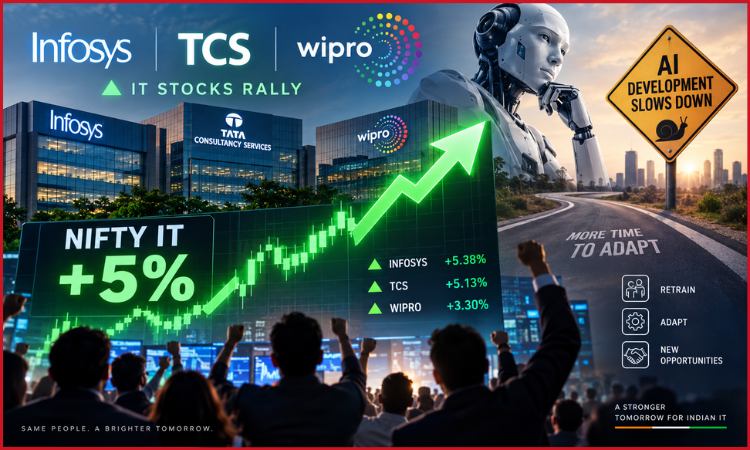
The change in tone gave investors a reason to reassess how quickly artificial intelligence could disrupt traditional software and IT services businesses. The NIFTY IT index jumped around 5% during early trade, with Infosys, TCS, HCL Technologies, Tech Mahindra and Wipro all recording gains.
For Indian IT companies, the market reaction reflects a simple idea: if the development of increasingly capable AI systems becomes more gradual, traditional software services firms could have more time to adapt their businesses, retrain workers and reshape client contracts.
NIFTY IT Jumps Around 5%
The NIFTY IT index climbed to around 30,390.70 during Tuesday’s session, with all ten companies in the index trading higher.
HCL Technologies was among the strongest performers, rising around 6.5% to ₹1,283.70 per share.
Infosys gained approximately 5.38% to ₹1,093.50, while Tata Consultancy Services moved 5.13% higher to ₹2,313.70. Tech Mahindra advanced roughly 5.63% to ₹1,627.70, while Wipro shares were up about 3.30% at ₹172.93.
The broad rally was notable because Indian technology stocks have faced considerable pressure this year.
Investors have spent months debating whether generative AI could reduce demand for traditional software-development projects, lower billing opportunities and allow customers to complete more work internally. Tuesday’s rally suggested that some of those concerns were being reconsidered.
AI Development Debate Changes Market Mood
The immediate trigger came from comments by leaders of major AI companies about the speed at which increasingly advanced models should be developed.
Anthropic chief executive Dario Amodei argued that the industry may need to proceed more cautiously while companies build stronger systems for monitoring and managing advanced artificial intelligence.
Other prominent AI executives also supported the idea of taking a more measured approach.
For markets, the discussion matters because much of the recent technology investment cycle has been built around an assumption that AI capabilities will continue advancing rapidly.
A slower pace could alter how companies allocate money between data centres, specialised chips, new models and software services.
It could also give established technology companies more time to integrate AI into their existing operations rather than reacting to constant technological shifts.
Infosys and TCS Could Get More Time to Adjust
India’s largest IT companies have already been adapting their strategies around artificial intelligence.
TCS, Infosys, Wipro and other major firms are investing in employee training, AI development platforms and specialised teams that work directly with customers. The concern for investors has been whether those companies can change quickly enough.
Traditional IT outsourcing has historically relied heavily on large teams billing clients for engineering, maintenance and consulting work. Artificial intelligence can automate parts of coding, testing, documentation and customer support.
That creates a challenge for companies whose revenue models have traditionally been connected with the amount of human work required to complete a project.
A slower pace of frontier AI development would not remove that challenge. It could, however, give Indian IT firms additional time to move towards new commercial models built around business results rather than simply employee hours.
That possibility helped support the latest Infosys share price and TCS share price gains.
Software Stocks See AI From a Different Angle
The market reaction also highlighted an interesting split within the broader technology industry.
Companies selling the chips and infrastructure required to build AI systems came under pressure globally, while several software and IT-services companies benefited.
That difference makes sense. Chipmakers have gained enormously from the rapid expansion of artificial intelligence infrastructure. A slower pace of investment could reduce expectations for future processor and data-centre demand.
Software companies face almost the opposite issue. Many have been under pressure because investors fear that AI tools could replace some of the services they currently provide.
If AI development becomes more controlled, software companies may have additional room to adjust their products and business models. That does not mean demand for artificial intelligence infrastructure will suddenly disappear.
Large technology groups have already committed significant amounts of money to data centres and computing capacity.
The market is simply beginning to consider whether growth could become more measured.
Wipro Remains Focused on Human-AI Model
Wipro has been particularly active in changing the way its employees work with artificial intelligence. The company has trained more than 100,000 employees in advanced AI-related skills and certifications.
Its technology leadership has also spoken about moving towards a human-AI operating model in which engineers work alongside automated systems and AI agents. The goal is not necessarily to replace workers one-for-one.
Instead, automation can free employee capacity that can then be redirected towards other projects, customer work or new technical skills.
That approach shows why the impact of AI on Indian technology employment may be more complicated than simply calculating how many jobs software can automate.
The larger question is how quickly companies can transform productivity gains into revenue growth.
Global AI Stocks Move in the Opposite Direction
While Indian IT stocks rallied, several major global AI-linked companies moved lower.
Semiconductor companies have been some of the biggest beneficiaries of the artificial intelligence investment boom because advanced models require enormous computing capacity.
Any suggestion that companies could slow the development of new frontier models naturally raises questions about future spending.
Investors are now examining whether the next stage of the AI cycle will involve the same aggressive infrastructure expansion seen over the past few years.
If spending becomes more disciplined, hardware companies could face pressure. For Indian IT services firms, however, a slightly slower development cycle may provide breathing room.
Indian IT Still Faces a Longer-Term AI Test
Tuesday’s rally does not mean the disruption threat facing Indian IT companies has disappeared. Artificial intelligence is already changing software development, customer service, data analysis and consulting work.
Clients increasingly expect technology vendors to deliver higher productivity at lower costs. Companies such as Infosys, TCS and Wipro will therefore still need to prove that they can make money from AI rather than simply use it to perform existing work faster.
The latest gains in IT stocks India reflect improved sentiment, not the end of the industry’s transition. Investors will now watch whether the current rally develops into something more sustainable.
If AI development becomes more measured, Indian IT firms may gain valuable time to retrain employees, adjust pricing models and build new services.
For now, the sharp rise in the NIFTY IT index shows that even a small shift in expectations around artificial intelligence can quickly change how investors value India’s biggest technology companies.
Source: Upstox: Infosys, TCS, Wipro: IT stocks zoom after global AI leaders call for slower development; NIFTY IT jumps 5%