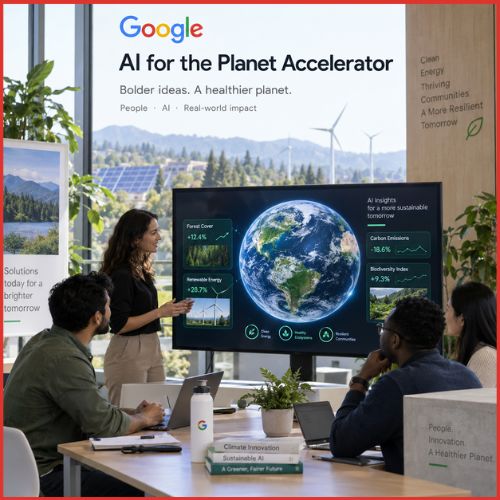
Google has selected four Indian startups for the inaugural Asia-Pacific edition of its AI for the Planet accelerator, putting homegrown climate-tech companies alongside innovators from across the region that are using artificial intelligence to tackle agriculture, carbon management and environmental challenges.
Terrastack, Varaha Climate, Farmers for Forests and Climitra Carbon are the four Indian companies joining the programme. They form part of a 16-member Asia-Pacific cohort spanning startups, nonprofit organisations and research teams working across sustainable agriculture, biodiversity, climate resilience and carbon solutions.
The selection highlights the growing role of Indian climate tech startups in developing commercially useful applications of artificial intelligence beyond mainstream areas such as chatbots and enterprise automation.
Four Indian Startups Make the APAC Cohort
The inaugural Google AI for the Planet accelerator includes organisations from India, Singapore, Australia, New Zealand, Indonesia, Thailand, Japan and South Korea.
India has secured four places in the 16-member programme, giving it one of the strongest representations in the first cohort.
The selected companies are working on different parts of the environmental technology ecosystem:
Terrastack is combining satellite information with agricultural data to provide plot-level intelligence for smallholder farmers.
Varaha Climate is using remote sensing and AI to verify regenerative agricultural practices and carbon-removal activity.
Farmers for Forests is applying AI-powered drones to agroforestry projects and biodiversity measurement.
Climitra Carbon is using Geo-AI to verify the removal of invasive vegetation and support its conversion into biochar.
Together, the companies show how AI climate solutions are moving beyond theoretical modelling and into areas where farmers, carbon-project developers and environmental organisations need measurable data.
Terrastack Brings AI Intelligence to Individual Farms
Terrastack is focused on making agricultural data useful at the plot level.
The company combines satellite imagery, land information, crop activity, climate signals and other agricultural datasets to help understand what is happening on individual parcels of farmland.
That level of detail can become important for smallholder farmers, who often operate on relatively small plots and may have limited access to structured financial or environmental data.
Terrastack has already worked on spatial intelligence covering more than 140 million hectares of farmland in India, integrating information that can support agricultural decision-making and access to climate-linked financial products.
Its inclusion in the accelerator fits into the programme’s sustainable-agriculture category, where artificial intelligence is being used to convert large quantities of satellite and farming information into practical recommendations.
For Indian climate tech startups, this is an area with substantial potential because India’s agricultural sector includes millions of small farms that cannot always be monitored efficiently using traditional field surveys.
Varaha Climate Focuses on Regenerative Agriculture
Varaha Climate is approaching the problem from another angle.
The company works with smallholder farmers and uses technology to measure and verify regenerative agricultural practices and carbon-removal projects.
The company’s digital monitoring tools also support the capture of geotagged farm information and verification of sustainable practices.
If verification becomes faster and more reliable, farmers could potentially participate more easily in carbon programmes while companies buying carbon credits gain greater confidence in the underlying projects.
That makes accurate measurement an important part of the wider AI climate solutions market.
Farmers for Forests Uses AI-Powered Drones
Farmers for Forests has been selected under the programme’s climate and carbon solutions category.
Its work focuses on smallholder agroforestry, where agricultural land is managed alongside trees and other vegetation.
This can make projects easier to monitor while creating more consistent datasets for organisations trying to demonstrate their impact.
The company’s selection also reflects a wider shift in climate technology towards measurable outcomes rather than simply environmental pledges.
Climitra Carbon Turns Invasive Biomass Into Biochar
Climitra Carbon is tackling both land restoration and carbon removal.
The company is developing a system that uses Geo-AI to verify the removal of invasive plant species before converting that biomass into biochar.
Climitra’s use of artificial intelligence focuses partly on verification.
Being able to digitally prove where vegetation has been removed and how projects are progressing can become important for carbon-removal programmes that depend on credible monitoring.
That combination of geospatial intelligence and physical carbon projects shows how AI is increasingly being connected with real-world environmental infrastructure.
Accelerator Will Run for Three Months
The Google AI for the Planet accelerator is designed as an intensive three-month programme.
The cohort began with a hands-on bootcamp in Singapore, while tailored support is scheduled to continue virtually between September and December.
A demo day is planned for December 10 in Singapore. Participating organisations will receive technical guidance, mentorship and access to Google’s AI technology stack.
The programme includes access to specialised frontier models built for environmental use cases, including technologies related to agriculture, biodiversity monitoring, forest analysis and climate forecasting.
Unlike a conventional startup accelerator centred primarily on fundraising or sales growth, the programme is specifically aimed at solving technical challenges associated with environmental projects.
That could be particularly valuable for climate-focused startups because their products often depend on complex combinations of satellite data, machine learning, physical infrastructure and scientific measurement.
India’s Climate-Tech Ecosystem Is Expanding
The four selections come as technology companies increase their focus on sustainability initiatives in India.
Artificial intelligence is increasingly being applied to areas such as rooftop solar assessment, agricultural monitoring, carbon markets, water management and waste recycling.
The broader opportunity is significant because many environmental problems are fundamentally data problems.
Understanding crop health, measuring forest growth or verifying carbon removal requires large amounts of accurate information collected over long periods.
AI systems can analyse satellite imagery, sensor readings and historical datasets much faster than conventional manual processes.
For startups, that creates opportunities to build platforms around monitoring and decision-making rather than relying entirely on expensive physical inspections.
The latest accelerator cohort therefore provides another indication that Indian climate tech startups are moving into increasingly specialised areas of artificial intelligence.
Climate AI Is Moving Beyond Experimentation
The four Indian companies also represent a wider change in the climate-AI sector.
Artificial intelligence is no longer being used simply to predict future environmental conditions.
Startups are increasingly connecting AI models with real-world activities such as farm management, forest restoration, carbon-credit verification and biomass processing.
That shift matters because climate technology ultimately needs measurable outcomes.
Farmers need useful information. Carbon buyers need verification. Environmental organisations need evidence that restoration work is producing results.
Platforms that can provide those answers reliably could become important infrastructure for the next generation of climate projects.
Google’s decision to include four Indian companies in its first Asia-Pacific AI for the Planet cohort suggests that India’s startup ecosystem is becoming increasingly relevant in that transition.
For Terrastack, Varaha Climate, Farmers for Forests and Climitra Carbon, the accelerator now provides an opportunity to combine their existing environmental expertise with more advanced AI technologies and take those solutions to a larger scale.
Source
Google Picks Four Indian Startups As Part Of ‘AI For The Planet’ Accelerator