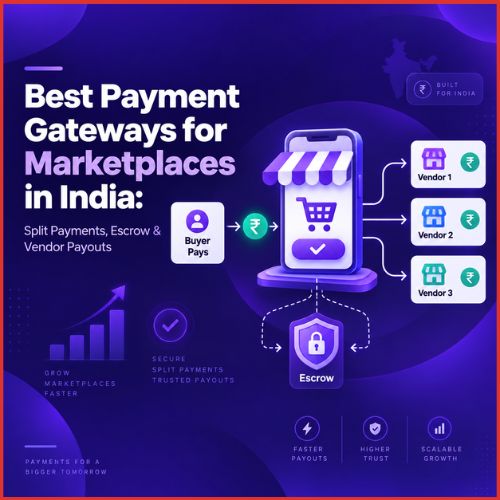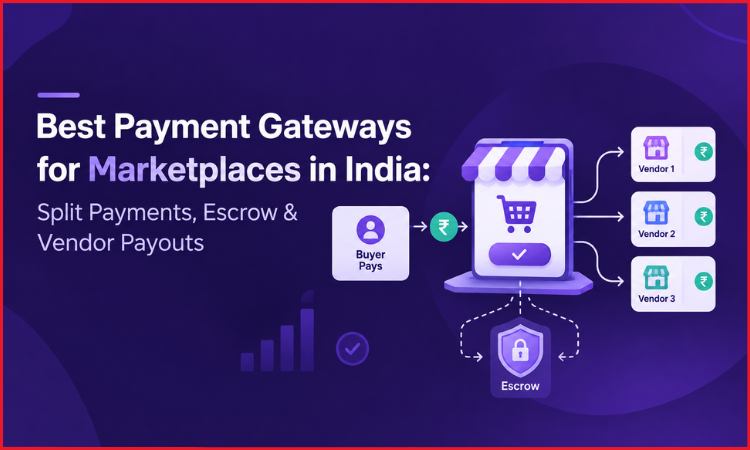
A modern marketplace payment architecture is a system that captures a single customer payment into a regulated nodal or escrow account, programmatically splits that amount between platform commission and individual vendor shares post-hold-period, and disburses vendor payouts via automated IMPS/NEFT/UPI rails, without manual ledger intervention.
This structure is required because traditional marketplace infrastructure isn’t built for the modern checkout experience.
A single customer order can span three vendors, two commission tiers, one partial refund, and a same-day payout obligation. The engineering challenge with this structure is that the payment gateway has to manage multi-cart routing across sub-merchants; the compliance challenge is keeping buyer funds out of a vendor’s account until RBI-mandated conditions are met.
Choosing the best payment gateway for marketplace India operations comes down to how well a provider automates this three-stage pipeline, not how many logos it has on its homepage.
How Split Payments and Escrow Accounts Work in India?
The transaction lifecycle in a compliant marketplace setup runs through four distinct stages, and where a gateway is weak usually shows up at stage three or four.
- Checkout and Capture: The customer pays once for a multi-vendor cart, and in return the gateway captures the full amount against a single order ID, but the backend must already know the vendor-wise split ratio, including commission percentage, fixed platform fee, or hybrid, before settlement logic runs.
- Escrow or Nodal Ingestion and Hold Period: Funds land in a nodal or escrow account, not directly with the vendor. Once there, the RBI’s Payment Aggregator (PA) guidelines must come into action and ensure the platforms cannot route buyer funds directly into a vendor’s bank account without passing through an RBI-authorized PA’s nodal account. Funds are typically held for a return/dispute window (commonly 3–7 days) before final settlement.
- Programmatic Split: Once the payment hold period ends, or even when payment gateways offer immediate clearance, the split engine computes platform commission versus vendor net pay.
This must handle partial refunds mid-cart: if a buyer returns one item from a three-vendor order, only that vendor’s share and the associated commission slice should reverse, not the entire settlement.
- Disbursement via Payout Engine: Vendor payouts route through IMPS, NEFT, or UPI, with T+0 or T+1 settlement cycles depending on the gateway’s payout infrastructure and whether it operates 24x7x365, including bank holidays.
Top Payment Gateways for Marketplaces in India
| Gateway | Split API Flexibility | Escrow Period Support | Instant Vendor Payouts | Webhook Reliability | Partial Refund Handling |
| Cashfree | Split-After-Pay Instant Split | Native nodal automation, configurable hold windows | T+0, 24x7x365 including bank holidays | Highly reliable with retry logic | Line-item level splits |
| Razorpay | Strong, but limitations apply as per the plan chosen | Supported via Route + escrow add-ons | Varies by routing tier | High | Order-level, needs custom logic for line-item |
| PayU | Moderate, enterprise-configured system | Supported, less self-serve | Standard T+1 in most flows | Moderate | Requires manual reconciliation support |
| CCAvenue | Limited, legacy API structure | Supported via managed setup | Standard cycles, less real-time | Moderate | Largely manual |
| Unlimit | Configurable via API Cross-border strength | Supported for domestic marketplace flows | Standard cycles | Moderate to high | Case-by-case, less line-item granularity |
| Easebuzz | Functional split APIs SME-focused | Supported, simpler hold logic | T+1 typical | Moderate | Basic order-level refunds |
- Cashfree
Cashfree’s Payouts and Marketplace Suite is built around a split engine that operates at the line-item level, and this means that if the customer has added products from three vendors in the cart with a single-item return, it only unwinds that vendor’s commission and net pay, leaving the rest of the settlement untouched.
Its nodal account automation handles nodal/escrow ingestion without requiring the platform to manually reconcile hold periods, and vendor KYC/onboarding is API-driven, which matters when a marketplace is onboarding hundreds of sellers monthly.
The standout differentiator is T+0 settlement availability 24x7x365, including bank holidays, a meaningful cash-flow lever for vendors who depend on payout velocity for working capital.
Best suited for high-volume marketplaces, on-demand gig/service platforms, and multi-vendor networks where real-time vendor settlement directly affects vendor retention.
- Razorpay (Route)
Razorpay Route provides an end-to-end payment flow, automating how payouts are completed according to the multiple vendors and business units connected to a single transaction.
Razorpay Route offers the following benefits;
- Mature developer tooling
- Clean documentation
- Comprehensive dashboard for finance teams
Razorpay offers another core feature here, Split logic. This is an important addition in the overall structure and is great for the standard commission model, but within this, the payout velocity and effective cost per payout shift depending on custom routing tier and volume commitments, so marketplaces running thin vendor margins need to model this carefully before committing.
- PayU
PayU works with in-depth enterprise legacy rails and broad domestic card/UPI acceptance. Their payment structure is ideal for marketplaces prioritizing payment method coverage over split automation.
However, where PayU takes a back seat is real-time programmatic split customizability, which means businesses may face issues with;
- Configuring nuanced hold-period logic
- Line-item refund splits
These components require more manual coordination with the provider’s integration team compared to API-first stacks, and this in turn slows time-to-launch for engineering-led marketplace builds.
- Unlimit
Unlimit brings notable strength in cross-border and multi-currency payment processing and is a better option for marketplaces with international vendor bases or buyers.
With Unlimit, domestic split-payment configurability is functional via API, but the ability to customise the structure at the granular line-item level is less than purpose-built Indian marketplace suites.
Specifically, the development team has to structure hold-period/escrow logic generally jointly with their integration team rather than self-serve.
- Easebuzz
Easebuzz targets SME and mid-market marketplaces with functional split APIs and simpler onboarding overhead.
Hold-period and escrow logic work reliably for standard use cases, but payout cycles typically run T+1 rather than instant, and refund handling is largely order-level rather than granular line-item splitting.
This means Easebuzz is adequate for lower transaction complexity, but when it comes to large and high-volume transactions on marketplaces with dense multi-vendor cards, the payments infrastructure can break under pressure.
Buyer’s Checklist Before Choosing a Provider
- Webhook Resilience: Check if the payment gateway provider guarantees retry logic and delivery confirmation for split/payout events, or will your team build a polling fallback?
- Refund Split Handling: Can the API reverse commission and vendor pay at the line-item level, or only at the full-order level?
- Vendor KYC APIs: Is onboarding programmatic, or does every new vendor require manual backend intervention?
- Automated Ledger Reconciliation: Does the dashboard/API expose a settlement report that matches your internal ledger without manual export-and-match work?
For marketplaces where vendor payout speed is a retention lever, gig platforms, D2C multi-brand, service aggregators, Cashfree’s T+0 payout infrastructure and line-item split granularity solve the specific problem that generic gateways treat as an edge case.
For marketplaces prioritizing broad payment method coverage over payout velocity, PayU or CCAvenue’s legacy rails remain defensible choices.
The right decision depends less on brand recognition and more on which stage of the split-escrow-payout pipeline your operations team can least afford to do manually.