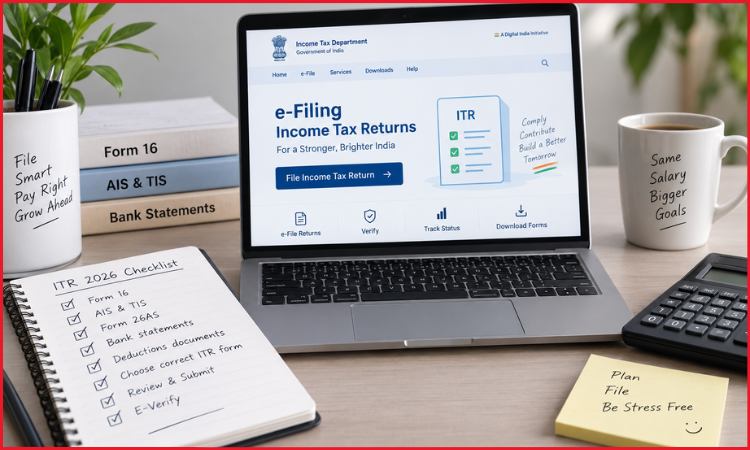
Last September, the income tax department’s servers buckled under 7.3 crore returns landing before the deadline, a record the CBDT confirmed publicly (CBDT, 2025). Somewhere in that rush was a mid-level manager in Pune who opened the portal at 11 p.m. on the last night and discovered her Form 16 numbers didn’t match what the system had pre-filled.
Knowing how to file ITR online in 2026 properly, and starting well before the deadline, is what separates a ten-minute filing from a three-hour ordeal. For salaried employees, income tax return filing for salaried employees during Assessment Year 2026-27 runs almost entirely online, but each step of the ITR filing process in India still has a way of going wrong if it’s rushed.
What Is an Income Tax Return
An Income Tax Return is a statement filed with the Income Tax Department that lays out your income, deductions, taxes already paid and final tax liability for a financial year. It works like a reconciliation exercise: the government checks whether the tax deducted from your salary through the year actually matches what you owed. This is the backbone of income tax e-filing 2026 for anyone drawing a regular paycheck.
A salaried employee earning ₹9 lakh a year, with a fixed deposit generating ₹15,000 in interest, still has to declare that interest even though it never showed up in Form 16. Even when TDS has already been deducted by an employer, that alone doesn’t excuse someone from filing income tax return online if their income crosses the threshold.
Which ITR Form Should Salaried Employees Use
Picking the correct form is the first real decision in the ITR filing process in India, and it’s worth getting right before anything else in your ITR filing online 2026 journey. For AY 2026-27, ITR-1 (Sahaj) generally suits a resident individual with total income up to ₹50 lakh from salary or pension, one house property, and other specified sources such as interest, family pension and dividends, along with limited Section 112A long-term capital gains up to ₹1.25 lakh.
Not every salaried employee fits that box. Anyone with additional capital gains beyond that limit, foreign assets or income, director status in a company, or unlisted equity shares typically needs ITR-2 instead. Selecting ITR-1 purely because a salary is involved, without checking the fine print, is one of the more common reasons returns get marked defective later, and it’s a mistake that trips up income tax return filing for salaried employees every single season.
Documents Required for ITR Filing
Before logging in, it helps to have the paperwork ready rather than hunting for it mid-form. The documents required for ITR filing start with Form 16 from the employer, which covers salary and TDS details, while the Annual Information Statement (AIS) and Taxpayer Information Summary (TIS) show what the department already knows about your financial transactions.
Form 26AS confirms TDS credits, bank statements surface interest income that Form 16 won’t mention, and anyone claiming deductions under the old regime should keep investment, insurance or loan documents on hand. None of these need to be uploaded with the return itself, but they matter if the department asks questions later. Keeping this checklist ready is really the first practical step in learning how to file income tax return online without last-minute scrambling.
Step-by-Step Guide to File ITR Online in 2026
Step 1: Visit the Income Tax e-Filing Portal
The first step in ITR filing online 2026 is to go to the e-Filing Income Tax Portal. Log in with your PAN or other acceptable login, and ensure that your registered mobile number is available for use during the OTP-based login procedure. Currently, the portal has all the ITR forms available for online filing for AY 2026-27, which is what makes income tax e-filing 2026 largely a home-based task.
Step 2: Select “File Income Tax Return”
Navigate to e-File → Income Tax Returns → File Income Tax Return, then select Assessment Year 2026-27. It’s worth remembering that AY 2026-27 relates to income earned in FY 2025-26; conflating the two years is a common early mistake in the ITR filing process in India.
Step 3: Select Your Taxpayer Status
Choose Individual if you’re filing a personal return as a salaried employee. The portal then routes you toward the applicable form based on your inputs, which keeps income tax return filing for salaried employees fairly guided from this point on.
Step 4: Select the Correct ITR Form
Confirm your income sources against the ITR-1 versus ITR-2 criteria before proceeding. Rushing this step tends to surface as a defective-return notice weeks later, not immediately, which is exactly why this stage deserves more attention than it usually gets.
Step 5: Review Your Pre-Filled Information
Salary, TDS, employer details and interest income often arrive pre-filled, but that convenience shouldn’t be mistaken for accuracy. Cross-check every field against Form 16, AIS, TIS and Form 26AS before trusting it; this reconciliation step is arguably the most important part of how to file income tax return online correctly.
Step 6: Check Your Salary Details
Match gross salary, exempt components, standard deduction, professional tax and TDS deducted against your actual Form 16. If you switched jobs during FY 2025-26, both employers’ figures need to be added in, not just the most recent one.
Step 7: Choose the Old or New Tax Regime
The new regime is the default for AY 2026-27, and it now carries a meaningfully higher tax-free threshold than it did two years ago. This regime choice is often the single biggest variable in the whole ITR filing process in India.
| Feature | Old Regime | New Regime (Default) |
| Section 87A Rebate | Up to ₹12,500 | Up to ₹60,000 |
| Rebate Income Ceiling | ₹5 lakh | ₹12 lakh |
| Standard Deduction | ₹50,000 | ₹75,000 |
| Deductions Allowed | 80C, 80D, HRA, home loan interest, and more | Standard deduction and employer NPS contribution only |
A bank officer earning ₹12.75 lakh with no other income ends up with zero tax liability under the new regime once the standard deduction and enhanced 87A rebate are applied (Income Tax Department, 2026). Compare both regimes against your actual numbers rather than assuming one is universally better for your income tax e-filing 2026 outcome.
Step 8: Report Other Sources of Income
Savings interest, fixed and recurring deposit interest, dividends and house-property income all need separate reporting. If your bank account earned interest during FY 2025-26, it stays taxable whether or not your employer mentioned it in Form 16.
Step 9: Enter Eligible Deductions
Under the old regime, enter deductions for Section 80C investments, health insurance, education-loan interest, eligible donations or housing-loan interest as applicable. Claiming a deduction just because it applied last year, without rechecking this year’s eligibility, is an easy way to trigger a mismatch.
Step 10: Check Your Tax Calculation
Review the portal’s computation from total income through to refund or additional tax payable. If extra tax is due, it needs to be paid before the return can be finalised.
Step 11: Review Your ITR Carefully
Give the return a final read across personal details, income heads, deductions, regime choice and bank account information. A few unhurried minutes here tend to save far more time than they cost, especially given how unforgiving income tax e-filing 2026 can be about small errors.
Step 12: Submit and E-Verify Your Return
Submitting isn’t the same as filing. E-verification, typically via Aadhaar OTP or another supported method, has to be completed and the acknowledgement saved before the return counts as filed at all under the current ITR filing process in India.
Common ITR Filing Mistakes to Avoid
Ignoring AIS and Form 26AS tops the list; portal data can lag behind actual bank or employer reporting, and small mismatches compound into scrutiny later. Choosing the wrong ITR form is a close second, since a salaried taxpayer with capital gains or foreign assets may need ITR-2 even though the income source looks straightforward.
Forgetting bank interest, picking a tax regime without comparing both, claiming deductions without rechecking eligibility, leaving out a previous employer’s income, and skipping e-verification round out the errors that show up most often during income tax e-filing 2026 and derail otherwise straightforward income tax return filing for salaried employees.
As one Bengaluru-based chartered accountant told a client this season, “the return doesn’t fail because the numbers are wrong, it fails because nobody checked them twice.”
ITR Filing Checklist for Salaried Employees
- Form 16 from every employer worked for during the year
- AIS and TIS reviewed against actual transactions
- Form 26AS checked for TDS credits
- Bank statements for interest income
- Investment and deduction records, where the old regime applies
- Correct ITR form confirmed
- Salary and TDS details from all employers combined
- Other income sources reported
- Tax-regime comparison completed
- Deduction eligibility rechecked for the current year
- Bank account details verified for refunds
- Final tax calculation reviewed
- E-verification completed and acknowledgement saved
What Happens After Filing ITR
Once a return is submitted and verified, the Income Tax Department processes it and issues one of three outcomes: a refund, no additional tax payable, or a demand notice requiring further action. Processing timelines vary, but keeping the acknowledgement, Form 16 and supporting documents on hand makes responding to any query considerably faster, and it closes the loop on the entire ITR filing process in India for that year.
Conclusion
Once you’ve been through it a couple of times, filing ITR online stops feeling like a chore and starts feeling like paperwork you can knock out over a cup of coffee. Pick the right form, don’t take the pre-filled numbers at face value, declare every rupee of income you actually earned, and weigh the two tax regimes against your own numbers rather than someone else’s advice. That’s really the whole playbook behind how to file income tax return online without stress.
ITR-1 will cover most salaried employees filing for AY 2026-27, though anyone with capital gains, foreign assets, unlisted shares or a slightly unusual income mix should check whether ITR-2 is the safer call. Either way, having the documents required for ITR filing sorted in advance makes the rest of the process move quickly.
If there’s one habit worth building, it’s this: don’t file in the last hour. Pull up your Form 16, AIS, TIS and Form 26AS side by side and actually compare them before you hit submit.
Do that, and filing ITR online in 2026 turns into exactly what it should be, a quick, accurate process you can finish from your laptop without ever walking into a tax office, and one that makes income tax return filing for salaried employees feel almost routine.
Frequently Asked Questions
1. Who needs to file ITR online in 2026?
Any resident individual whose gross income for FY 2025-26 crosses the ₹4 lakh basic exemption threshold under the new regime generally needs to file, even if the final tax works out to zero after rebates. Salaried employees with TDS already deducted are usually required to file regardless of whether a refund is due, which is a core part of income tax return filing for salaried employees.
2. Which ITR form should a salaried employee use?
ITR-1 is for salaried employees having income of up to ₹50 lakh per annum from salary, one house property, and other limited sources. Small limit of capital gains exemption, those who have foreign assets, or are a director, should check ITR-2 eligibility.
4. Can I switch between the old and new tax regime every year?
Yes, a salaried individual with no business income can choose his/her preferred regime afresh every year without having to file a separate form. Other restrictions apply to taxpayers who have business or professional income.
5. What happens if I forget to e-verify my return?
An unverified return is treated as though it was never filed, which can mean losing a refund or facing non-filing penalties. Verification is usually completed through Aadhaar OTP or another electronic method within the window the portal specifies during income tax e-filing 2026.
6. Do I need to report bank interest if my employer didn’t include it in Form 16?
Yes. Savings account interest, fixed deposit interest, and similar income sit outside payroll data, so they won’t appear in Form 16 even though they remain taxable. AIS and your own bank statements are the more reliable sources for catching this income before you file, which is exactly why documents required for ITR filing extend beyond Form 16 alone.