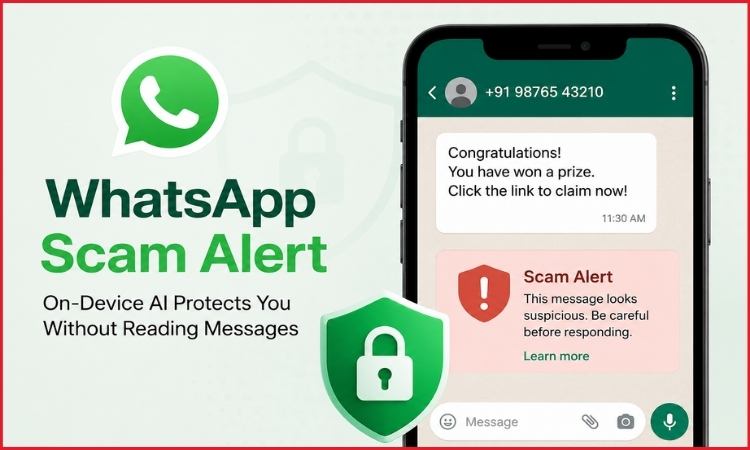
WhatsApp is testing a new security feature that can warn users when messages from unfamiliar numbers show patterns commonly associated with financial scams.
Called Scam Alert, the optional tool uses a small machine-learning model that runs directly on the user’s phone. Meta says messages remain on the device during analysis and are not automatically sent to WhatsApp, Meta or any third party.
The feature is currently available only through a limited beta rollout. WhatsApp has not announced when it will reach every user or provided a complete list of countries, devices and operating-system versions included in the test.
Its purpose is to create an extra pause before a user responds to an unknown sender who may be using impersonation, false job opportunities, investment promises or other social-engineering tactics to obtain money or sensitive information.
How WhatsApp Scam Alert Works
Scam Alert must be activated by the user. Once enabled, WhatsApp downloads a machine-learning model to the device.
The model then analyses incoming messages from numbers that are not saved in the user’s contacts. It looks for conversational structures and linguistic signals similar to patterns found in scam conversations previously reported to WhatsApp.
The system uses probabilistic classification, meaning it estimates the likelihood that a message is suspicious. It does not establish with certainty that the sender is a criminal.
When a message is identified as a likely scam, a warning appears inside the chat. The sender cannot see the warning and is not automatically told that the conversation has been flagged.
The recipient can then choose to block the account, report it to WhatsApp or continue the conversation. If the alert appears to be incorrect, the chat can be marked as trusted. WhatsApp will remove the warning and stop flagging that particular conversation.
Users who mark a chat as trusted can separately choose to share the last five received messages with WhatsApp. This information may help improve the model, but sharing is voluntary and does not happen simply because the system generated an alert.
The warning should therefore be treated as an additional safety signal rather than proof. Legitimate messages may occasionally be misclassified, while sophisticated scams could still avoid detection.
Message Analysis Stays on the Phone
The main distinction between the new WhatsApp scam warning and conventional cloud-based detection is where the analysis takes place.
Classification runs locally on the phone. Meta says the message text and the model’s decision do not leave the device unless the user actively submits a report or agrees to share the five-message sample.
This approach is designed to preserve WhatsApp’s default end-to-end encryption. The company cannot automatically read the message content merely because Scam Alert has examined it on the user’s device.
WhatsApp still needs limited information to determine whether the feature is working properly. It measures approximate counts of warnings and the actions users take afterwards, such as trusting, blocking or reporting a sender.
Meta says these measurements are converted into anonymous aggregates and processed in confidential computing environments. Noise is added using differential privacy so that the resulting statistics can measure performance without identifying individual users or conversations.
The system does not provide WhatsApp with the text that triggered a warning, the identities of the sender and recipient or the specific conversation in which the alert appeared.
Meta Opens the Model to Independent Checks
WhatsApp is introducing additional safeguards intended to make the system independently verifiable.
Every model version, including experimental variants, must be published on a public, append-only transparency ledger before it can be delivered to a device. The ledger creates a tamper-evident record of the versions being used.
Model files are signed through a third party, and the WhatsApp application verifies the signature and file hashes before loading them. If the verification fails, the model will not run.
Meta also says the download process has been designed so that WhatsApp cannot secretly send a different model to one particular user. Requests are anonymised, IP addresses are removed from the model-delivery process and experimental groups are assigned locally on the phone.
The company is publishing the on-device AI model weights so qualified researchers can examine whether it is limited to scam detection. The feature is also being tested through Meta’s bug-bounty programme before a wider production release.
Users included in the beta can request a transparency log showing which messages were analysed, whether an alert appeared and which model version was responsible. This information can be accessed through Account, Request Info and Scam Alert Activity.
Scam Alert Is One Part of Wider Protection
The new feature complements other WhatsApp protections rather than replacing them.
WhatsApp already offers warnings for suspicious device-linking requests, safety information when an unfamiliar person adds someone to a group and an option to silence calls from unknown numbers. It has also started providing Android users with more context about non-contact callers, including whether a number is from another country and whether the participants share any groups.
Meta has separately strengthened two-step verification by replacing the earlier six-digit PIN with a longer password that can contain letters, numbers and special characters. WhatsApp also supports passkeys, which allow account verification through a fingerprint, facial recognition or the device screen-lock code.
Scam Alert addresses the stage before money or credentials are handed over. However, it cannot guarantee that every fraudulent message will be identified.
Users should still avoid sending verification codes, banking details or money in response to unexpected messages. Requests involving urgency, unusually high returns or a person claiming to be a relative should be independently verified through another trusted communication method.
WhatsApp’s limited beta will allow Meta to measure false positives, identify attempts to bypass the model and determine whether the privacy safeguards work as intended. A wider release will depend on the results of that testing.