Global cloud infrastructure spending hit $129 billion in the first three months of 2026 alone, up 35% from a year earlier, according to Synergy Research Group data reported by Statista (statista.com/chart/18819), the ninth straight quarter of accelerating growth.
Every founder, CTO, and CFO reading this is somewhere inside that number. Choosing among the top cloud computing companies is no longer just an IT decision it decides how fast a business can ship products, how much it pays every month, and how exposed it is if one vendor has a bad day.
This list ranks the ten best cloud service providers actually running the world’s workloads in 2026, from the established cloud infrastructure providers everyone knows to the challengers quietly winning specific industries with sharper enterprise cloud solutions.
How We Ranked the Top Cloud Computing Companies
This ranking isn’t based on revenue or market share alone. We looked at each company’s overall standing in the cloud industry, the breadth of its cloud services, how widely it’s adopted by enterprises, its technology and AI capabilities, its global reach, and how fast it’s been growing recently. We also factored in the different areas these companies actually serve, from raw infrastructure to business software, data platforms, and hybrid cloud setups.
Because these providers don’t all compete in the same lane some sell infrastructure, others sell finished software, others specialize in hybrid deployments this list is best read as an overall comparison rather than a strict market-share ranking. The aim is to spotlight the cloud computing companies having the biggest impact on businesses and the wider cloud market in 2026.
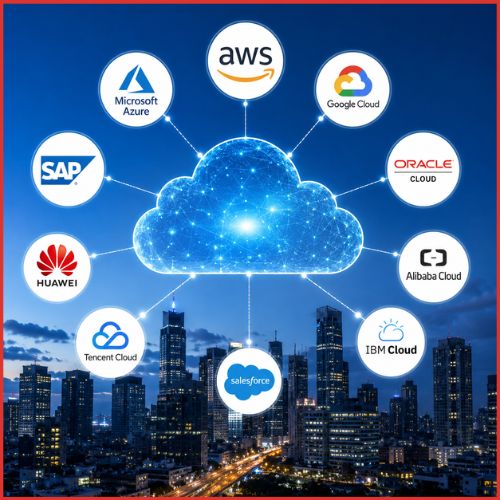
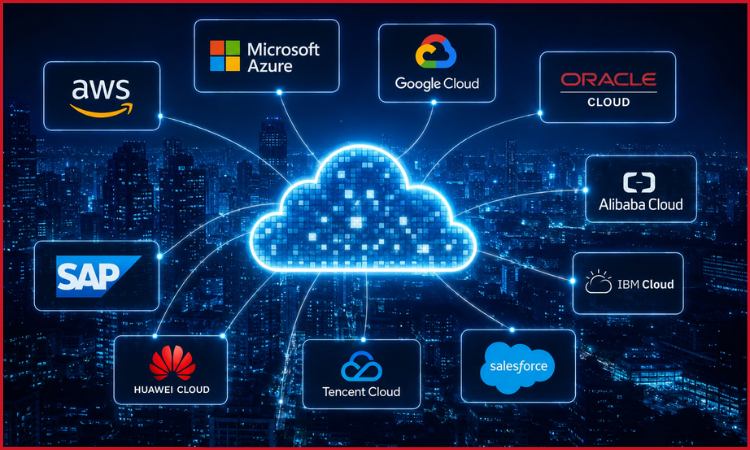
Quick Glance: Top 10 Cloud Computing Companies
| Name | Founded | Sector / Focus | Key Metric |
| Amazon Web Services | 2006 | IaaS, PaaS, global cloud infrastructure | 28% global market share, Q1 2026 |
| Microsoft Azure | 2010 | Hybrid cloud, enterprise software integration | 21% global market share, Q1 2026 |
| Google Cloud | 2008 | AI infrastructure, data analytics | $20.0B Q1 2026 revenue, up 63% YoY |
| Oracle Cloud Infrastructure | 2016 | AI training infrastructure, databases | OCI revenue up 93% YoY, Q4 FY2026 |
| Alibaba Cloud | 2009 | Cloud infrastructure across Asia-Pacific | Largest cloud provider in China |
| IBM Cloud | 2013 | Hybrid cloud, enterprise AI (watsonx) | Anchored by Red Hat OpenShift |
| Salesforce | 1999 | SaaS, enterprise CRM cloud | World’s largest CRM platform |
| Tencent Cloud | 2013 | Gaming, fintech, enterprise cloud | Top-three cloud provider in China |
| Huawei Cloud | 2017 | Enterprise cloud across Asia, Africa, Middle East | Fast-growing outside US-aligned markets |
| SAP | 1972 | Enterprise cloud applications (ERP, S/4HANA) | Cloud revenue now majority of SAP sales |
1. Amazon Web Services (AWS)
Amazon launched AWS in 2006 almost as a side project, spare capacity from running Amazon.com, rented out to other developers. Andy Jassy built the unit from a small team into the largest of the world’s cloud infrastructure providers by revenue. AWS held 28% of global cloud infrastructure spending in Q1 2026, ahead of every rival, per Synergy Research Group. Its edge is breadth: over 200 services, from raw compute to managed AI, and the deepest bench of enterprise case studies of any provider on this list.
2. Microsoft Azure
Azure’s story is really Satya Nadella‘s story. When he took over as CEO in 2014, Microsoft was still seen as a desktop-software company losing the cloud race. Nadella pushed Azure hard and tied it to Microsoft 365, Dynamics, and GitHub, turning it into one of the most complete enterprise cloud solutions on the market. Azure held 21% of global infrastructure spend in Q1 2026 and grew 40% year over year, faster than AWS, largely on the back of its OpenAI partnership.
3. Google Cloud
Google entered cloud infrastructure late, in 2008, and spent years playing catch-up to AWS and Azure. That changed with the AI boom. Google Cloud posted $20.0 billion in Q1 2026 revenue, up 63% year over year, according to Alphabet’s Q1 2026 earnings, as reported by Axis Intelligence (axis-intelligence.com). Many enterprises now treat Google Cloud as the AI layer of a broader multi-cloud strategy rather than a full replacement for AWS or Azure.
4. Oracle Cloud Infrastructure (OCI)
Larry Ellison built Oracle into a database giant long before cloud existed, and he was slow to admit the internet-software shift was real. OCI, launched properly in 2016, has now become Oracle’s growth engine: infrastructure revenue jumped 93% year over year to $5.8 billion in the fiscal Q4 2026 quarter, according to Oracle’s Q4 FY2026 earnings, covered by ERP Today (erp.today). Oracle is also pushing hard into cloud migration services, aiming to pull large database customers off legacy on-premises systems and onto OCI.
5. Alibaba Cloud
Jack Ma’s Alibaba launched its cloud arm in 2009, years before most Chinese rivals took infrastructure seriously. Alibaba Cloud is now one of the largest cloud infrastructure providers across mainland China and a major player through Southeast Asia, powering everything from Singles’ Day traffic spikes to regional fintech apps. Outside China, it remains a smaller name, but for companies expanding into Asia-Pacific, it is often the default choice among enterprise cloud solutions.
6. IBM Cloud
IBM built its modern cloud business largely through acquisition, most notably the $34 billion purchase of Red Hat in 2019. That deal gave IBM Cloud its real identity: hybrid cloud computing built on OpenShift, aimed at regulated industries like banking and healthcare that can’t move everything to a public cloud overnight. IBM doesn’t chase hyperscaler-style growth numbers; it chases enterprises that need enterprise cloud solutions spanning their own data centres and the public cloud at once.
7. Salesforce
Marc Benioff founded Salesforce in 1999 on a simple bet: business software didn’t need to be installed on a server; it could just run in a browser. That bet created the SaaS category itself. Salesforce isn’t an infrastructure provider like AWS or Azure; it’s the world’s largest cloud-based CRM platform, and its Agentforce push in 2025-26 shows its enterprise cloud solutions now competing directly for AI budgets, not just sales-team budgets.
8. Tencent Cloud
Pony Ma’s Tencent built its cloud business in 2013 on the back of WeChat and its gaming empire, then opened it up to outside enterprise customers. Tencent Cloud now ranks among China’s top three cloud infrastructure providers, with particular strength in gaming infrastructure, video streaming, and fintech sectors where Tencent already had deep product expertise before it ever sold cloud.
9. Huawei Cloud
Huawei entered cloud relatively late, formalising Huawei Cloud in 2017, partly as a response to US sanctions that pushed the company to build more of its own software stack. It has grown fastest in markets where Western hyperscalers face political friction, parts of Africa, the Middle East, and Southeast Asia, positioning itself as one of the few cloud infrastructure providers willing to operate where the Big Three won’t.
10. SAP
SAP is the oldest name on this list by five decades, founded in Germany in 1972 as an enterprise resource planning company. Its cloud shift came later and slower than Salesforce’s, but under its S/4HANA Cloud push, cloud revenue now makes up the majority of SAP’s total sales. Its customers are rarely startups; they’re the manufacturers, logistics firms, and industrial giants running hybrid cloud computing setups that blend on-premises ERP with SAP’s newer enterprise cloud solutions.
What These Cloud Providers Have In Common
Every company on this list is chasing the same thing right now: AI workloads, not storage or basic compute. GPU capacity, not disk space, is what’s driving the fastest revenue growth across the board.
Most of the best cloud service providers here are also no longer competing to be a company’s only cloud. Roughly 75% of enterprises now run a multi-cloud strategy rather than betting on one provider, and cloud migration services have become a competitive battleground in their own right as enterprises shift workloads between vendors.
Key Takeaways
● AWS still leads in absolute revenue, but Azure and Google Cloud are growing faster off a smaller base; share erosion doesn’t always mean weakness.
● AI infrastructure, not traditional storage or compute, is now the main growth driver across every major provider.
● A multi-cloud strategy is now the default for most enterprises; not the exception. Vendor lock-in is a bigger risk than most contracts admit.
● Regional cloud infrastructure providers (Alibaba, Huawei, Tencent) matter more outside the US than global rankings suggest.
● Hybrid cloud computing players like IBM and SAP win by serving regulated industries the pure hyperscalers can’t fully satisfy.
● Cloud migration services and switching costs, not just monthly compute pricing, decide which enterprise cloud solutions actually pay off.
Conclusion
Among the best cloud service providers on this list, there is no single universal winner. Picking the right cloud infrastructure provider in 2026 is about matching a business’s workload AI training, regulated data, regional latency, existing software stack to the enterprise cloud solutions built for that exact problem. A hybrid cloud computing setup that pairs a hyperscaler with a specialised regional partner is increasingly a smarter multi-cloud strategy than betting everything on one name, and the real cost of that decision usually shows up in the cloud migration services it takes to get there, not just the invoice each month.
Frequently Asked Questions
1. Which company has the largest cloud market share in 2026?
Amazon Web Services remains the largest by revenue, holding roughly 28% of global cloud infrastructure spending in Q1 2026, according to Synergy Research Group. Microsoft Azure and Google Cloud follow, though both are growing faster than AWS in percentage terms.
2. What is the difference between IaaS, PaaS, and SaaS?
IaaS (infrastructure as a service) provides raw compute and storage, such as AWS EC2. PaaS gives developers a managed environment to build on. SaaS delivers finished enterprise cloud solutions, like Salesforce, that businesses use without managing any underlying infrastructure.
3. Why are companies adopting a multi-cloud strategy instead of one provider?
A multi-cloud strategy reduces dependence on a single vendor’s pricing and outages, and lets a company pick the best cloud service providers for each specific workload. It also gives negotiating leverage that single-cloud contracts don’t offer.
4. Are Alibaba Cloud and Huawei Cloud used outside China?
Yes, though less than the Big Three globally. Alibaba Cloud has strong adoption across Southeast Asia, while Huawei Cloud has grown mainly across Africa, the Middle East, and parts of Asia where it faces less political resistance than US-based cloud infrastructure providers.
5. Is hybrid cloud computing still relevant with public cloud growing so fast?
Yes, regulated industries like banking, healthcare, and government still need to keep sensitive workloads on-premises while using public cloud for everything else. IBM and SAP built much of their current growth specifically around hybrid cloud computing demand.
6. What should a business check before choosing enterprise cloud solutions?
Data residency requirements, existing software commitments (Microsoft shops lean Azure, for instance), AI/GPU availability, and the total cost of cloud migration services not just the sticker price of compute per hour.