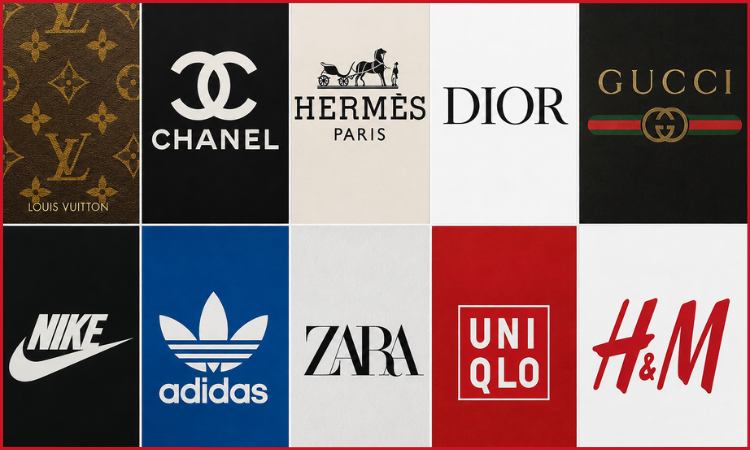
Behind every handbag, sneaker, and monogrammed scarf sits a balance sheet most shoppers never think about. A small group of names now controls price points, runway influence, and investor attention across a market worth hundreds of billions of dollars.
The top 50 luxury names alone are worth $317 billion, up 43 percent since 2019, according to Brand Finance’s 2026 Luxury & Premium report. That kind of scale is why the most popular fashion brands in the world get studied in boardrooms as closely as on runways. Clothing racks are just the visible layer of a business built on brand equity, licensing, and pricing power.
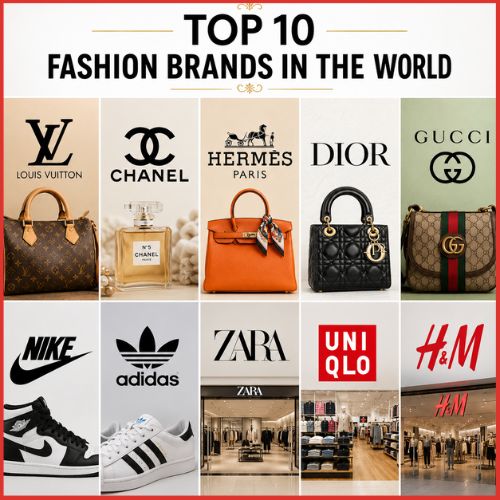
This list ranks the ten names still setting that pace in 2026, based on brand value, revenue, and market influence rather than follower counts.
Quick Glance
| Rank & Name | Founded | Sector / Focus | Key Metric |
| Louis Vuitton | 1854 | Leather Goods & Luxury Apparel | Brand value $48.4B (Interbrand, 2025) |
| Chanel | 1910 | Haute Couture | Brand value $37.9B (Brand Finance, 2025) |
| Hermès | 1837 | Luxury Leather & Apparel | Brand value $40.9B (Interbrand, 2025) |
| Dior | 1946 | Haute Couture | Brand value $17.3B (Brand Finance, 2025) |
| Gucci | 1921 | Luxury Apparel & Accessories | Owned by Kering, restructuring since 2025 |
| Nike | 1964 | Sportswear & Footwear | Revenue $46.3B (Nike, FY2025) |
| Adidas | 1949 | Sportswear & Footwear | Brand value $17.4B (Interbrand, 2025) |
| Zara (Inditex) | 1975 | Fast Fashion | Group sales €39.86B (Inditex, FY2025) |
| Uniqlo | 1949 | Fast Fashion & Casualwear | Brand value $17.7B (Interbrand, 2025) |
| H&M | 1947 | Fast Fashion | Group sales ~€21B (2023 fiscal year) |
1. Louis Vuitton
- Established Year: 1854
- Headquarters: Paris, France
- Signature Products: Monogram trunks, Speedy & Neverfull handbags, leather goods
- Brand Value: $48.4 billion
- Global Presence: Sold through LVMH’s retail network across 50+ countries
Founded by trunk-maker Louis Vuitton in Paris, this house has held the number-one spot in Interbrand’s rankings for eight straight years. Parent company LVMH posted €80.8 billion in 2025 revenue even through a soft luxury cycle. Its monogram canvas remains one of the most recognised symbols among luxury fashion brands anywhere. Readers curious about the founder’s own journey can explore the full account of Luxury Redefined: The Story of Louis Vuitton.
2. Chanel
- Established Year: 1910
- Headquarters: London, United Kingdom (global holding company; house founded in Paris)
- Signature Products: No. 5 perfume, tweed suits, quilted flap bags
- Brand Value: $30.5 billion
- Global Presence: 500+ boutiques across more than 110 countries
A 45 percent jump in brand value pushed Chanel past Louis Vuitton to the top of Brand Finance’s Apparel 50 in 2025, landing at $37.9 billion. Credit goes largely to creative director Matthieu Blazy, only the fourth designer to lead the house in 114 years. Founded by Gabrielle “Coco” Chanel in 1910, the brand still trades on discipline rather than novelty.
3. Hermès
- Established Year: 1837
- Headquarters: Paris, France
- Signature Products: Birkin & Kelly bags, silk scarves, leather goods
- Brand Value: $40.9 billion
- Global Presence: Nearly 300 stores across 45 countries (Hermès, 2025)
Few names among the best clothing brands globally post a 40.5 percent operating margin, but Hermès did exactly that in 2025. Scarcity is deliberate here. Waiting lists for the Birkin and Kelly bags have become part of the product itself, and Interbrand now values the house at $40.9 billion, up 18 percent year on year.
4. Dior
- Established Year: 1946
- Headquarters: Paris, France
- Signature Products: Lady Dior bag, haute couture, J’adore perfume
- Brand Value: $9.3 billion
- Global Presence: 532 stores worldwide under parent group LVMH
Christian Dior founded the house in 1946 with a single collection that reshaped postwar fashion overnight. In 2025, Jonathan Anderson took charge of womenswear, menswear, and haute couture simultaneously, a first since the founder himself ran every line. Brand value rose 13 percent to $17.3 billion, a steady climb rather than a spike.
5. Gucci
- Established Year: 1921
- Headquarters: Florence, Italy
- Signature Products: GG monogram bags, loafers, ready-to-wear
- Brand Value: $11.6 billion
- Global Presence: 635 stores worldwide under parent group Kering
Gucci’s story right now is a lesson in what happens when creative direction stalls. The house saw one of the sharpest brand-value corrections among famous fashion brands in 2025, prompting Kering to install Francesca Bellettini as CEO and move up designer Demna’s runway debut. Founded in Florence in 1921 on leather craftsmanship, its recovery hinges on whether Demna’s early reception, reportedly strong, converts into sales.
6. Nike
- Established Year: 1921
- Headquarters: Florence, Italy
- Signature Products: GG monogram bags, loafers, ready-to-wear
- Brand Value: $11.6 billion
- Global Presence: 635 stores worldwide under parent group Kering
Interbrand cut Nike‘s brand value by 25.9 percent to $33.7 billion in 2025, and the stock lost roughly 13 percent for the year. Yet Brand Finance still ranked it the strongest apparel brand globally, with a 94.7 Brand Strength Index score. Revenue climbed 2 percent to $11.4 billion in the first quarter of 2026, a sign the swoosh is stabilising after its steepest decline in decades, as Forbes noted.
Also Read: Bill Bowerman Legacy: The Man Behind Nike’s Success
7. Adidas
- Established Year: 1949
- Headquarters: Herzogenaurach, Germany
- Signature Products: Samba, Gazelle, Ultraboost, three-stripe apparel
- Brand Value: $17.4 billion
- Global Presence: Products sold in more than 160 countries worldwide
Adidas has quietly gained ground while its biggest rival stumbled. Interbrand’s 2025 report placed the brand at $17.4 billion, up two spots to 49th globally, powered by retro lines like Samba and Gazelle winning back style-conscious buyers. Founded in Germany in 1949 by Adolf Dassler, it remains one of the world’s steadier leading fashion brands in the sportswear category.
8. Zara (Inditex)
- Established Year: 1975
- Headquarters: Arteixo, Galicia, Spain
- Signature Products: Fast-fashion ready-to-wear collections
- Brand Value: $19.4 billion
- Global Presence: 2,000+ stores across 96 countries (Forbes)
Amancio Ortega opened the first Zara store in A Coruña in 1975 with a simple bet: get runway looks onto shelves faster than anyone else. That bet built Inditex into a €39.86 billion group in FY2025, a 3.2 percent rise confirmed in the company’s own Inditex FY2025 Results. Zara alone drives more than 70 percent of that revenue, and its India joint venture with Trent continues expanding, part of the wider India Fashion E-commerce Growth Report.
9. Uniqlo
- Established Year: 1949
- Headquarters: Yamaguchi, Japan
- Signature Products: HeatTech, Ultra Light Down, LifeWear basics
- Brand Value: $17.7 billion
- Global Presence: 2,500+ stores across 26 markets worldwide
Uniqlo’s climb has been slower but steadier. Owned by Fast Retailing and founded in Japan in 1949, it leapt into Interbrand’s global top 100 for the first time in 2025 at a $17.7 billion valuation, overtaking Adidas along the way. Sponsorships of players like Roger Federer and Novak Djokovic reinforce a quality-first positioning that international fashion brands often struggle to hold at scale.
10. H&M
- Established Year: 1947
- Headquarters: Stockholm, Sweden
- Signature Products: Affordable fast fashion, designer collaborations
- Brand Value: $11.9 billion
- Global Presence: Stores in 81 markets, e-commerce in 62 (H&M Group, 2026)
H&M generated roughly SEK 234 billion, close to €21 billion, in its most recent full fiscal year. Founded in Sweden in 1947 as a single womenswear shop, it now competes directly with Zara for the fast-fashion crown. Its challenge going forward is less about volume and more about margin, a gap Zara has widened through faster design cycles.
What These Brands Have In Common
Every name on this list treats brand equity as a balance-sheet asset, not a marketing line item. Heritage buys trust, but only continuous reinvention through design leadership, supply-chain speed, or scarcity keeps that trust compounding. One quotable pattern holds across the group: brands stop growing the moment they mistake their history for a strategy.
Conclusion
Brand value in fashion behaves less like a marketing metric and more like a leading indicator of business health. The best clothing brands globally are proving that craftsmanship, distribution speed, and disciplined creative direction matter more than sheer scale. For Indian founders building consumer brands, the lesson from this year’s reshuffle is straightforward: protect the story, but never let it substitute for product decisions made on time.
Also Read : Top 10 Fashion Designers in India
Frequently Asked Questions
1. Which is the most popular fashion brand in the world right now?
Louis Vuitton holds the top spot by Interbrand’s 2025 valuation at $48.4 billion, though Chanel leads Brand Finance’s separate Apparel 50 ranking. The answer shifts slightly depending on which methodology a source uses.
2. How are top fashion brands in the world actually valued?
There are plenty of companies such as Interbrand and Brand Finance that perform royalty relief calculations, which are simply a means of estimating the cost to a firm to license their own brand. The final figure includes contributions from revenue, growth, and consumer sentiment.
3. Are luxury fashion brands still growing despite economic pressure?
Selectively, yes. The sector is showing a more nuanced split between winners and losers, with Hermès and Chanel logging double-digit gains in 2025 and Gucci and Nike experiencing sharp corrections.
4. Why do fast-fashion names like Zara and Uniqlo appear alongside luxury houses?
Brand value is a financial weight and a recognition value, not only a price point. The fact that fashion brands like Inditex at €39.86 billion or Interbrand at €433 million are selling with high price tags but you can still get them for a reasonable cost is a testament to how popular fashion and brand equity work these days.
5. What makes a brand rank among the world’s leading fashion brands consistently?
This may help with a name for heritage, but as long as she is continuously reinventing herself through design, the speed of the supply chain, or scarcity, a name will remain relevant across cycles. Founders need to take Gucci’s 2025 correction as a clear warning.
6. Is India a growing market for these international fashion brands?
Yes. Zara has also announced its joint venture with Trent, and the growing fashion e-commerce traffic itself indicates that demand is still there, despite the growing competition from domestic players.