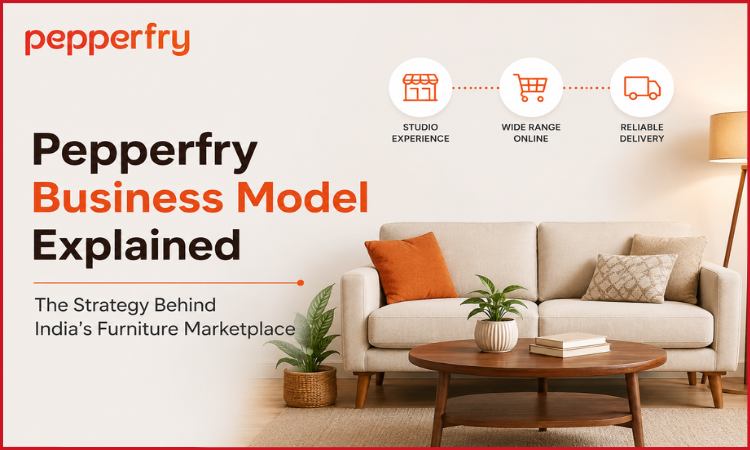
Unlike many other marketplaces that are selling products vertically (e.g., fashion, food) in a different manner, Pepperfry has carved out its unique approach towards how people buy furniture online. Instead of trying to be another Fashion Marketplace which tries selling everything from apparel, Pepperfry decided to focus on creating an experience for its customers for buying furniture online.
While reading the material provided here, it becomes clear that Pepperfry claims to be the leading online Furniture & Home Décor Marketplace in India, with their Franchise Deck stating that the Indian Market is still mostly Offline & Unorganised. And that’s what forms the basis of Pepperfry’s business model.
In this Article We’ll Be Taking A Deep-Dive Case Study On Pepperfry’s Business Model, Their Omnichannel Strategy, Marketplace Economics, Franchise Studios & Other Operating Logic Behind Creating India’s Online Furniture Market!
Why Pepperfry’s Market Opportunity Was So Large
The category structure – bulky product size, expensive shipment cost, high cost-to-return ratio and preference for designer taste – are completely different when compared with most other e-commerce verticals. To give an idea on how big this segment is, Pepperfry’s franchise deck states that India has a $30 billion furniture market, out of which around 90 per cent remains offline and unorganized.
It also explains why a digital-first player could carve a niche in this space by offering people a more convenient way to buy things without worrying too much about logistics. Also note that unlike a typical e-commerce category, in furniture the ‘scale’ element plays a far greater role. As its app listing shows (below), Pepperfry now offers over 1 lakh pieces of furniture and home décor.
Pepperfry Business Model at a Glance
Pepperfry’s model works by operating as an omnichannel marketplace offering everything from furniture and home décor to homeware and beyond – all under one roof (for now). On its site, you can explore a vast selection of products organized into furniture, sofas & seating, mattresses, home décor, furnishings, lighting, kitchen & dining, luxury, and modular categories. But the model goes beyond online product listings. A critical part of the Pepperfry experience involves visiting a local studio to test out what you plan to purchase before finalizing your order.
Today, Pepperfry’s current franchise proposition notes that the brand currently maintains 150+ studios in 100+ cities around the world – composed of company-owned or company-operated studios as well as franchisee-operated studios. And since launching back in 2016, Pepperfry has fulfilled over 10 million customer orders to date. Now, with such an extensive offline footprint, Pepperfry can focus even more on expanding its online business knowing it will have an existing ecosystem upon which to capitalize.
The Real Strategy: Make Furniture Feel Less Risky to Buy
To better comprehend this strategy, here’s how Pepperfry approaches this problem: For consumers, buying expensive items such as a sofa or dining table isn’t easy—it requires them to evaluate the product’s quality, determine its measurements, and find assurance of after-sales services before they make a purchase decision. Therefore, Pepperfry has created its official storefront and category pages to highlight these options alongside a studio network where customers can try out the actual product before purchasing it.
A good way to understand Pepperfry’s business model would be by looking at what role its online (and now physical) stores play when paired together. By combining online and offline elements, Pepperfry ensures that there is no confusion around how they work since they serve completely different functions along a buyer’s purchase path.
It suggests that the omni-channel approach will always win in any industry where people don’t know much about the product or aren’t sure who they should talk to if they have questions. This includes almost every item you buy online except electronics—they tend to be fairly straightforward purchases once you’ve decided you need one. Whether a buyer needs guidance or reassurance choosing from many models or that things will go smoothly post-purchase, having access to human contact provides peace-of-mind benefits unmatched by anything else available today!
How Pepperfry Makes Money
To understand this dynamic better, looking at the report for FY24 shows that Pepperfry earned most of their operating revenue through services, with product sales contributing to the rest. This makes sense given that many marketplaces are built on facilitating transactions, engaging brands and providing various other services – none of which require them to invest in inventory themselves.
Franchise partnerships help the company’s growth strategy further, too. As outlined in their franchise deck, Pepperfry’s studio format allows a franchisee to begin with an initial outlay starting around ₹30 lakh (which may vary depending upon location), with no inventory risks involved because Pepperfry handles everything end-to-end including fulfillment. Franchisees receive training assistance, along with being able to leverage the brand’s existing support system towards customer engagement efforts.
This approach offers several advantages for Pepperfry compared to traditional retailers who typically have high fixed costs associated with maintaining extensive inventories across multiple locations. For instance, instead of having to handle all those overhead expenses directly when opening new stores, they can work closely with partners who already cover much of what would traditionally be considered operational spending items. This helps make their operations far less capital intensive overall. Another benefit mentioned explicitly within their franchise materials relates specifically to the time needed before seeing positive returns on such investments – somewhere between roughly 24-months worth according to some estimates provided there.
Why Omnichannel Became the Competitive Moat
Pepperfry’s offline studios are not simply stores. They are conversion tools, trust-builders, and brand education centers. The company’s materials describe a process in which partners are onboarded, trained, and supported by Pepperfry teams, with studio webpages, Google presence, and local serviceability activated as part of the rollout. In a category where size, finish, and comfort matter, this physical layer is a major part of the customer experience.
This is where Pepperfry’s strategy differs from a standard e-commerce play. A typical online retailer wins by simplifying logistics and maximizing repeat orders. Pepperfry wins by making a traditionally offline category feel digital without removing the reassurance of offline touchpoints. The result is an omnichannel furniture marketplace that can serve both digital-first shoppers and cautious buyers who still want to “see before they buy.”
The Pricing Promise and Value Proposition
So what does Pepperfry’s website look like? The company claims to be able to offer furniture prices up to 70% cheaper than retail markets if you visit the website and shop for anything from sofas to office chairs to home décor. Then, when visiting a category page on the website, the company tells customers about various discounts, cashbacks, EMI (easy monthly instalments) as well as offers of different kinds on all items.
In short, while visiting their website, a customer is presented with an enormous amount of variety along with clearly marked prices, convenience of purchasing online and also some degree of confidence due to backing by brands. It goes without saying that these are quite effective in converting someone who plans to buy high-ticket-priced home products such as furniture into actual buyers once they become comfortable with both the item itself and how they will pay for it.
A key point is how Pepperfry manages to take care of several pain points associated with selling high-ticket-priced items through one single business model. For instance, since furniture tends to get delayed primarily because of affordability issues, providing discounting as well as EMI facilities helps in mitigating some of those problems.
The Financial Reality: Growth, Pressure, and Adaptation
Pepperfry’s journey also shows the pressure that comes with building a difficult category business. Reporting on FY24 said operating revenue fell 30.6% year-on-year to ₹188.9 crore, while losses narrowed 37.4% to ₹117.4 crore. In June 2025, the company also raised ₹43.3 crore from existing investors, and later reporting said the business was sharpening its omnichannel, quick-commerce, B2B, and franchise focus to improve growth and margins.
That pattern tells an important story. Pepperfry is not a company that found a frictionless consumer category and scaled effortlessly. It is a company that had to continuously adapt its operating model to the reality of furniture retail in India. When revenue softens, the response is not just discounting. It is a rebalancing of channels, economics, and customer acquisition strategy.
What Pepperfry Teaches About Building a Marketplace in India
In thinking about lessons to take forward from the Pepperfry journey, what stands out is how we need to think differently about which markets offer the best potential for marketplace play in India – these aren’t the ones you might assume.
Instead, focus on markets with offline experiences that deliver high levels of buyer pain, then identify a hybrid approach (like Pepperfry’s) that marries an online dimension with physical elements to reduce pain. Finally, create a compelling mix of trust-building features to reinforce this unique proposition – such as studios, service support, and assortment depth.
And don’t forget the key role played by brand positioning in reinforcing your value proposition, helping build familiarity even in challenging markets like furnishing. This is exactly the strategy that has enabled Pepperfry to emerge as one of the country’s best-known furniture platforms in its space.
Final Take
So what does all this mean? To understand the business model of Pepperfry, think of them as providing an omnichannel solution to an offline problem. This was not just about listing out furniture items on their website but providing you with solutions that let you discover, compare, experience and ultimately buy furniture with far less fear.
What makes them unique from other marketplaces in India are their breadth of selection, studio-based franchises, brand-backed fulfillment options and more importantly, their focus on service. Their strategy for building India’s furniture marketplace continues to be an inspiration.
FAQ
What is Pepperfry’s business model?
Pepperfry operates as an omnichannel marketplace for furniture and home products, combining online assortment with offline studios, franchise partners, and brand-led fulfillment.
Why did Pepperfry add physical studios?
Furniture is a high-consideration category, so physical studios help customers inspect products, build trust, and convert online interest into purchases. Pepperfry’s official franchise material shows that the studio network is central to its growth strategy.
How does Pepperfry earn revenue?
Its public reporting shows a mix of operating revenue from services and product sales, supported by marketplace activity and partner-led retail expansion.
Is Pepperfry a pure e-commerce company?
No. It is better described as an omnichannel furniture marketplace, because its online platform and offline studios work together as one customer journey.