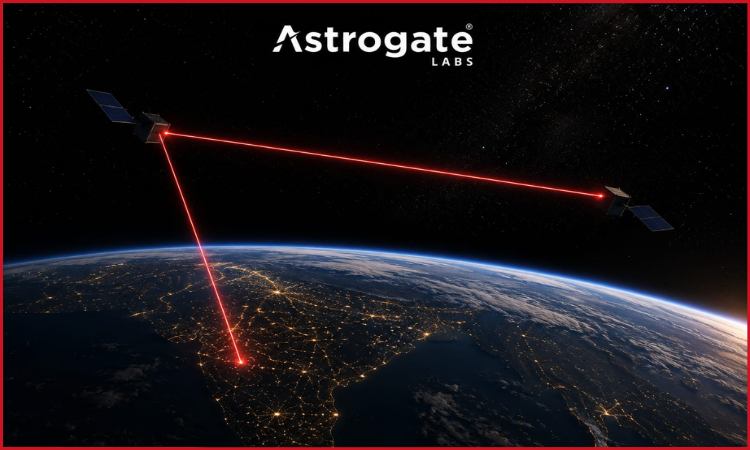
Bengaluru-based Astrogate Labs is betting that laser communication, rather than conventional radio frequency (RF) systems alone, will play a defining role in the next phase of satellite connectivity as India’s private space sector expands and satellite constellations generate ever-larger volumes of data.
In an interview with Business Outreach, Subhajit Chakraborty, Co-founder of Astrogate Labs, spoke about the evolution of India’s private space ecosystem, why optical communication is becoming increasingly important for satellites, and how deep-tech startups require patient capital before commercial returns begin to materialise.
The company’s optimism comes at a time when India’s space sector is seeing growing policy support and international engagement.
India’s private space sector enters a new phase
According to Chakraborty, meaningful momentum in India’s commercial space industry has emerged only over the last few years.
“It has happened in the last two to five years that the sector is seeing a lot of interest,” he said, adding that government policy has increasingly encouraged private participation.
He said the liberalisation began with launch vehicle companies before extending to downstream applications, which received a boost as government agencies started making datasets available for commercial use.
Astrogate operates in what he describes as the midstream layer of the ecosystem, developing laser communication terminals that transfer data within satellite networks.
Why laser communication is gaining ground — and wind
Explaining the technology, Chakraborty said satellites today support telecommunications, earth observation and surveillance missions, all of which are generating significantly larger amounts of data than in previous years.
Drawing an analogy with smartphone cameras, he said image sizes have increased from kilobytes a decade ago to tens of megabytes today, creating a corresponding need for faster data transmission in orbit.
“For the form factors we work in, like CubeSats and other small satellites, radio frequency terminals are capable of doing around 200 Mbps, ballpark. We are already at a stage where we are doing 10 Gbps,” he said.
He also pointed to the growing importance of inter-satellite links, where satellites relay information among themselves before transmitting it to Earth. Laser-based optical communication enables much higher bandwidth for these links while avoiding spectrum congestion associated with RF systems.
At the same time, Chakraborty emphasised that laser communication is not expected to replace radio frequency altogether.
“Laser is actually the future of space communication,” he said. “But it is a complement to RF because RF cannot be totally ruled out.”
Deep-tech requires patient capital
Looking ahead, Chakraborty said Astrogate expects wider adoption of laser communication technologies as satellite manufacturers and constellation operators increasingly integrate optical communication into their systems.
“It is only the starting for us,” he said, adding that the company is positioning itself for broader industry adoption as the market matures.
He also acknowledged that commercialisation timelines in deep tech remain significantly longer than those in consumer-facing businesses.
“A deep-tech startup, a normal one and a good one, will take around seven to eight years to reach a point where it can make money,” he said.
Despite the longer gestation period, he believes investor appetite reflects confidence in the sector’s long-term potential.
“If you are seeing investments into deep tech, it means investors have already solved that math. They know they have to wait for some time, but the returns will also come.”
With India’s private space ecosystem expanding, international partnerships gathering momentum under agreements such as the India-UK CETA, and demand rising for high-speed satellite connectivity, Astrogate Labs is positioning laser communication as a key enabling technology for the industry’s next phase of growth.
Earlier this month, Astrogate Labs Founder and CEO Nitish Singh was part of the business delegation accompanying Union Commerce and Industry Minister Piyush Goyal to the UK, where discussions around the India-UK Comprehensive Economic and Trade Agreement (CETA) highlighted opportunities for deeper collaboration in science, technology and innovation.
Singh said the agreement could strengthen cooperation in emerging technologies, including space-tech, and help companies building advanced communication systems access global markets.