Listening to music today takes only a few seconds: just open an app, search for a track, and press play. Hundreds of millions of people stream their favourite music while travelling, working, exercising, studying, or relaxing, rarely considering how dramatically the music industry has changed over the past two decades.
Before widespread music streaming, users purchased CDs, downloaded MP3 files, or relied on illegal file-sharing platforms such as Napster and Kazaa. Discovering new artists was often difficult, purchasing music was expensive, and the music industry struggled with declining revenues as piracy became widespread across the world.
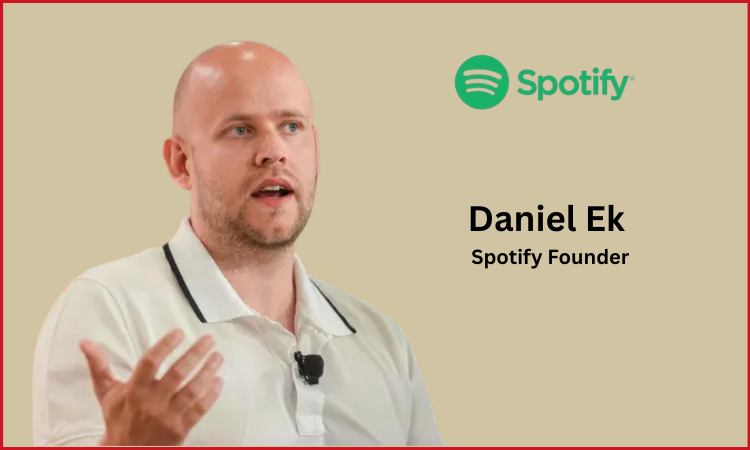
While others saw chaos, Daniel Ek saw an opportunity. Instead of viewing piracy itself as the obstacle, he understood that consumers lacked an affordable, legal, and convenient way to access music. In 2006, together with co-founder Martin Lorentzon, he founded Spotify with the simple mission of making legal music streaming more convenient than piracy.
Since then, Spotify has grown to become the world’s largest music streaming platform, serving hundreds of millions of listeners across music, podcasts, and audiobooks. Under Ek’s leadership, the company has transformed not only listening habits but also how artists distribute their music and how the global music industry generates revenue.
Who Is Daniel Ek?
Daniel Ek was born on 21 February 1983 in Stockholm, Sweden. Fascinated by computers from an early age, he quickly learned programming as a teenager and began building websites for clients while still in school.
As early as the age of 14, Daniel was earning money by building websites for local businesses. His entrepreneurial mindset developed from his curiosity about technology and his desire to solve real-world problems rather than follow a traditional career path.
He studied at KTH Royal Institute of Technology in Stockholm for a short time but dropped out, believing that entrepreneurship offered greater opportunities than conventional university education.
Rather than pursuing a corporate career, Daniel dedicated himself to building technology companies that solved genuine consumer problems, a philosophy that would later define Spotify.
Before Spotify: Building an Entrepreneur
Before launching Spotify, Daniel Ek had already established himself as a successful entrepreneur.
Before founding the music streaming giant, he worked at internet companies such as Tradera, one of Sweden’s leading online marketplaces, and Stardoll, a digital entertainment platform. These experiences gave him valuable exposure to internet businesses and digital consumer behaviour.
He also founded an online advertising company called Advertigo, which was later acquired. The successful exit provided both the capital and confidence to pursue larger entrepreneurial ambitions.
During this period, he also explored peer-to-peer file-sharing technologies, including μTorrent, one of the world’s most widely used file-sharing platforms. This experience allowed him to understand the growing demand for digital content and the limitations of existing distribution models.
Instead of focusing on launching yet another internet startup, Daniel began thinking about how technology could solve one of the music industry’s biggest challenges.
The Birth of Spotify: Solving a Global Problem
The music industry experienced one of the most serious crises in its history during the mid-2000s.
Illegal music downloads through services like Napster and Kazaa had become widespread. People wanted instant access to music, but legal alternatives were expensive, fragmented, or inconvenient. Record labels lost billions of dollars, while artists faced declining revenues.
Daniel Ek believed people were not unwilling to pay for music—they simply wanted a better experience.
In 2006, Daniel Ek and entrepreneur Martin Lorentzon founded Spotify to provide legal music streaming that was faster, simpler, and more convenient than piracy. Instead of asking users to purchase individual albums or songs, Spotify gave listeners instant access to millions of tracks through a single digital platform.
The concept represented a fundamental shift in music consumption. Instead of owning music, listeners could stream virtually any song whenever they wanted.
How Spotify Changed the Way the World Listens to Music
Spotify did more than launch another music streaming platform; it fundamentally changed consumer behaviour and reshaped the global music industry.
Before Spotify vs. After Spotify
| Before Spotify | After Spotify |
| Music was purchased through CDs or digital downloads. | Millions of songs became instantly available through streaming. |
| Illegal downloads through piracy were common. | Affordable subscriptions made legal streaming more attractive. |
| Discovering new artists depended largely on the radio or music stores. | Personalised recommendations helped users discover new music every day. |
| Independent artists often struggled to reach global audiences. | Artists could distribute music to listeners worldwide through one platform. |
Rather than relying solely on legal action against piracy, Spotify changed consumer habits by making legitimate music streaming easier, faster, and more convenient. This transformed the relationship between listeners, artists, and record labels while encouraging millions of users to embrace subscription-based music streaming.
Music Beyond Entertainment
Spotify has also changed the way people use audio in their everyday lives.
Today, users stream focus playlists while studying, workout playlists while working out, relaxing music after work, and ambient sounds while sleeping. They also discover podcasts covering business, technology, education, mental wellness, and self-improvement, making Spotify much more than a music platform.
Additionally, research suggests that music can support mood regulation and stress reduction for many people, while streaming platforms have made these listening experiences far more accessible. Although Spotify is not a healthcare service, its extensive catalogue has helped integrate music and audio into the daily routines of hundreds of millions of people worldwide.
By making music and audio available anytime and almost anywhere, Daniel Ek’s vision has extended far beyond the music industry, influencing how people learn, work, exercise, relax, and discover new ideas every day.
Spotify’s Business Model: Making Music Accessible Through Freemium
In contrast to traditional music labels whose revenue structure was predominantly based on album sales, Daniel Ek built Spotify around a freemium business model that combines accessibility with recurring revenue.
Rather than paying before streaming, users can listen to millions of songs for free with advertisements. Those who want an ad-free experience, offline downloads, higher audio quality, and additional features can subscribe to Spotify Premium.
This lowered the barrier to legal music streaming while encouraging millions of free users to gradually upgrade to Premium subscriptions.
Spotify’s Business Model
| Revenue Source | How It Works |
| Premium Subscriptions | Monthly subscription options that provide an ad-free experience, offline downloads, and additional benefits. |
| Advertising | Earnings from advertisements displayed to free users. |
| Podcasts | Revenue generated through advertising, creator partnerships, and premium podcast offerings. |
| Audiobooks | Premium audiobook access, expanding the subscription offering. |
| Creator Ecosystem | Tools and services that help artists, podcasters, and creators grow their audiences and monetize their content. |
This model has enabled Spotify to become the world’s largest music streaming platform. By 2026, it serves 761 million monthly active users (MAUs), including 293 million Premium subscribers, demonstrating the scalability of its subscription-based business while maintaining one of the world’s largest free user communities.
From Startup to Global Streaming Leader
Spotify’s journey illustrates how continuous innovation can reshape an entire industry.
Spotify’s Growth Timeline
| Year | Milestone |
| 2006 | Spotify was established by Daniel Ek and Martin Lorentzon. |
| 2008 | Spotify officially launched in Europe. |
| 2011 | Expanded into the United States, accelerating global growth. |
| 2018 | Completed a direct listing on the New York Stock Exchange. |
| 2024 | Reported its first full year of profitability. |
| 2026 | Continues to be the world’s largest music streaming platform, with 761 million MAUs and 293 million Premium subscribers. |
Instead of remaining only a music streaming service, Spotify has grown into a comprehensive audio platform by expanding into podcasts, audiobooks, AI-powered recommendations, and creator tools. These investments have helped diversify revenue while increasing user engagement across different forms of digital audio.
Beyond Spotify: Investing in the Future of Technology
Daniel Ek’s entrepreneurial journey extends well beyond Spotify.
Through Prima Materia, the investment company he co-founded, Daniel supports ambitious European startups working in artificial intelligence, healthcare, biotechnology, defence technology, and other advanced technologies.
Among its notable investments are Neko Health, a healthcare company that uses AI and advanced scanning technology to detect health risks earlier, and Helsing, an AI-powered defence technology company focused on strengthening European security.
Rather than focusing solely on entertainment, Daniel has established himself as a long-term technology investor backing companies that aim to solve complex global challenges.
2026: Leading Spotify’s Next Chapter
While Daniel Ek stepped down as Spotify’s Chief Executive Officer in January 2026, he continues serving as the company’s Executive Chairman.
In this role, he focuses on long-term strategy, capital allocation, regulation, and future innovation, while co-CEOs Alex Norström and Gustav Söderström oversee the company’s day-to-day operations.
Spotify continues strengthening its position through AI. , AI-powered music recommendations, personalised discovery features, creator tools, and its Interactive DJ help listeners discover new content while enabling creators to reach wider audiences. The company is also expanding its podcast ecosystem, audiobook library, and AI-powered content experiences to support long-term growth.
Financially, Spotify continues building on its recent profitability. Growth in Premium subscriptions, increasing user engagement, disciplined cost management, and an expanding portfolio of AI-powered services position the company for continued growth while competing with Apple Music, YouTube Music, Amazon Music, and other global streaming platforms.
Challenges Along the Way
Like most technology companies that disrupt established industries, Spotify continues to face several challenges.
One of the most persistent debates centres on artist compensation. While Spotify has created new revenue opportunities by helping artists reach global audiences, many musicians and industry groups argue that streaming royalties remain too low, particularly for independent creators.
Spotify also operates in an intensely competitive market alongside Apple Music, YouTube Music, Amazon Music, and other streaming services. To remain competitive, the company continues investing in artificial intelligence, personalised recommendations, exclusive content, podcasts, audiobooks, and creator tools while balancing creator monetisation with sustainable business growth.
Daniel Ek has also faced criticism beyond Spotify. In 2025, Prima Materia’s investment in Helsing, an AI-powered defence technology company, prompted some artists to remove their music from Spotify in protest. Daniel maintained that supporting advanced European technology was in the long-term interest of innovation and security.
Despite these challenges, Spotify continues expanding its global reach while adapting its business model to changing consumer behaviour, technological advances, and the evolving creator economy.
Leadership Lessons from Daniel Ek
Daniel Ek’s entrepreneurial journey offers valuable lessons for founders, business leaders, and aspiring entrepreneurs.
His biggest lesson is to solve genuine consumer problems rather than simply improving existing products. Instead of fighting music piracy through stricter enforcement, he created a legal alternative that was faster, more convenient than illegal file sharing, and easier for consumers to adopt.
His journey also demonstrates the importance of thinking globally from the beginning. Spotify was built for international expansion from the outset, allowing the company to scale across markets and serve hundreds of millions of users across the world.
Another defining characteristic of Daniel’s leadership is his commitment to continuous innovation. Rather than remaining solely a music streaming platform, Spotify has expanded into podcasts, audiobooks, AI-powered experiences, creator tools, and personalised audio experiences to keep pace with changing consumer expectations.
Daniel also believes entrepreneurship is a long-term commitment. Through Prima Materia, he continues investing in AI, healthcare, biotechnology, and advanced technologies, reflecting his belief that entrepreneurs should solve not only today’s challenges but also prepare for the opportunities and problems of the future.
Conclusion
Daniel Ek’s story is about much more than launching Spotify. It is about identifying a global problem, using technology to transform an entire industry, and building a business model that changed how people access and experience music.
By making legal music streaming more affordable and convenient than piracy, Spotify transformed listening habits worldwide while creating new opportunities for artists, creators, and listeners. Today, the platform has evolved beyond music into podcasts, audiobooks, and AI-powered audio experiences, serving hundreds of millions of users across the globe.
As Executive Chairman of Spotify in 2026, Daniel Ek continues guiding the company’s long-term strategy while investing in the future of European technology through Prima Materia. His entrepreneurial journey demonstrates that lasting success comes from solving genuine consumer problems, embracing continuous innovation, and preparing for the opportunities of tomorrow.
FAQs
1. Who is Daniel Ek?
Daniel Ek is a Swedish entrepreneur best known as the co-founder of Spotify. He currently serves as Executive Chairman of Spotify and is also an investor through Prima Materia, which supports companies in AI, healthcare, and advanced technologies.
2. How did Spotify change the music industry?
Spotify transformed the music industry by making legal music streaming easier and more convenient than piracy. It introduced a subscription-based streaming model that improved music discovery, expanded access to millions of songs, and created new revenue opportunities for artists and record labels.
3. How does Spotify make money?
Spotify primarily generates revenue through Premium subscriptions and advertising on its free platform. The company also earns revenue through podcasts, audiobooks, and creator-focused services.
4. What is Daniel Ek doing in 2026?
In 2026, Daniel Ek serves as Spotify’s Executive Chairman, focusing on the company’s long-term strategy, capital allocation, and future innovation. He also continues investing in AI, healthcare, and deep-tech companies through Prima Materia.
5. What is Daniel Ek’s net worth in 2026
According to the Forbes Real-Time Billionaires Tracker, Spotify co-founder Daniel Ek has a net worth of $9.4 billion.
6. What can entrepreneurs learn from Daniel Ek’s journey?
Entrepreneurs can learn the importance of solving real customer problems, building products that people genuinely want to use, thinking globally from the beginning, embracing continuous innovation, and creating long-term value through technology, disciplined execution, and long-term thinking.