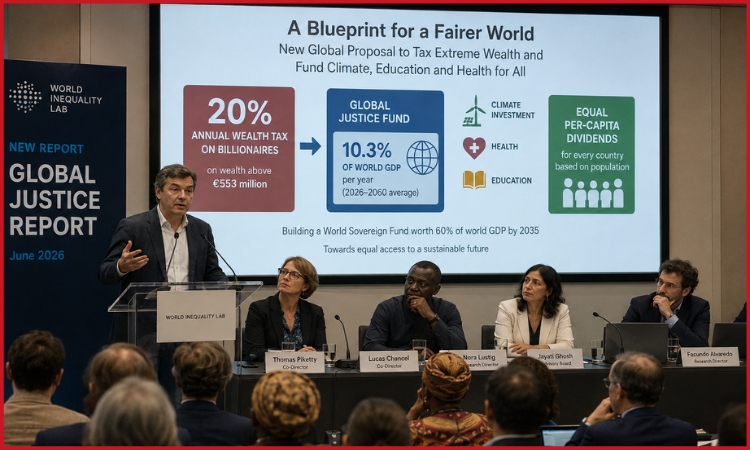
A major new international research report has put a concrete proposal on the table: tax the world’s billionaires at 20% of their wealth every year, use the proceeds to build a new global fund larger than anything that currently exists, and redirect the money to climate infrastructure, education, and healthcare in the world’s poorest countries.
The Global Justice Report, released in June 2026 by the World Inequality Lab — the Paris-based research initiative co-led by economist Thomas Piketty — is the first attempt to lay out a fully quantified plan of this kind. It is not a position paper. It runs to 136 pages of projections, tax schedules, and institutional design, drawing on two centuries of inequality and economic data.
The wealth tax and who pays it
The report proposes a global progressive wealth tax that starts at zero and rises steeply at the top. It kicks in at ten times average world wealth — roughly €1.1 million per adult in 2026 — and climbs through a series of brackets. The schedule reaches 5% at €11 million, 10% at €55 million, 15% at €110 million, and tops out at a flat 20% on anyone holding more than €553 million in net assets. That last bracket is, in the report’s own terms, the billionaire class.
“All billionaires pay a global wealth tax equal to 20% of their wealth,” the report states.
At that rate, the annual tax bill for most billionaires would exceed their income — meaning the only practical way to pay it is to sell or transfer assets. The report explicitly addresses this: taxpayers can hand over securities directly to the new fund, or sell assets to other individuals and pay in cash. It notes that asset sales could be structured to allow employees to buy into the companies they work for, expanding what the report calls participatory governance.
The tax is designed to sit on top of existing national tax systems, not replace them. It targets roughly 1% of the world’s population.
Billionaires aren’t the biggest revenue source — millionaires are
One of the report’s more counterintuitive findings is that billionaires, despite facing the steepest rates, do not generate the most revenue. “In terms of potential tax base and tax revenue, billionaires do matter, but less so than decamillionaires and centimillionaires,” it states.
The numbers back this up. In 2026, the report projects billionaires — about 29,000 individuals globally — paying 4.2% of world GDP in wealth tax. Millionaires, decamillionaires, and centimillionaires together pay 6.1% of world GDP in the same year. Over the full 2026–2035 period, billionaires contribute 10.9% of cumulated world GDP in tax, against 16.3% from millionaires, 19.8% from decamillionaires, and 16.5% from centimillionaires. The reason: the 20% annual rate erodes the billionaire tax base quickly, as wealth is transferred or sold to comply.
A parallel income tax — going up to 90%
Running alongside the wealth tax is a global income tax, also layered on top of national systems, also targeting the top 1%. It applies to post-national-tax disposable income and rises from 0% below seven times average world income (€149,100 in 2026) to 5% at ten times, 20% at twenty times, 40% at fifty times, and hits 90% above 5,000 times average world income — an annual income of over €106 million.
The income tax raises an average of 4% of world GDP per year between 2026 and 2035, compared with 6.8% for the wealth tax in the same period.
Proposing the Global Justice Fund
Together, these taxes — plus investment returns from a sovereign portfolio built with early revenues — would finance the Global Justice Fund, projected to spend an average of 10.3% of world GDP per year between 2026 and 2060, rising to 14.1% in the first decade alone.
The comparison the report draws is stark. Total official development aid today stands at 0.3% of world GDP. The combined annual budgets of the United Nations, IMF, and World Bank amount to 0.1% of world GDP. “This vastly exceeds total development aid or the combined budget of UN, IMF and WB,” the report states.
The reason for the scale: climate investment alone will require 3–4% of world GDP per year over the coming decades, and that has to run alongside a sustained push on education and health to close development gaps. Even at 10% of world GDP, the report concedes the fund falls short of what full equalisation would require. “The Global Justice Fund would need to be approximately four times larger — around 40% of world GDP in annual expenses — to provide full equal access in the immediate future.”
The World Sovereign Fund — a public portfolio 40 times the size of Norway’s
Most of the money raised in the first decade (2026–2035) does not go directly to countries. It goes into building a World Sovereign Fund — an active portfolio of sustainable assets — with a target of reaching 60% of world GDP by around 2035, equivalent to roughly 10% of the entire world capital stock.
Norway’s sovereign fund, widely considered the world’s largest, equals about 500% of Norway’s own GDP. The WSF would be, in the report’s own calculation, “about 40 times larger than Norway’s sovereign fund” in volume terms.
Once built up, the WSF’s investment returns — projected at 4.8% of world GDP per year on average over 2026–2100 — gradually replace tax revenues as the fund’s main income source. By 2100, the report projects that virtually all GJF revenue comes from WSF returns alone, with the wealth and income taxes becoming almost negligible.
Country dividends: what poor countries receive
On the spending side, the GJF distributes country dividends to every government on an equal per-capita basis — the same amount per person regardless of nationality. These are not cash handouts to individuals; they are government allocations tied to spending on climate, education, and health, with conditionalities on measurable outcomes.
Per-capita dividends peak at roughly €1,900 per person per year around 2035, split across approximately €850 for climate investment, €630 for health, and €420 for education.
Because the allocation is per-capita, poorer countries with larger populations receive far more as a share of their economies. Sub-Saharan Africa would receive dividends worth 8.8% of its GDP on average. South and South-East Asia (home to India) would receive 5.4%. Europe and North America/Oceania would receive between 2.2% and 2.5%.
The gaps that remain
The report does not oversell what this achieves. Education spending per capita currently ranges from €209 in Sub-Saharan Africa to €4,141 in North America/Oceania — a gap of 1:20. Under the GJF, that narrows to roughly 1:3 by 2050, and only reaches full convergence by 2100. The health gap is worse: €113 per capita in Sub-Saharan Africa against €8,301 in North America/Oceania today — a ratio of nearly 1:80 — narrowing to 1:3 by 2050. “Although this is again more gradual than what the principle of equal opportunity would imply, we believe this would be a very meaningful achievement,” the report states.
The report describes the GJF as a “gradualist” platform — and then adds a note of self-criticism: “arguably too moderate and gradualist.”
The political test
The report is clear-eyed that none of this happens automatically. It names India, Brazil, South Africa, Nigeria, Turkey, Indonesia, and Egypt as the coalition of Southern nations whose participation would be essential even if the US and China do not join.
And it frames the entire proposal — the taxes, the fund, the dividends — as the 21st-century equivalent of the social democratic transformation that reshaped Western economies in the 20th century.