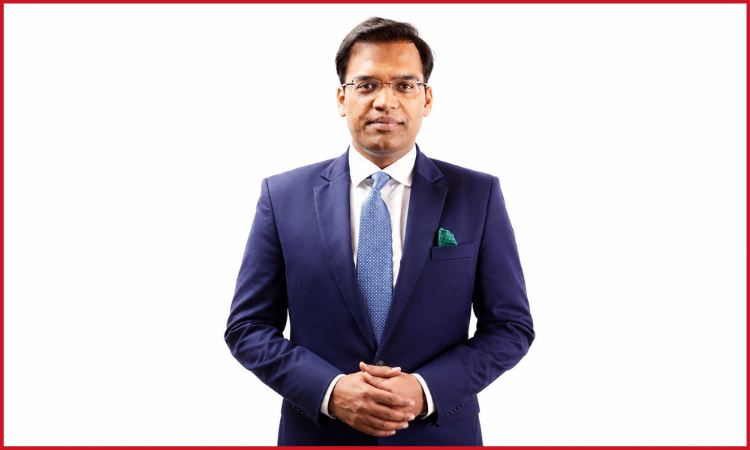
After more than a decade scaling Motilal Oswal Real Estate into one of India’s largest institutional platforms, Arnya RealEstates Fund Advisors founder Sharad Mittal is betting that India’s next real estate decade demands a fundamentally different kind of firm.
Twelve years is a long time to build something. Sharad Mittal spent that time at Motilal Oswal Real Estate, growing its AIF platform from nothing into one of India’s largest real estate investment vehicles — ₹7,150 crore in AUM, a roster of marquee developers, and a track record that institutional investors still cite. In 2023, he walked away to start over.
In his reading, something larger was about to go very right, and the only way to be positioned for it was to build from scratch.
“While the journey was immensely rewarding, it also gave me a front-row seat to the changing contours of India’s real estate market. Over time, I became increasingly convinced that the next decade of Indian real estate would be fundamentally different from the previous one.” The firm he founded, Arnya RealEstates Fund Advisors, is his answer to that conviction,” Mittal tells Business Outreach in an exclusive interview.
A structural bet
Mittal’s case for Arnya begins with a macro argument. India, he believes, has entered a structural real estate upcycle, one underpinned by accelerating urbanisation, rising household incomes, large-scale infrastructure creation, and the formalisation of a sector that for decades ran largely outside institutional frameworks. Layered on top of that is a shift in investor appetite: away from plain-vanilla debt strategies and toward a broader spectrum of structured equity, development capital, yield assets, warehousing, plotted development, and special situations.
That is precisely what Arnya is being built to offer. “Arnya was founded with the vision of building a next-generation, full-stack real estate alternative investment platform that combines institutional investing discipline with entrepreneurial agility,” Mittal says. Arnya, as per Mittal, is not a single-strategy credit fund that has wandered into equity. It is, from the ground up, a platform designed to move across the capital stack as opportunities demand.
The early numbers suggest the timing was right. Arnya’s maiden debt fund, launched in April 2024, has committed over ₹1,000 crore, including co-investments, in under two years across 11 transactions, nine of them in premium mid-segment residential projects and two in luxury. Its second fund, an equity strategy focused on Mumbai redevelopment, raised ₹1,300 crore in under six months after launching in 2025. A third fund, a preferred equity vehicle to be structured with one of India’s largest developers, is planned for the second half of 2026. By 2027, Mittal is targeting ₹5,000 crore in AUM.
‘Real estate investing is fundamentally about risk management’
Mittal brings over two decades of real estate investment experience to Arnya, and the philosophy that runs through all of it is less about chasing returns than about managing what can go wrong. “Real estate investing is fundamentally about risk management rather than return maximisation,” he says.
The underwriting framework at Arnya evaluates every deal across four axes: sponsor quality, legal certainty, market demand, and execution capability — with proactive asset management treated as a fifth, ongoing discipline rather than an afterthought.
That framework is tested hardest in Mumbai redevelopment, which has become a centrepiece of Arnya’s equity strategy. Mumbai redevelopment is among the most complex deal terrain in Indian real estate, layered with regulatory timelines, legal title risk, political dynamics, and the management of existing residents. Mittal is clear-eyed about where the traps lie. “Mumbai redevelopment offers one of the most compelling opportunities, but success requires patience, local expertise and disciplined underwriting. We prefer projects where critical risks are identifiable and manageable rather than relying on optimistic assumptions regarding approvals or stakeholder resolutions.” Arnya’s focus, accordingly, is on society redevelopment in established, well-understood micro-markets.
The mezzanine investing that has defined much of Mittal’s career slots naturally into this framework. Sitting between senior debt and pure equity, mezzanine capital offers developers the flexible growth financing that bank lending rarely provides, while giving investors a layered return structure — fixed income, profit participation, and structural downside protection — that pure equity cannot. “It offers developers flexible growth capital while providing investors enhanced risk-adjusted returns through a combination of fixed returns, profit participation and structural protections,” Mittal explains.
Why independence matters
One of Arnya’s founding arguments is that independence — from a parent financial group, from cross-selling pressures, from conflicts of interest — is not just a nice-to-have for an investment manager. It is a structural advantage.
Mittal has operated inside large institutional frameworks for most of his career, and the decision to build outside one this time is informed by that experience. As an independent, single-asset-class manager, Arnya can align incentives cleanly between the fund and its investors, make decisions without navigating institutional hierarchies, and build a team and culture oriented entirely around real estate outcomes.
The firm’s 20-plus-year combined track record — spanning 175 investments, over 100 exits, and a 20%-plus IRR — represents the professional histories of its founding team rather than Arnya’s short institutional life. But that provenance is the point. “Starting afresh was not about moving away from the past, but about building upon the experience, relationships and learnings accumulated over the years,” Mittal says.
Arnya today operates out of five cities — Mumbai, Gandhinagar, Bengaluru, Kolkata, and Delhi — with its Gandhinagar office anchoring a GIFT City fund structure for overseas investors.
Geographically, its deployment has tracked where institutional real estate capital in India has always concentrated: Mumbai, NCR, Bengaluru, Pune, Hyderabad, and Chennai, cities where economic scale, employment depth, and housing demand create the deal flow and exit visibility a platform fund requires.
The next chapter for Sharad Mittal
What Mittal is building toward is a full-stack real estate AMC — a firm that can move across debt, mezzanine, preferred equity, development equity, real assets, and plotted development depending on where India’s real estate cycle is creating value. “Our objective is to build a diversified investment platform spanning private credit, development equity, real assets and thematic residential strategies,” he says.
India’s real estate sector is, in his telling, moving through a structural transition that will be defined by consolidation — fewer but more creditworthy developers — and by the growing weight of institutional capital in a market where informal finance once dominated. That transition creates both the opportunity and the imperative for a firm like Arnya. “We expect significant demand for both structured credit and growth capital over the next several years.”
Twelve years building a large real estate platform gave Mittal the blueprint. The question he set out to answer in 2023 was whether he could build the next one better, on his own terms, at the exact moment India’s real estate market was ready for it.
So far, the answer looks like yes.