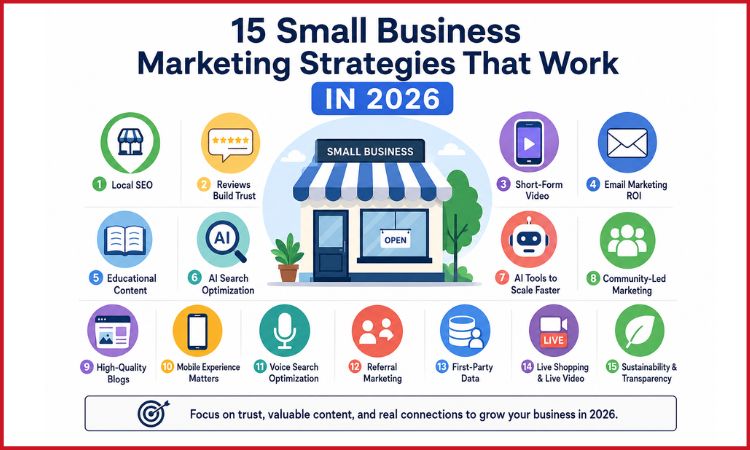
Small business marketing is becoming far more competitive, AI-driven and trust-focused than it was just a few years ago.
Businesses are no longer competing only for Google rankings and social media engagement. They are also competing for visibility across AI-generated search answers, Google Maps recommendations, Instagram Reels, YouTube Shorts, online reviews, Reddit discussions, and personal recommendations.
Meanwhile, traditional website traffic is transforming radically. At HubSpot’s INBOUND conference, the company shared that nearly 60% of Google searches now end without a click, as users receive the information they require directly from AI-generated summaries and search features. This means businesses can no longer rely solely on rankings to drive visibility.
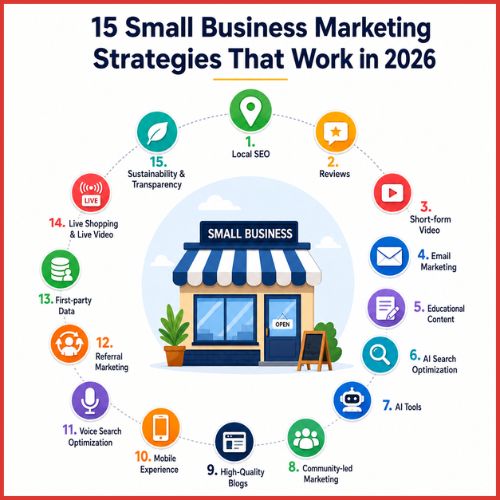
In this article, we will explore the most effective small business marketing strategies businesses should focus on in 2026.
Why Small Business Marketing Has Shifted in 2026
Customer search behavior is shifting dramatically to AI-powered discovery and trust-based purchase decisions.
Marketers are more heavily focusing on AI-powered personalization, automation, customer experience and educational content as audiences engage less with traditional promotional content, found HubSpot’s State of Marketing Report.
At the same time, users are increasingly judging online content based on how much they trust the business or brand behind it, as easily created low-quality content floods search engines and social media through various AI tools.
Businesses that provide helpful content, proactive customer engagement, and straightforward communication have built stronger long-term visibility than any business relying solely on constant ads.
1. Local SEO is driving high-intent customer traffic
As of 2026, local SEO remains a very powerful and effective channel of advertising for small businesses, as local searches often reflect strong purchase intent.
According to a Safari Digital report, 46% of searches today have local intent, and 86% of Google searches for a business name look up the business on Google Maps.
These are important statistics, as Search engines are now placing more value on the prominence of local businesses on Google Maps search results, voice searches, AI searches and in mobile searches.
Businesses with an optimized Google Business Profile perform significantly better, as customers trust detailed, complete profiles with current business information, reviews, photos and business activity.
2. Reviews influence AI visibility
Reviews have become more than simply trust signals; they are now crucial discoverability signals.
Trustpilot found that businesses with over 80 verified reviews appear in over 75% of AI-generated responses across various platforms.
BrightLocal also shared that 98% of users read reviews before they decide on which local businesses to patronize and that recent reviews have much more influence than outdated ones.
Companies that systematically solicit and respond to reviews demonstrate increased visibility and improved conversion rates over time.
3. Short-form video delivers the highest ROI
Short-form video became the #1 highest ROI content format for marketers in HubSpot’s latest marketing research, outperforming several other more traditional content formats across the board for engagement and conversions.
Short-form video content continues dominating platforms such as Instagram Reels, TikTok, YouTube Shorts and Facebook Reels as users devote substantial time to these formats.
Consumers in 2026 are increasingly following customer experience, transformation or education videos, user-generated content, behind-the-scenes, and product demonstrations rather than meticulously manufactured advertisements.
4. Email Marketing still delivers a strong ROI
Email marketing, despite predictions of its decline, remains one of the most effective channels for small business marketing ROI.
Reports share that businesses are now earning nearly $36-42 in revenue for every $1 spent on email marketing.
The reason that email marketing still performs is that small businesses have control over direct relationships and direct communication; they do not rely on search engine or social media algorithms for visibility.
TechRadar also found that segmenting email marketing efforts can deliver up to 760% more revenue than mass or undifferentiated email campaigns.
5. Educational content outperforms promotional content
Customers today tend to tune out generic sales-driven messaging, preferring informative content that provides value and answers questions.
Businesses producing blogs, tutorials, “how-to” guides and frequently asked questions continue to perform well, HubSpot noted in its latest marketing study, as educational content continues to drive significant return on investment.
Key benefits of educational content include search visibility, customer trust, authority building, long-term website traffic and even increased visibility on AI searches.
The businesses consistently generating more long-term engagement are focusing more on tutorials, guides, FAQs, case studies rather than primarily direct sales pitches.
6. AI Search optimization is becoming mandatory
One comprehensive academic study that analyzed over 24,000 searches in 243 countries found that AI search answers grew dramatically from 2024 through 2025. The study also showed that users are increasingly depending on AI-generated summaries and direct answers to discover information online.
Instead of simply clicking on links, searchers are increasingly getting direct answers from summaries generated by AI search engines.
This means your content is more well-structured and trustworthy compared with AI search to index, categorize and use information.
Having clearly labeled sections, well-researched data, FAQ sections and, in many cases, excellent reviews can make the difference.
7. AI tools help small businesses scale faster
87% of marketers use generative AI tools in some form in 2026 to improve efficiency and productivity and automate tasks.
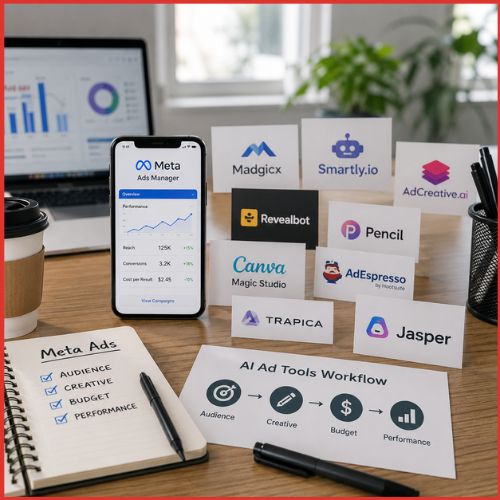
Businesses are now increasingly utilizing AI to write content drafts, perform advanced analytics, answer customer questions, craft ad copy, personalize marketing emails and automate social media scheduling.
The small businesses benefiting from these tools aren’t replacing human strategy; they are utilizing AI to automate repetitive tasks and improve efficiency.
8. Hypergrowth of community-led marketing
Businesses everywhere are focused on building customer ecosystems ranging from WhatsApp groups, newsletters, Discord communities, web-based webinars, and meetups (local and global) to increase customer loyalty in the long run.
According to HubSpot’s latest trends report, the well-performing brands have established high customer relationships with communities, which are a key to long-term customer engagement.
9. High-Quality Blogs Continue Generating Long-Term Organic Traffic
Although increased AI-generated content has likely signaled the end for conventional blogging, well-curated and maintained blogs continue to pull significant traffic and engagement.
Research from Entrepreneur HQ states that actively updated blogs receive more than 55% additional traffic compared to companies that do not maintain their blogs.
AI-generated generic content continues to receive very little traffic and attention and as the trends show, content built around unique expertise, information, data, actionable tips, and value are in extremely high demand.
10. Mobile experience directly impacts conversion rates
Mobile is now the dominant force behind every modern customer journey, and a negative mobile experience can severely diminish every facet of your marketing.
According to TechRadar, 50% of all emails are now opened on mobile, indicating the importance of mobile optimization.
Companies that prioritize fast-loading mobile pages, simple navigation, and easy user interfaces tend to see the greatest overall marketing performance.
11. Voice search optimization is an increasingly significant practice
Voice search usage across smart speakers, AI assistants, and mobile devices is growing significantly. Users now perform online searches using conversational keywords and questions, instead of short, simple keywords, to find companies, services and local stores.
In the context of 2026 SEO, small and local businesses are now expected to appear not only for localized search intent keywords, but also for conversational and voice search queries. Search engines are looking for rapidly loaded, mobile-responsive and direct, knowledge-based responses to their queries.
Small business voice Search optimization can lead to massive discovery advantages locally. Any business that has a properly optimized Google Business Profile, a Q & A section that answers common questions that users are asking and locally-optimized keywords in addition to being mobile-friendly and speedy should perform well with the continued push of voice search for local discovery.
12. Referral marketing continues driving customer acquisition
Referral marketing, one of the cheapest forms of customer acquisition, is becoming extremely popular. Recommendations from family, friends, and existing customers remain among the most trusted forms of marketing after word of mouth.
Companies put in place referral schemes, loyalty schemes, discounts, offers, and promotions in order to get customers referring them, bring in new leads, develop a customer relationship, raise conversion rates and improve customer loyalty.
The customer quality generated by referral marketing alone is superior to many other forms of customer acquisition, as referred customers are more trustworthy than customers acquired via paid advertising.
13. First-party data is an increasingly valuable practice
As privacy regulations grow and third-party cookies fall by the wayside, first-party data acquisition will grow in importance for marketers. Customer purchase history, likes, emails, and other direct contact with the business are now a critical part of the business marketing strategy in 2026.
Businesses are going away from heavy external advertising channels and looking more into first-party data, such as customer purchases from a direct interaction or through the website, subscription forms, newsletters, or membership to the brand.
These efforts are being made in order for companies to improve targeting accuracy, customer loyalty, and personalization. First-party data has made it effective to deliver on the efforts of personalization, product recommendations, advertising, and communication with consumers.
14. Live shopping and live video engagement continue to surge
Live video e-commerce is quickly becoming one of the dominant customer engagement strategies on channels like Instagram, TikTok, Facebook, and YouTube. Many companies utilize live streaming for new product launches, live demonstrations, real-time Q & A’s and direct customer engagement.
Customers, as compared to highly edited advertising campaigns, are seeking more interaction and authenticity in purchasing decisions. Live shopping enables the demonstration of goods in a very authentic, honest way while interacting directly with the consumer and providing instant answers to product questions.
Live selling is expected to dominate in the beauty, fashion, electronics, and fitness industries. Small businesses that implement live streaming will benefit from higher engagement and better social media conversions.
15. Sustainability and transparency are becoming purchase drivers
Today, when engaging with companies, customers prioritize transparency and sustainability. Companies that are open about their origins, pricing structure, operations, and principles will become more favorable to customers.
In 2026, practices such as sustainability programs, ethical and responsibly sourced products, eco-friendly packaging, and clear and transparent policies will be part of effective marketing campaigns.
Conclusion
The key to a successful small business marketing plan in the coming years is not just about mass distribution but also about trust, visibility on AI-powered platforms, developing stronger customer relationships and creating authentic and valuable experiences.
Key strategies for businesses in 2026 include local SEO, reviews, effective content marketing, email automation, AI tools, customer-centric marketing and short-form video. By implementing these early on in the AI-powered digital economy, businesses can get a competitive advantage.
FAQs
What marketing strategy is most successful for small businesses in 2026?
According to many trends and recent data, local SEO, customer reviews, short-form video and email marketing provide the best return on investment for small businesses currently.
Are the benefits of SEO still available to small businesses?
Yes, but besides getting rankings, businesses should also focus on visibility across AI-driven search results and local platforms.
Why are online reviews important for small businesses in 2026?
AI-driven recommendations are increasingly relying on online review profiles and customer trust signals.
Is email marketing worth using in 2026?
Yes, email marketing remains highly cost-effective for small businesses, especially as automation tools make campaigns more efficient and personalized.
How can small businesses make use of AI?
AI tools can help small businesses with content generation, customer service, data analysis, personalized email campaigns, and marketing automation.