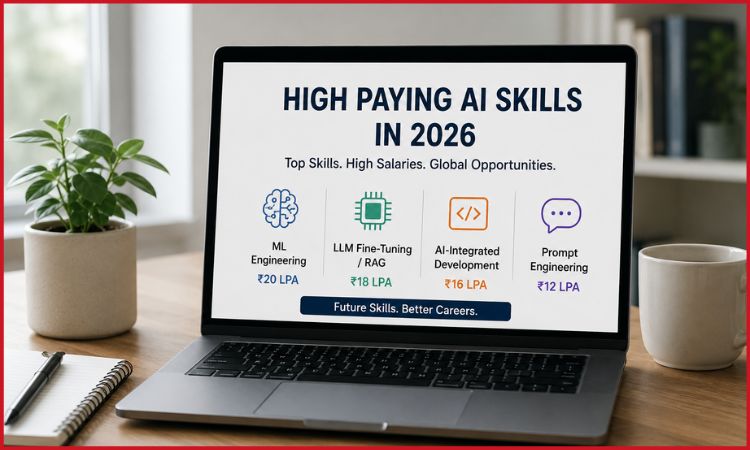
PwC’s analysis of more than a billion job postings found that jobs that listed at least two AI skills paid 43% more than comparable jobs that didn’t.
In India, AI and Machine Learning job postings grew 49% year-on-year in 2026 alone.
If you’re freelancing globally, skills like LLM fine-tuning and RAG architecture are billed at $80–$150 an hour on Western platforms. Earning in USD while based in India remains the smartest leverage play in 2026.
This guide covers the exact AI skills salary data role-wise, city-wise, and globally. So you know precisely where to invest your next six months.
AI Job Salaries in India vs US (2026 Data Breakdown)
Figures below cover professionals with two to five years of relevant experience. ESOPs and variable pay excluded.
| Skill | India Median | India 75th %ile | US Median | Time to Role |
|---|---|---|---|---|
| ML Engineering | ₹20 LPA | ₹48 LPA | $155K | 14–18 months |
| LLM Fine-Tuning / RAG | ₹18 LPA | ₹38 LPA | $130K | 6–10 months |
| AI-Integrated Dev | ₹16 LPA | ₹34 LPA | $115K | 5–8 months |
| Prompt Engineering | ₹12 LPA | ₹28 LPA | $90K | 2–4 months |
Sources: AmbitionBox (India, Apr 2026), Glassdoor US (Mar 2026), Levels. fyi senior benchmarks.
Two things stand out when you look at this table, honestly:
- ML Engineering pays the most but demands the longest investment by far.
- AI-Integrated Development is the fastest route for anyone already in tech.
- A developer at ₹10–12 LPA can realistically hit ₹20–25 LPA in under a year. Just by adding LangChain, vector databases, and RAG patterns to their existing JavaScript or Python skills.
Top 4 High-Paying AI Skills to Learn in 2026
1. ML Engineering Salary & Career Path in India
If you want the biggest paycheck, this is where you go. But the bar is high and the timeline is real.
- What you actually do: Understand, train, and tune models. Lots of math, statistics, and patience.
- Timeline: 14–18 months to become job-ready.
- Salary range: ₹30–50 LPA in India, $155K median in the US.
- Honest suggestion: If you can’t commit 15 hours a week for 16+ months alongside a full-time job, this path will stall halfway and a half-finished ML transition is worth considerably less than a completed one.
2. LLM Fine-Tuning & RAG Jobs in 2026 (Salary + Demand)
Probably the most undervalued skill in the current market. Most AI practitioners can use a model. Far fewer can make it useful for a specific company’s data.
- What you actually do: Train models on company data, connect them to real-world information via RAG. It’s a bridge between development and hardcore ML.
- Timeline: 6–9 months.
- Salary range: ₹18–35 LPA in India, $130K median in the US.
- Why it’s powerful: Scarcity. Companies actively need this and very few people do it well.
3. AI-Integrated Development Roadmap (Fastest Way to ₹25 LPA)
If you already write code, this is the quickest way available right now.
- What you actually do: Build products using AI chatbots, automation pipelines, and AI-powered app features using APIs and orchestration frameworks. You’re not training models. You’re deploying them.
- Timeline: 5–8 months for developers, sometimes faster.
- Salary jump: ₹10–12 LPA → ₹20–25 LPA. Common, not exceptional.
- Key tools: LangChain, Pinecone or Weaviate, OpenAI/Anthropic APIs, RAG patterns.
4. Prompt Engineering Jobs in 2026 (Skills, Salary & Scope)
Prompt engineering wasn’t killed by automation. It evolved.
- What you actually do: Design reliable, auditable AI workflows for regulated industries, such as insurance, banking, and healthcare. Making AI outputs predictable and safe enough for a senior analyst to stake their name on.
- Timeline: 2–4 months, the shortest of the four.
- Salary range: ₹12–25 LPA.
- Key edge: Domain knowledge beats coding skills here. If you understand how banking or healthcare actually works, you already have an advantage that most candidates don’t.
ROI of Learning AI Skills in 2026 (India Career Analysis)
Forget ROI as “return vs course fees” that is a misleading number. The real cost is time. The biggest opportunity cost is the hours you spend learning instead of earning, sleeping, or just living.
Say you’re currently at ₹12 LPA. Here’s what both realistic paths look like:
AI-Integrated Development (fastest option)
- Study commitment: 3 hrs/evening × 5 days × 32 weeks = 480 hours total
- Direct cost: ₹30,000 (courses) + ₹6,000 API credits
- Opportunity cost: Minimal evenings and weekends only
- Projected salary: ₹22–26 LPA (Glassdoor India, Apr 2026)
- Income uplift: +₹10–14 LPA
- Time to break even: Under 10 days of your new salary
ML Engineering (highest ceiling)
- Study commitment: 15 hrs/week × 70 weeks = 1,050 hours
- Direct cost: ₹1.5–2.5 lakh
- Opportunity cost: High — over a year of dedicated time
- Projected salary: ₹32–48 LPA
- Income uplift: +₹20–36 LPA
- Time to break even: 1.5–2 months at the new rate
Both paths are financially excellent. The variable most people miscalculate is personal sustainability.
Can you maintain 15 hours of technical study a week for 16 months while holding a full-time job?
If not, the ML Engineering path will stall around month eight and that’s an expensive place to stop.
How to Choose the Right AI Skill in 2026 (Step-by-Step Framework)
Most people spend three months deciding which skill to learn. Here’s a 20-minute framework instead:
- Step 1: Open your CV or LinkedIn profile. List your top three technical or domain skills right now.
- Step 2: Match them against the salary table above. The skill with the shortest learning curve that overlaps with what you already know is your starting point.
- Step 3: Before signing up for any course, build one thing this week — a chatbot using an LLM API, a prompt that solves a real task at your current job, or a Python script that calls a model. Something that exists.
- Step 4: Put it online. GitHub, Dev. to, LinkedIn anywhere.
Publishing forces clarity and starts building the portfolio that hiring managers actually look at.
The professionals transitioning fastest into AI roles are not the ones who took the most courses. They built things in public from month one, posting projects, writing about their learning, sharing failures alongside wins.
Best AI certifications in 2026
2026 is the AI age. We all know that integrating AI into our existing workflow is not only a smart move but also a necessary step to our careers.
It brings us more opportunities around our core skills in this modern AI era. Getting AI certifications is not expensive; you just need dedication to learn it.
There are thousands of free courses and micro courses available on the internet. You can learn any of them.
Some best sources are Google AI Learning Hub, Kaggle Learn, Harvard CS50 AI, Anthropic Academy, MIT OpenCourseWare.
| Goal | Best choice |
| Quick resume boost | Google AI essentials |
| Corporate IT career | Microsoft AI-900 |
| Serious ML engineering | Stanford or MIT open courses |
| Data science | Kaggle learn by Google |
| AI agent building | Anthropic Academy |
| Freelancing | Courses from Deeplearning.AI |
Companies hiring for these skills
Instead of those promising high-salary careers, AI has much more to offer us. Companies across different sectors, such as health, finance, consulting, and cloud, are actively hiring individuals with AI and agent-building skills in 2026.
| Skills | Demand in 2026 |
| LLMs | Very high |
| RAG systems | Extremely high |
| AI Agents | High |
| Cloud AI | Extremely high |
| LlamaIndex | Very High |
Source:- Naukri.com
Conclusion: Which AI Skill Should You Learn in 2026?
AI skills pay highly in 2026, because the demand is real, the talent gap is structural, and the salary numbers confirm it.
What actually matters: depth beats breadth, and the market rewards people who can show work, not credentials.
Pick one skill from the table. Build something this week. That’s it. You are ready to launch your AI career.
Frequently Asked Questions
Do I need a CS degree for an AI job in India?
No. In 2026, hiring managers are screening GitHub repositories and project write-ups before they look at degrees. A CS background helps, but a portfolio of working projects is the actual entry ticket.
How long does it realistically take to land a paying AI role?
Depends on your starting point. A developer with existing Python skills can transition to AI-Integrated Development in five to eight months.
Someone coming from a non-technical field should expect 10 to 14 months with steady weekly effort. Anyone promising results in 30 days is selling a course, not a career path.
Is prompt engineering still worth learning?
Yes. The ‘prompt engineering is dead’ narrative resurfaces every six months and it’s been wrong every time.
The role evolved — it’s less about clever phrasing and more about designing reliable AI systems for regulated enterprise workflows.
Can I earn in US dollars while living in India?
Yes, and not enough people do. Platforms like Toptal, Contra, and direct LinkedIn outreach to US and European SMEs let skilled Indian AI professionals bill $80–$150 per hour.
The vetting is rigorous (Toptal accepts around 3% of applicants), so you need a real project portfolio. At 20 billable hours a week, that’s roughly ₹1–1.5 lakh per month without relocating.
What’s the single biggest mistake people make breaking into AI?
Studying in private. The fastest movers build in public from month one posting projects, writing about progress, sharing failures alongside wins. Every piece of public work builds portfolio and network simultaneously. Waiting until you feel ready is how people spend 18 months learning and still have nothing to show.