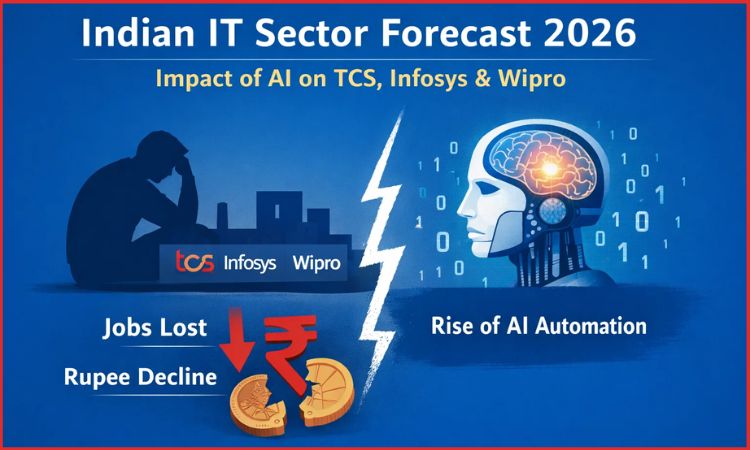
For decades, India’s tech giants like TCS, Infosys, and Wipro have been the undisputed kings of global outsourcing. But a chilling new report suggests that Artificial Intelligence is not just a tool, it’s a wrecking ball aimed directly at their foundations.
The Indian IT sector is currently facing its “Oppenheimer moment.” For thirty years, the industry thrived on a simple, golden rule: Labour Arbitrage. By providing world-class software developers at a fraction of Western costs, India built a $200 billion export engine that balances the nation’s trade deficit and powers its middle class.
However, a viral “macro memo” from Citrini Research has sent shockwaves through Dalal Street, painting a haunting picture of a 2028 where this golden rule no longer applies. The report doesn’t just predict a slowdown; it predicts an AI Doomsday.
Why the “Marginal Cost of Code” is the New Enemy
The core of the “Citrini Memo” lies in a brutal mathematical shift. Traditionally, if an American firm needed a software update, they paid $150/hour in Silicon Valley or $30/hour in Bengaluru. The choice was easy.
But what happens when an AI coding agent can do the same job for the price of the electricity used to run it?
According to the report, we are entering an era where the marginal cost of code is collapsing to near zero. This shift is already manifesting in “contract cancellations” that could accelerate through 2027. If a Fortune 500 company can build its own software internally using agentic AI, the $200 billion outsourcing model doesn’t just shrink, it evaporates.
The 18% Rupee Crash: A Macroeconomic Nightmare
This is not just a “tech problem”; it’s a national economic threat. The report suggests that if IT exports fail to bring in US dollars, the Indian Rupee could tank by as much as 18% against the USD in a matter of months.
Imagine a scenario where the IMF is forced into “preliminary discussions” with New Delhi because the service sector, which anchored India’s external accounts for decades, has been hollowed out by automation.
Beyond the Hype: Is the AI Panic Justified?
While the Nifty IT index recently shed over $56 billion in market value, its worst performance since the 2008 financial crisis, industry veterans are pushing back.
Nandan Nilekani, Chairman of Infosys, recently addressed the panic, stating that AI is a “fundamental root-and-branch surgery” for the industry. His take? It’s not about the end of the sector, but a massive explosion in the complexity of problems IT firms will solve.
The Counter-Argument:
- Legacy Complexity: Fortune 500 systems are messy. You can’t just plug in an AI and hope it understands 40 years of “spaghetti code” overnight.
- Trust and Governance: AI agents still “hallucinate.” Large enterprises need the human accountability that firms like TCS and Wipro provide.
- The Productivity Paradox: While AI reduces headcount, it allows for more software to be built than ever before. The “volume” of work might expand to fill the gap left by automation.
The Verdict: Adapt or Extinguish
The “AI Doomsday” narrative might be exaggerated, but it serves as a necessary wake-up call. The days of “body shopping” and simple maintenance contracts are over.
For the Indian IT sector to survive, the giants must pivot from being “providers of people” to “architects of AI.” The companies that will thrive in 2028 are not the ones fighting the bots; they are the ones teaching the bots how to run the world’s most complex businesses.
The market has spoken, and the $56 billion wipeout is a clear signal: The old playbook is dead. It’s time to write a new one.