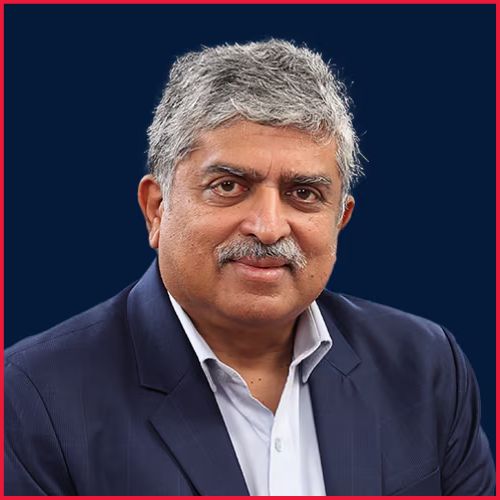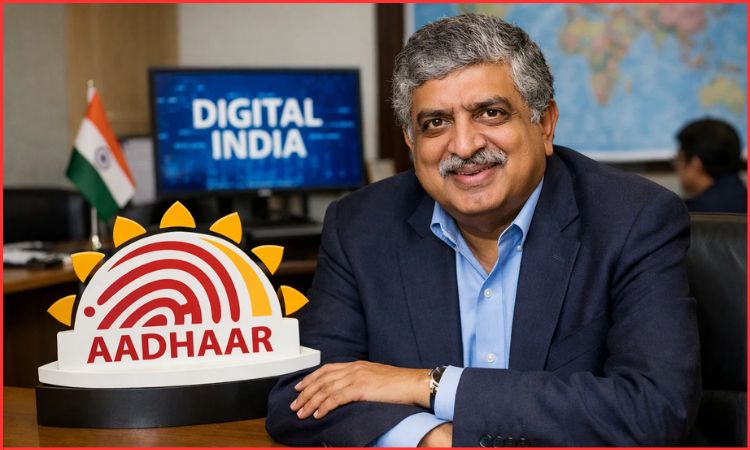
Nandan Nilekani, a pivotal figure and titan of information technology in India, is a co-founder of Infosys and leads the world’s most extensive biometric ID system, Aadhaar. His visionary leadership has given a favour and bridged technology, governance, and inclusion, which powers Digital India initiatives.
Let’s explore his achievements and the lasting impact of his mind behind the idea of Aadhaar and Digital India.
Nandan Nilekani Biography
Nandan Mohanrao Nilekani was born in Bangalore on June 02, 1955, and is known as the architect of digital India. He was raised in a middle-class family that valued intellectual rightness. His father worked as a General Manager at Mysore and Minerva Mills, implementing Fabian Socialist values, which emphasised social justice and gradual reform, which influenced Nandan’s later focus on inclusive growth.
He attended Bishop Cotton Boys School in Bangalore and Joseph’s High School in Dharwad. Later, he attended Karnataka PU College. He got his bachelor’s degree in electrical engineering from IIT Bombay.
These are the years that shaped his analytical mindset, preparing him for a career in technology.
Nandan Nilekani’s Journey of Infosys
In 1978, Nilekani joined Patni Computer Systems in Mumbai and met N.R. Narayana Murthy. Together, they co-founded Infosys with other 6 members in 1981.
He was promoted to President and COO, then to CEO, in 2002 and led Infosys until 2007, when it achieved global status with revenue exceeding $4 billion. As a non-executive chairman since 2017, he has guided its market cap to trillions.
From beginning with just ₹10,000 in personal savings to becoming a known brand, he has covered a long yet inspiring journey.
During his tenure as CEO, from 2002 to 2007, Infosys witnessed explosive growth:
- Revenue: The company’s topline sixfold, reaching $3 billion by the time he stepped down as CEO.
- Global Recognition: During his tenure, Infosys gained global recognition in technology.
- Corporate Governance: Under his leadership, Infosys set gold standards for transparency and ethics in Indian business.
Philanthropy, Investments, and Donations
Nilekani not only helps shape India with technology, but also helps people through donations and charity. He and his wife Rohini, pledged 50% of their wealth to the Giving Pledge in 2017, recognising rising inequality.
He donates ₹315 crore in 2023 to IIT Bombay for research and hostels, and ₹50 crore to the Indian Institute for Human Settlements, and support for the EkStep Foundation in education to improve literacy and numeracy for millions of children through technology. Totalling ₹400 crore.
He promotes the idea of social platforms and open-source digital infrastructure, which are designed to solve complicated social problems. He also made investments through Fundamentum and raised around $227 million in 2022, and backing startups like Juggernaut and Mubble.
Nandan Nilekani: The Mind behind Aadhaar and Digital India
Source: The Global Indian
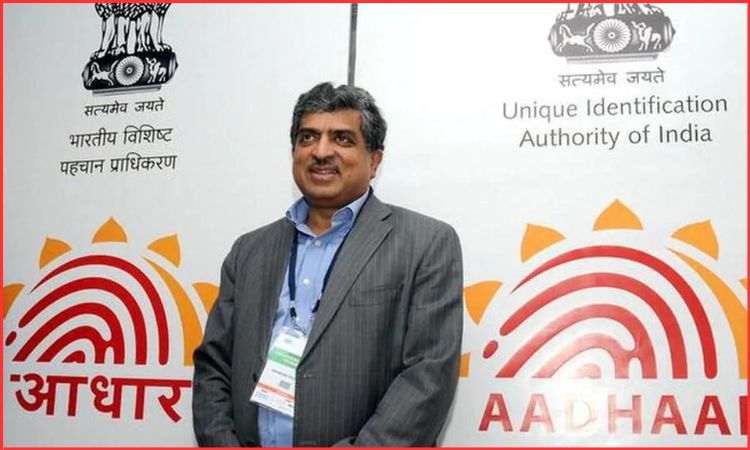
When Nilekani was appointed as the founding chairman of UIDAI in 2009, he launched Aadhaar to provide unique identities and ID cards to the Indian population.
Over 600 million enrollments were completed at the 25,000+ Aadhaar centres by 2014, and today 1.3 billion Indians hold Aadhaar cards as their proof of identity.
In January 2025, the graph showed an increase of up to 32% in authentications year over year. Aadhaar-enabled 284 crore authentications, fueling digital services like direct benefit transfers and saving ₹2.5 lakh crore in leakages.
Nilekani ensured that Aadhaar was seen by numerous government and private institutions as their own strategic goals. But the RBI saw it as a path to financial involvement for India’s 700 million unbanked.
Public sector oil companies viewed it as a means to eliminate fraudulent customers who were taking advantage of subsidies. The state government, on the other hand, saw it as a platform to devise better social welfare programs.
Aadhaar: The Identity of Billions
In 2009, Nilekani took a step that remains extraordinary in Indian corporate history. He resigned from Infosys to accept a cabinet-rank position as the chairman of the Unique Identification Authority of India (UIDAI).
He later returned to Infosys as non-executive chairman in 2017 to stabilise the company and reaffirm its founding principles.
However, the challenge was massive. To provide a biometric-based unique identity to over 1.2 billion Indian residents, many of whom had no formal identification.
Aadhaar has become the foundation for Digital India, enabling the Jan-Dhan-Aadhaar-Mobile “JAM Trinity.” This allowed for Direct Benefit Transfer (DBT), ensuring that welfare subsidies reached the intended poor directly into their bank accounts.
Aadhaar in numbers (source: Forbes India):
- Total enrollments received at UIDAI: 565 million
- Number of UIDs generated: 430 million
- Number of enrollments per month: 30 to 35 million
- Number of authentications during the last five months: 10 million
- Number of authentications per day as of now: 100,000
- Success percentage of the authentication system in the field (without iris-scanning): 91%
- False positives: None reported
Vision and Implementation of Aadhaar
Aadhaar was visualised not just as an identity card, but as a foundational digit infrastructure to enable incorporation and service delivery at scale.
- Aadhaar generates 12-digit unique IDs tied to biometric data, including fingerprints and iris scans.
- The system has enrolment of over 1.3 billion residents, making it the largest biometric database in the world.
- Aadhaar IDs are used over 80 million times per day for authentication, Know Your Customer (KYC), and service access.
Impact on governance and public services
Aadhaar card is not only for identification, but has become the backbone for:
- Direct Benefit Transfer (DBT) is a system that transfers government subsidies directly to people in need and eliminates intermediaries.
- Removing duplicate or fake beneficiaries saves the government billions of dollars. Nandan Nilekani himself has cited savings of roughly $9 billion by reducing fraud in welfare programs.
- Enabling over 500 million Aadhaar-linked bank accounts, which facilitated more than $12 billion of real-time government transfers.
Although Aadhaar has become a technological triumph, it also generates debates on:
- Concerns over privacy, data protection, and misuse of the biometric data of individuals were raised by activists and analysts.
- Supreme Court sustained the Aadhaar card’s validity, but also applied limitations on the mandatory use of Aadhaar to protect the rights of individuals.
Despite these challenges, Aadhaar remains central to India’s digital infrastructure and public service ecosystem. Nilekani converted what was initially a disadvantage (UIDAI was not authorised by the Parliament) into a life-changing event.
His aim of giving every citizen a unique identity is successful, as we can see today, every individual has their own Aadhaar ID card.
Nandan Nilekani’s Awards, Net Worth and Legacy:
Nandan Nilekani’s net worth is around ₹28,463 crore, mainly from Infosys shares, as of 2025. He also got the Lifetime Achievement Award at the Future of Government Awards 2025.
It also gets featured in TIME’s 100 Top Voices in AI 2024. His work on data empowerment shaped DEPA for privacy-balanced innovation. Despite his vast wealth, Nilekani is renowned for his “giving while living” philosophy.
Nilekani was recognised with India’s third-highest civilian award, the Padma Bhushan, in 2006 and was honoured with multiple industry awards for innovation and leadership. And societal impact.
Nandan Nilekani’s vision beyond Aadhaar to India Stack
Source: NDTV Profit
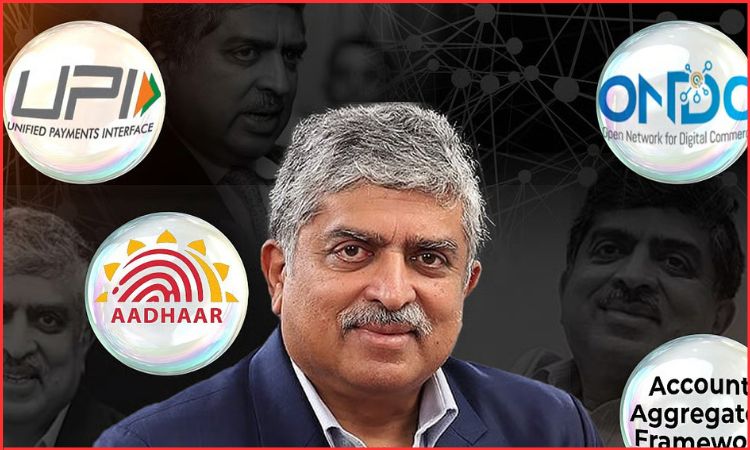
Nilekani’s influence did not just limit to Aadhaar cards, but extends beyond it, to Digital India via India Stack, which opens APIs integrating Aadhaar, UPI, and DigiLocker for seamless services, including:
- Aadhaar Authentication
- eKYC (Electronic Know Your Customer)
- Unified Payments Interface (UPI)
- Account Aggregator Framework
- Open Network for Digital Commerce (ONDC)
This allows government and businesses to utilise the digital identity for paperless, presence-less, and cashless service delivery.
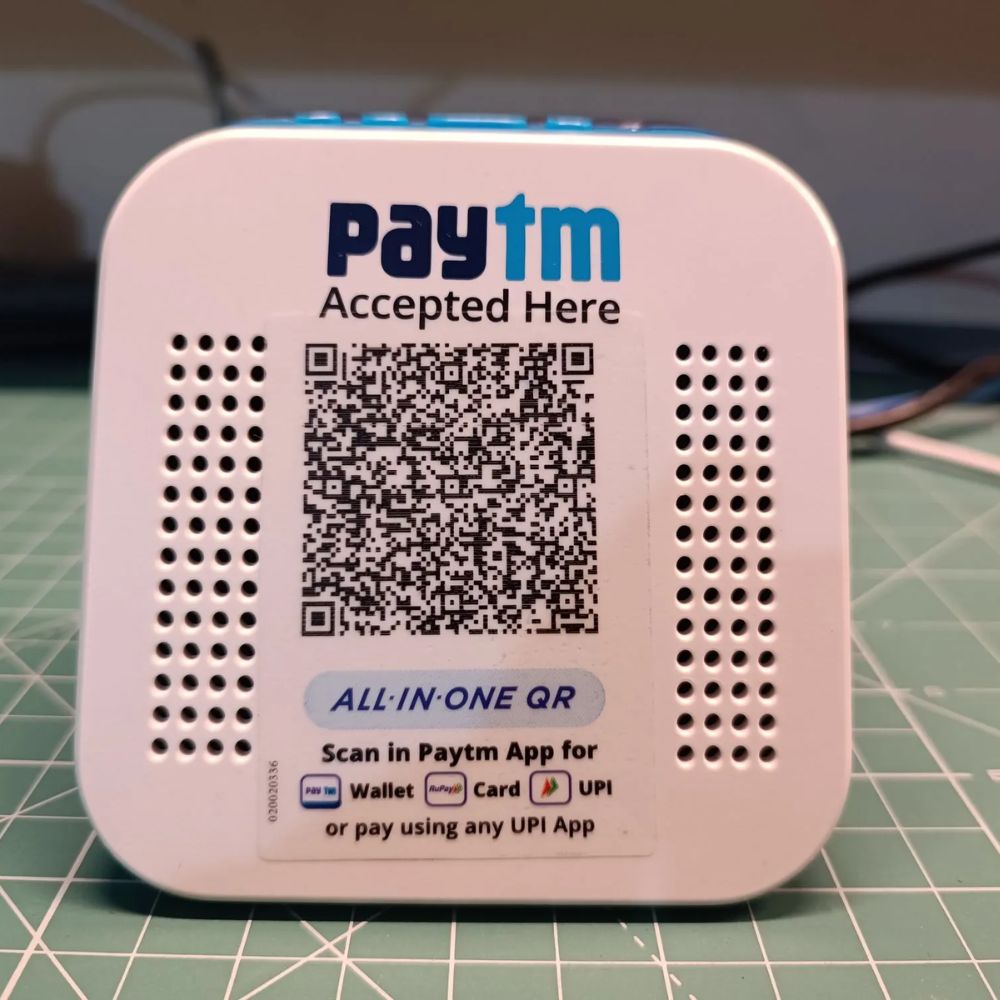
He launched UPI in 2016 with NPCI.
- In H1 2025, it hit 106.36 billion transactions worth ₹143.34 lakh crore, up 35% year over year, with 84.8% volume share.
- In November 2025, 20.47 billion transactions were processed at 682 million per day, transforming payments.
| Initiative | Stats | Impression |
| Aadhaar | 1.3 billion enrollments and 284 crore authentications in January | Identity for subsidies and banking |
| UPI | 106 billion transactions (H1) and ₹143 lakh crore value | 84.8% payment volume share |
| India Stack | Unified APIs for e-KYC and payments | Enabled 1 billion+ digital users |
Conclusion
Nandan Nilekani’s life is a testament to the power of scale. Whether it was scaling a software company into a multi-billion dollar enterprise or growing a digital identity to a billion people, his approach always remains constant.
He believes in simplifying the complex things, building for the long term, and ensuring that technology serves every person standing in the queue. Through his thought leadership and philanthropic commitments, he continues to influence the ethical use of technology and becomes the master mind behind Aadhaar and Digital India.
FAQ on Nandan Nilekani’s Biography
Q1. What is Nandan Nilekani’s role in the launch of Aadhaar?
A: He served as UIDAI founding chairman from 2009 to 2014, getting 600 million enrollments, which currently has around 1.3 billion users.
Q2. How did Nilekani contribute to UPI?
A: Nilekani contributes to UPIs through NPCI and India Stack, enabling UPI’s 106 billion H1 2025 transactions.
Q3. What is Nandan Nilekani’s net worth in 2025?
A: His net worth is approximately ₹28,463 crore from Infosys and investments.
Q4. What are Nilekani’s major philanthropic donations?
A: He helped foundations with donations of a total of ₹400 crore to IIT Bombay, EkStep foundation, and the Giving Pledge commitment.
Q5. What awards has Nandan Nilekani won?
A: He has won Lifetime Achievement at Future of Government Awards 2025, TIME AI Voices 2024, and WEF Global Leader.