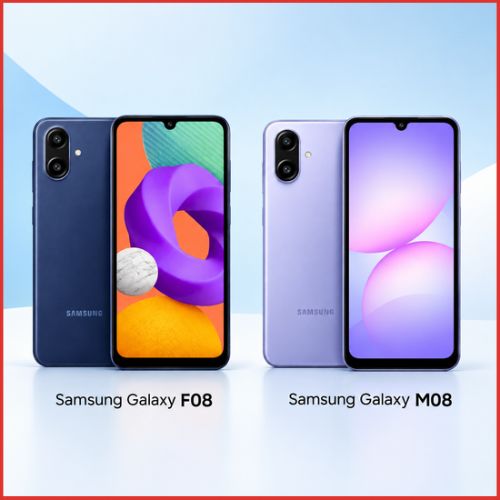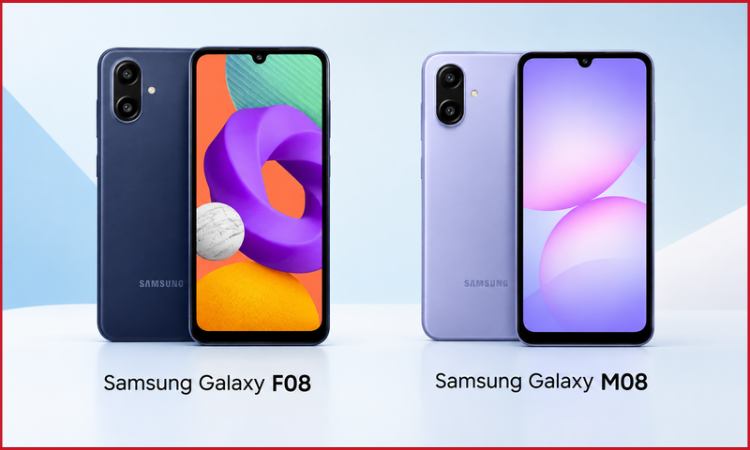
Samsung has added two new models to the affordable end of its smartphone range, unveiling the Galaxy M08 and Galaxy F08 with almost identical hardware, a 6,000mAh battery and an unusually long software-support commitment for budget devices.
The Samsung Galaxy M08 and F08 are powered by MediaTek’s Helio G99+ processor and come with a 50MP primary rear camera, 4GB of RAM and expandable storage.
Both are 4G smartphones rather than 5G models, indicating that Samsung is prioritising battery size, software support and familiar Galaxy features instead of next-generation mobile connectivity at this end of the range.
Pricing has not yet been formally announced across all markets.
Galaxy M08 and F08 Are Almost the Same Phone
Samsung has used its M and F families for years to target slightly different online and retail channels.
That strategy continues with the new models.
The underlying specifications of the Galaxy M08 and Galaxy F08 are almost identical. The most obvious difference announced so far is colour: the M08 is shown in Silver, while the F08 is available in Dark Blue.
Both use the same MediaTek processor, battery capacity, camera arrangement and software policy.
That means buyers will probably make their decision based more on availability, pricing and retailer offers than meaningful performance differences.
Samsung’s Indian product pages list an October 1, 2026 launch date for both devices, although availability remains limited and the phones are still marked as not for sale at the time of listing.
Helio G99+ Handles Everyday Performance
The phones run on MediaTek’s Helio G99+ chipset.
This is a 4G processor aimed at everyday smartphone tasks rather than flagship gaming or demanding AI workloads.
Samsung pairs it with 4GB of RAM, with storage configurations including 64GB and, depending on the market, 128GB.
There is also a dedicated microSD slot supporting cards of up to 2TB.
That expandable storage is useful at the budget end of the market, where paying significantly more for a higher internal-storage configuration may not make sense for every buyer.
Someone storing large numbers of photos, offline videos or music can add inexpensive storage later without replacing the phone.
The devices retain a 3.5mm headphone jack as well, a feature that has disappeared from most premium smartphones.
A 6.7-Inch HD+ Display Sits on the Front
Both devices use a roughly 6.7-inch PLS LCD display with HD+ resolution.
The panel is clearly designed around affordability and battery efficiency rather than maximum sharpness.
At this size, Full HD would provide higher pixel density, but HD+ remains common in lower-priced Android phones where manufacturers are trying to balance display size with cost and endurance.
Samsung also lists Gorilla Glass protection for the new models.
The large screen should make the Samsung Galaxy F08 and M08 suitable for video streaming, social media and casual gaming, even if display specifications are more modest than those of Samsung’s A-series and premium Galaxy devices.
The phones measure about 8mm thick and weigh approximately 197g despite the large battery inside.
A 50MP Camera Leads the Rear Setup
Samsung has kept the rear camera system straightforward.
The main camera uses a 50MP sensor with an f/1.8 aperture and autofocus.
It is accompanied by a 2MP secondary camera, while an 8MP camera handles selfies and video calls from the front.
There is no optical image stabilisation on the main camera.
Rear video recording reaches Full HD at 30fps, while HD slow-motion recording at up to 120fps is supported.
This is a relatively simple setup by modern smartphone standards, but it avoids the practice of filling the back of an affordable phone with several low-resolution cameras primarily to increase the camera count.
The main 50MP sensor will do most of the photographic work.
6,000mAh Battery Is One of the Biggest Selling Points
Battery capacity is likely to be one of the stronger reasons to consider either model.
The Galaxy M08 battery and Galaxy F08 battery are both rated at 6,000mAh.
That is larger than the 5,000mAh capacity still common across many Android smartphones and should give the phones additional room for calls, messaging, video and everyday app use.
Charging is supported at up to 25W through USB-C.
Samsung notes that the compatible 25W charger is sold separately, so customers may need to factor that into the overall purchase cost if one is not already available.
Neither device is being pitched as a fast-charging specialist. The emphasis is much more clearly on having a large battery that does not need frequent attention.
Six Android Generations Is the More Surprising Feature
The standout specification may not be hardware at all.
Samsung is promising six generations of OS upgrades and six years of security updates for both models.
The phones arrive with Android 17 and Samsung’s One UI software.
Samsung’s official support information says security coverage is expected to continue until September 30, 2032, subject to its software policy.
That is an unusually long commitment for budget smartphones.
Affordable Android devices historically received much shorter support periods than flagship models, sometimes making perfectly usable hardware feel old simply because major security and operating-system updates stopped arriving.
Six generations significantly change that equation.
Whether the processor and 4GB of RAM remain comfortable to use several Android versions from now is a separate question, but buyers at least have the option of keeping the phones updated.
Knox Vault and Circle to Search Are Included
Samsung is also bringing features previously associated with more expensive Galaxy phones further down the lineup.
The M08 and F08 include Samsung Knox Vault, which is designed to isolate sensitive security information from the rest of the smartphone’s main operating environment.
Circle to Search with Google is supported too.
That feature allows users to circle or highlight something shown on the display and search for related information without manually switching to a separate search app.
Quick Share and SmartThings support round out the wider Galaxy ecosystem features.
Both phones also receive a side-mounted fingerprint sensor rather than an under-display reader.
IP64 Adds Basic Dust and Splash Protection
The new Galaxy models carry an IP64 rating.
That means they are rated for protection against dust ingress and splashing water under controlled test conditions.
It should not be confused with the stronger IP67 or IP68 water-resistance ratings found on more expensive devices.
Users should not deliberately submerge either phone.
Still, IP64 protection is a useful addition at the budget end because everyday exposure to rain or accidental splashes becomes slightly less worrying.
Connectivity includes dual-SIM 4G LTE, Wi-Fi 5, Bluetooth 5.3, GPS and USB-C.
Samsung Is Betting on Longevity Rather Than Headline Specs
The Galaxy M08 and F08 are not attempting to win a specification race.
There is no 5G, no high-end chipset and no elaborate multi-camera system.
Instead, Samsung has concentrated on a few practical areas: a 6,000mAh battery, expandable storage, a 50MP main camera, basic water and dust protection, and an unusually long update policy.
That could make the Samsung Galaxy M08 and F08 interesting for buyers who plan to keep an affordable phone for several years.
Pricing will ultimately determine how competitive the two devices are.
If Samsung positions them aggressively, six generations of Android upgrades could become a much stronger selling point than another minor processor or camera improvement in a segment where long-term software support is still far from universal.