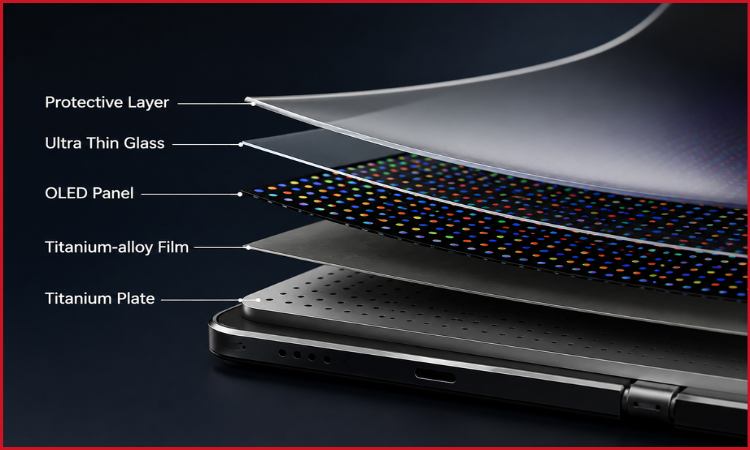
Samsung Electronics has unveiled Flex Titanium, a new display technology for its next-generation Galaxy foldables that promises tougher screens with a less visible crease without adding bulk. The tech will debut at Galaxy Unpacked this month.
Two pieces of titanium, one goal
Flex Titanium combines two components: a titanium-alloy film beneath the OLED panel, and a titanium plate supporting the module from below. According to Samsung, the film delivers “20 times greater mechanical stiffness” than polymer film, while measuring “roughly one-third the thickness of an average human hair.”
The plate, meanwhile, uses “advanced hole processing technology” to eliminate air gaps between the display module and adhesive, giving “more stable support underneath the display when unfolded” while still folding repeatedly without failing.
Why titanium, of all things
Titanium is the material behind satellite antennas and Mars rover wheels — objects built to survive extremes, not fold in half thousands of times. Samsung acknowledges the tension directly: the metal’s “stiffness” makes it a “significant engineering challenges” for foldable use, even as its strength was exactly what the display needed.
The fix was precision rolling to thin the alloy film down and micro-patterned holes cut into the plate’s folding section — a way to keep titanium’s toughness while coaxing flexibility out of it.
The company’s framing
Sunghoon Moon, EVP at Samsung’s Mobile R&D Office, said the effort reflects “connecting user needs with our technologies that deliver tangible benefits in everyday life.” Kyung-Jin Yoo of Samsung Display added that the micro-patterned holes let the company “secure flexibility with robust durability,” while newer organic materials and a higher-resolution architecture also cut power consumption.
What it means for buyers
Samsung frames this as the result of seven generations of foldable devices and user feedback pointing to the same asks each time: bigger, more immersive screens, less crease, no durability trade-off. Flex Titanium is pitched as the answer to that specific complaint list — not a new form factor, but a sturdier, smoother version of the one Samsung already sells.
The company hasn’t named which device ships first with the tech; that detail arrives at Unpacked.