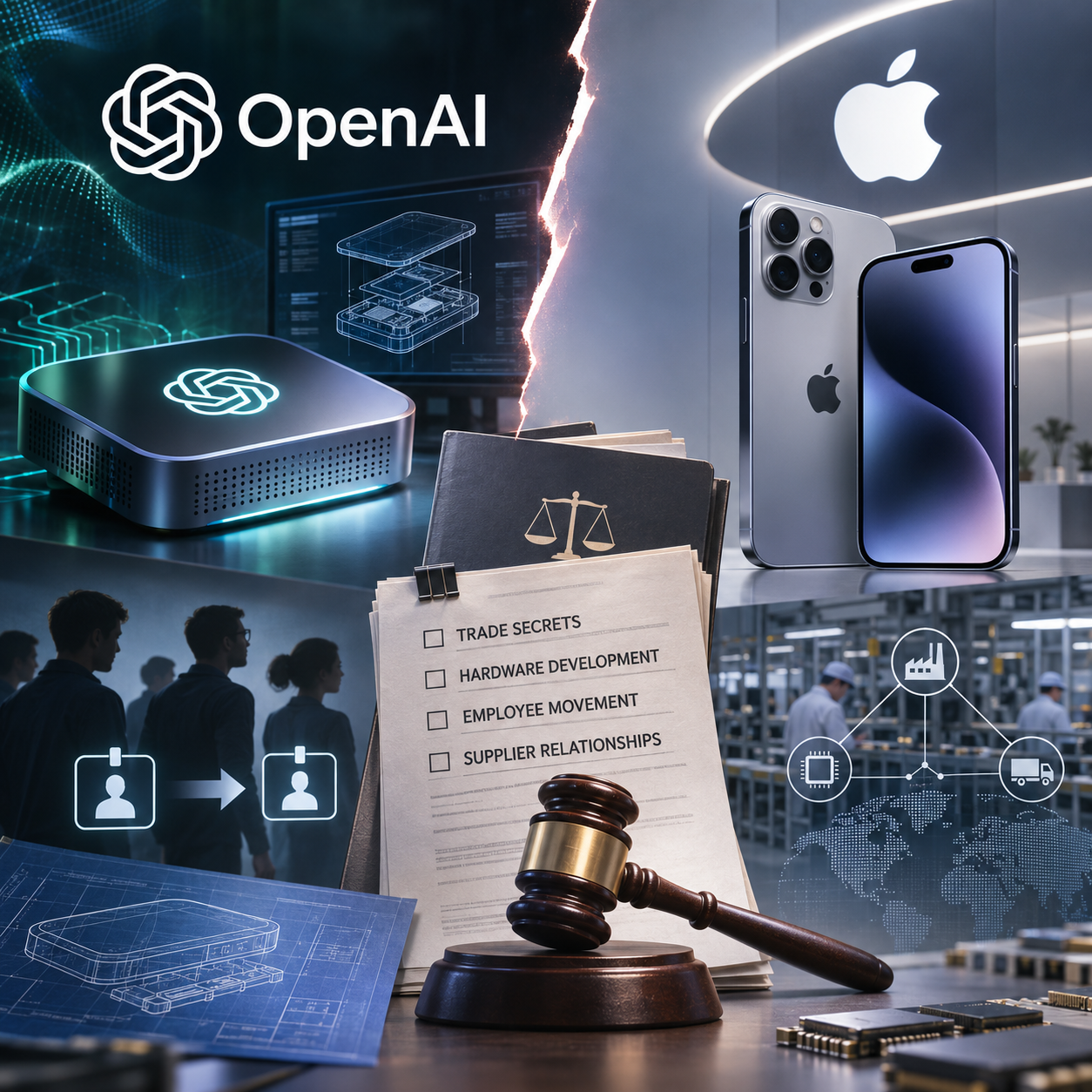
OpenAI has filed counterclaims against Apple, accusing the iPhone maker of obtaining confidential information and discouraging suppliers from working on OpenAI’s planned devices.
The filing in California federal court on November 27 escalates a dispute that began with Apple’s own allegations against OpenAI and former employees.
Apple denies using a returning employee to obtain OpenAI’s confidential information and denies attempting to suppress competition in AI-device manufacturing. It described the counterclaims as an effort to divert attention from its original lawsuit.
The competing allegations place employee departures, access to company information and relationships with hardware suppliers at the centre of a widening confrontation. They also underline how closely the race to develop AI-powered consumer devices is tied to experienced engineers and manufacturing expertise.
A Returning Employee Features In OpenAI’s Allegations
OpenAI alleges that a former employee who spent six months at the company gained access to information about an unreleased device and its future hardware plans before returning to Apple.
Its counterclaims argue that the circumstances raise concerns about how that information was obtained and where it went.
Apple rejects the allegation that it used the returning employee to access OpenAI’s confidential material.
That disagreement requires careful separation between access, possession and use. An employee’s ability to view sensitive information does not, by itself, establish that another company obtained or exploited it.
The significance of particular documents, the circumstances of their movement and the actions of the people involved will depend on evidence examined through the proceedings.
The latest filing presents OpenAI’s account of those events, rather than a judicial determination that its allegations are correct.
Apple’s Original Case Remains Part Of The Dispute
Apple sued OpenAI and former Apple employees Tang Tan and Chang Liu in July, alleging that confidential information had been misappropriated to support OpenAI’s hardware ambitions.
Tan previously held a senior product-design role at Apple and was involved in io Products, the hardware venture acquired by OpenAI in 2025.
OpenAI and the employees deny Apple’s allegations.
The new counterclaims mean the dispute now contains accusations running in both directions. Apple’s case does not disappear because OpenAI has made allegations of its own.
Nor does either side’s denial resolve the factual questions. Each claim must be assessed against the relevant evidence and legal requirements.
For readers following the case, that distinction matters. The latest development expands the dispute; it does not establish a winner.
Personal Devices And Work Accounts Become A Flashpoint
Another part of OpenAI’s argument concerns the separation of personal and company information when employees leave Apple.
OpenAI alleges that Apple encourages work through personal devices and accounts, then makes an orderly separation difficult when employees depart for competitors.
It also claims continued access can allow Apple to monitor former staff. These are contested allegations within the litigation.
The underlying operational issue is familiar beyond this case. When personal and professional information coexist on a device or account, an employee’s departure can create complicated questions about what must be preserved, transferred or removed.
A contact list, private conversation and confidential engineering document may be stored through connected services while remaining very different categories of information.
Clear records and access controls become important when reconstructing what happened after employment ended.
Supplier Relationships Add A Commercial Dimension
OpenAI also accuses Apple of discouraging hardware suppliers from working on its future products. Apple denies attempting to suppress competition in that market.
The allegation reaches beyond information moving between employees. It concerns the practical ability to develop and manufacture a competing device.
A hardware project needs more than a design. Components must be sourced, prototypes built, manufacturing processes established and finished units produced consistently.
A supplier can therefore be important long before a product reaches customers.
That helps explain why supplier relationships feature in a dispute over emerging AI hardware. Nevertheless, the existence of commercial competition does not establish that improper pressure occurred. The particular communications and conduct alleged will matter.
Experience And Confidential Information Are Different
The case also brings attention to the boundary between professional experience and protected company material.
An engineer changing employers brings skills, judgement and knowledge developed over a career. At the same time, confidential documents and product plans can raise separate obligations.
Disputes become difficult when those categories overlap in practice.
A person may understand why a manufacturing approach failed without needing a former employer’s internal report. Conversely, carrying that report into a new workplace introduces a different question from remembering lessons learned.
The litigation will turn on specific conduct and information, rather than the broad fact that employees moved between competitors.
For companies, the practical lesson is the value of documented joining and departure procedures. Those processes can help establish what information employees were permitted to retain and what access should have ended.
The Hardware Race Raises The Stakes
The OpenAI–Apple legal dispute is unfolding as OpenAI works on personal electronic devices, bringing its ambitions closer to a category Apple has shaped for decades.
That creates competition across several areas at once: product design, engineering talent, suppliers and the everyday interactions through which customers use technology.
An AI device needs to offer more than access to a capable model. It must justify its physical form, work reliably and fit naturally into a user’s routine.
The commercial importance of those decisions helps explain why unreleased designs and product roadmaps can be sensitive. Information about what a competitor plans to build may affect development priorities before either product is publicly available.
That commercial significance, however, remains separate from proving any alleged misconduct.
Evidence Will Determine The Next Stage
OpenAI has previously published statements disputing Apple’s allegations and outlining concerns about access to its own information. The latest counterclaims formalise a broader challenge involving trade secrets, employment practices and suppliers.
Apple continues to contest that account and defend the substance of its original case.
For now, the clearest development is procedural: a lawsuit initially brought by Apple has become a two-way confrontation over confidential technology and competitive conduct.
Its eventual outcome will depend on documents, communications and other evidence considered by the court. The public accusations reveal how strained the relationship has become; they do not settle the underlying facts.
Sources: The Indian Express’ Reuters Report, Reuters’ Original Coverage, CNN’s Report Via Yahoo Finance and OpenAI’s Earlier Public Response. Technology News – The Indian Express