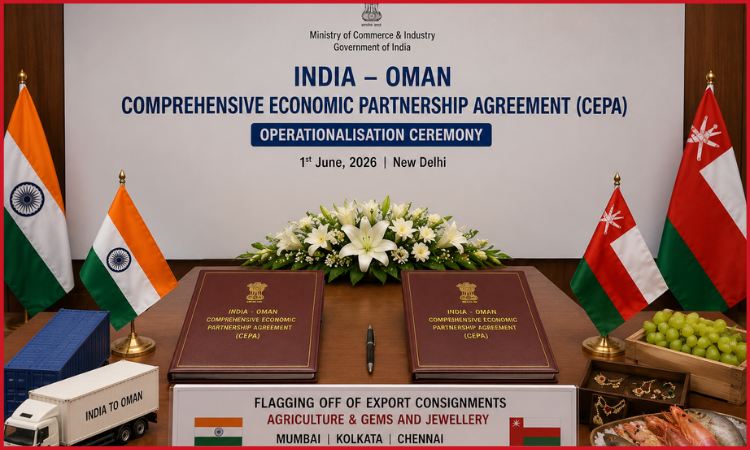
India and Oman have entered into a Comprehensive Economic Partnership Agreement (CEPA), with the pact coming into force on June 1, 2026 — nearly six months after it was signed in Muscat on December 18, 2025, in the presence of Prime Minister Narendra Modi and Oman’s Sultan Haitham bin Tarik Al Said.
Union Commerce Minister Piyush Goyal and Oman’s Ambassador to India, Issa Saleh Al Shibani, presided over the operationalisation ceremony. The first consignments of agriculture and gems and jewellery exports availing preferential tariff rates were flagged off from Mumbai, Kolkata and Chennai to mark the occasion.
Bilateral trade between the two countries reached USD 11.18 billion in FY 2025–26, up from USD 10.61 billion in FY 2024–25, with Oman being India’s second-largest trading partner in the Gulf.
Sweeping tariff gains for Indian exporters
Under the CEPA, 99.38% of India’s exports to Oman by value receive duty-free access, covering 98.08% of Oman’s tariff lines, the Ministry of Commerce & Industry said in a statement. All zero-duty concessions take effect immediately. Under the earlier MFN regime, only 15.33% of India’s exports entered Oman duty-free.
Gems and jewellery duties of up to 5% have been eliminated from day one. India’s exports in the segment stood at USD 25.78 million in 2025, with projections indicating a sixfold rise to USD 150 million within three years, the ministry said. Clusters in Surat, Jaipur, Mumbai, Kolkata and Chennai are expected to be the primary beneficiaries.
All marine products including shrimp, fish and cuttlefish, receive immediate duty-free access, replacing earlier import duties of up to 5%. India’s marine exports to Oman stood at USD 10 million against total Omani marine imports of USD 35.3 million, indicating substantial untapped potential, the ministry noted.
India’s engineering exports to Oman reached USD 875.83 million in FY 2025–26 and are projected to rise to USD 1.3–1.6 billion by 2030, with all engineering goods now receiving zero-duty access, the ministry said. On pharmaceuticals, products approved by USFDA, EMA, UK MHRA and TGA will receive marketing authorisation within 90 days without prior inspection. Oman’s pharma market, valued at USD 302.84 million in 2025, is projected to reach USD 473.71 million by 2031 at a CAGR of 6.6%.
Services, mobility and sensitive sector carve-outs
Oman has offered market access commitments across 127 services sub-sectors — the most comprehensive services offer made by any GCC country to India. For the first time in any bilateral FTA, Oman has made binding commitments for defined professional categories including accounting, engineering, medicine, IT, education and construction, the ministry said.
The Intra-Corporate Transferee ceiling has been raised from 20% to 50%. Business visitors can stay up to 90 days, independent professionals up to 180 days, and ICTs up to four years.
India has offered tariff liberalisation on 77.79% of tariff lines covering 94.81% of imports from Oman by value, while excluding dairy, cereals, fruits, vegetables, edible oils, oilseeds, rubber, leather and spices from market access, the ministry said.
What officials said
Commerce Minister Piyush Goyal called the agreement “a force multiplier in the Gulf region,” adding that it would “support job creation, drive investment and enable Indian enterprises to compete on an equal footing with suppliers from countries enjoying preferential market access,” according to the Ministry of Commerce & Industry statement.
Commerce Secretary Rajesh Agrawal described the CEPA as “tariff liberalisation PLUS,” saying it “enhances market access, facilitates service trade and provides greater predictability for businesses operating across both markets.”